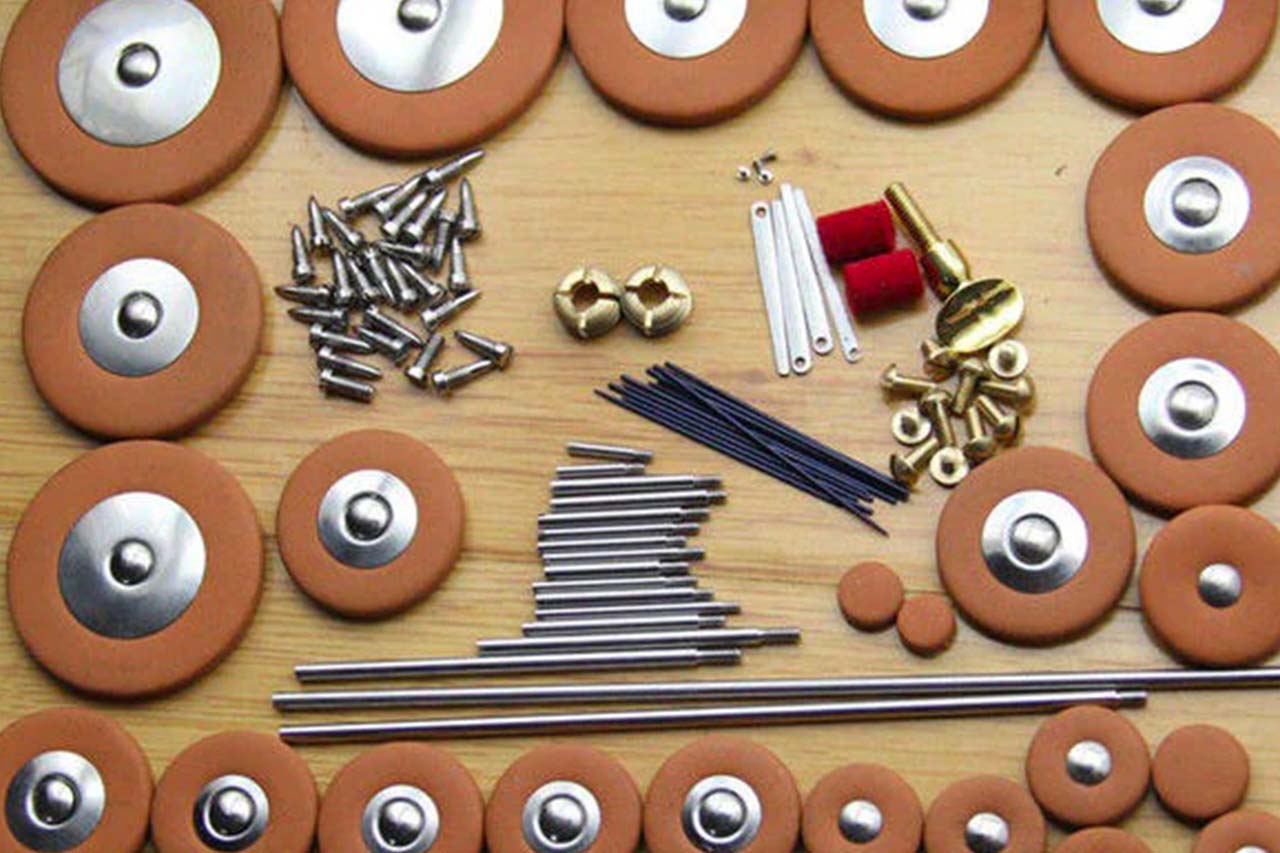
To go further in the acoustic study of pad resonators, an auditory perception experiment was conducted using four Yamaha saxophones with different resonators. Discover all the results!
A Conversation with Ralph Morgan on Resonators Let me start by saying that these are notes from a conversation I had with Ralph Morgan back around 2003. His views were based on research and development which were conducted by him and others at the Selmer Company in the early 1960s. If you...
The results of an experimental and theoretical investigation of the influence of wall vibrations on the sound of brass wind instruments are presented. Measurements of the transmission function and input impedance of a trumpet, with the bell both heavily damped and freely vibrating, are shown to be consistent with a theory that assumes that the internal pressure causes an oscillation of the diameter of the pipe enclosing the air column. These effects are shown to be most significant in sections where there are flaring walls, which explains why damping these vibrations in cylindrical pipes normally produces no measurable effects.
The results of an experimental and theoretical investigation of the influence of wall vibrations on the sound of brass wind instruments are presented. Measurements of the transmission function and input impedance of a trumpet, with the bell both heavily damped and freely vibrating, are shown to...
scholarship.rollins.edu
Abstract
Previous work has demonstrated that structural vibrations of brass wind instruments can audibly affect the radiated sound. Furthermore, these broadband effects are not explainable by assuming perfect coincidence of the frequency of elliptical structural modes with air column resonances. In this work a mechanism is proposed that has the potential to explain the broadband influences of structural vibrations on acoustical characteristics such as input impedance, transfer function, and radiated sound. The proposed mechanism involves the coupling of axial bell vibrations to the internal air column. The acoustical effects of such axial bell vibrations have been studied by extending an existing transmission line model to include the effects of a parasitic flow into vibrating walls, as well as distributed sound pressure sources due to periodic volume fluctuations in a duct with oscillating boundaries. The magnitude of these influences in typical trumpet bells, as well as in a complete instrument with an unbraced loop, has been studied theoretically. The model results in predictions of input impedance and acoustical transfer function differences that are approximately 1 dB for straight instruments and significantly higher when coiled tubes are involved or when very thin brass is used.
Previous work has demonstrated that structural vibrations of brass wind instruments can audibly affect the radiated sound. Furthermore, these broadband effects are not explainable by assuming perfect coincidence of the frequency of elliptical structural modes with air column resonances. In this...
Hearing a 1dB change in *volume is tricky outside the lab, but I guess they are talking about 1dB shifts in resonant peaks which will result in subtle timbral differences. I suspect the normal 'proving a hearing *difference, is easier than demonstrating reliable *preference' might apply! I knew a group in Valencia, Spain who put a bit of work in in this area.
I’ve been reluctant to post this book. The approach here is NOT DIY instruction. Shop skills, basic tool knowledge and safety should be well understood beforehand.
I have this book, and as a “professional amateur”, there were definitely parts of this book that made me think, even as a brave but basically stupid young man, “Danger here!! Stay away from this part.” In particular, the parts where cyanide is used…
When Erick Brand left Selmer he re-published the book under his own name. You can still get a hard copy from Ferree’s. EB3 Erick Brand Repair Manual


 (bottom of page)