

Beginner impro Relative minors

For me it's easier to think and play sharps than flats. To play and read flats is harder for me. I prefer sheet music in C# (7 sharps) than Db (5 flats). They sounds the same.

Another Ray Charles song that Charles made famous, Unchain My Heart, is in Am (C). Not often you see horn charts written in minor?

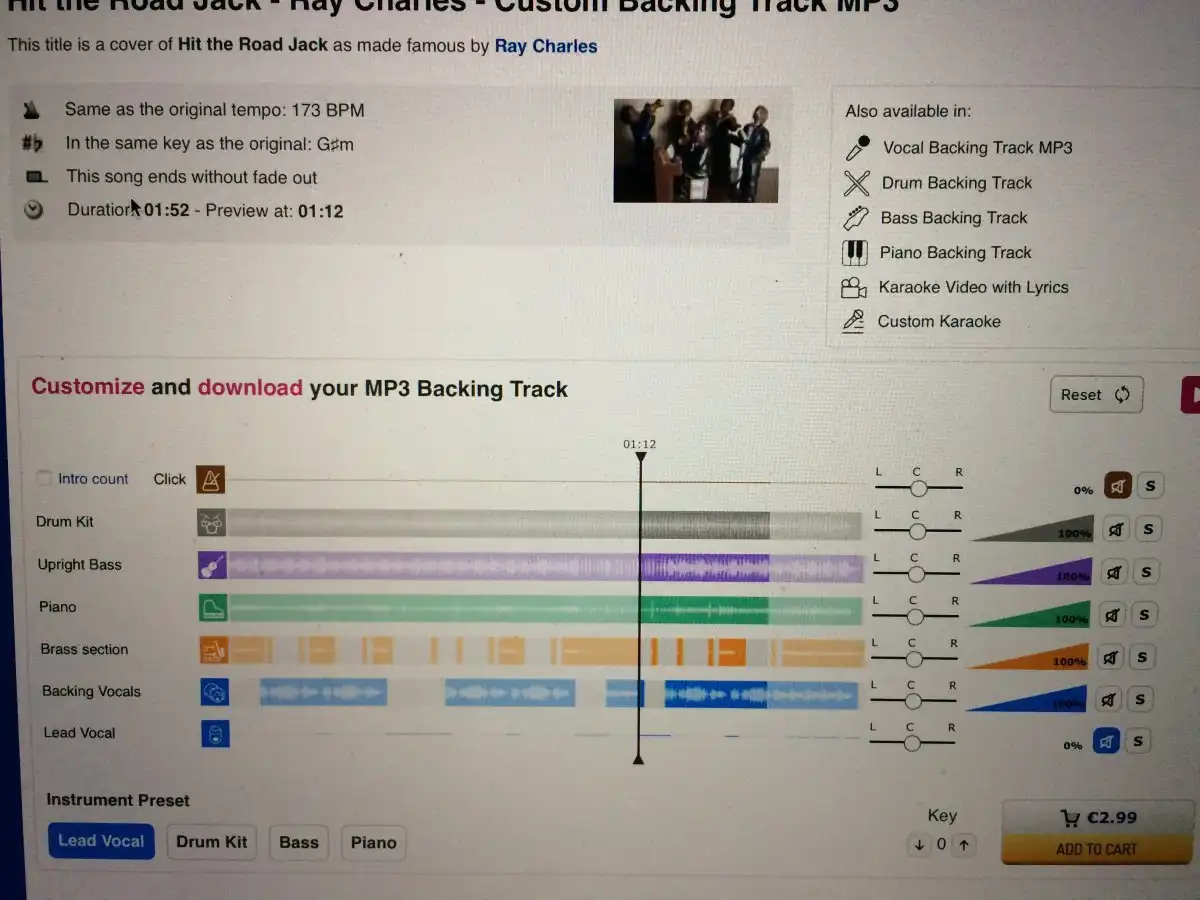
KV's "Hit the Road Jack" is in concert G#m. Ab minor and Cb major have 7 flats. C# major and A# minor have 7 sharps.
IMG_4896.JPG
 
Last edited:
I can’t understand anyone thinking that it might be ambiguous, as some tunes can be. It starts in the minor key and (heavily) reaffirms that pretty much every line of music if I remember correctly - by way of a V7 - 1.
 
I can’t understand anyone thinking that it might be ambiguous, as some tunes can be. It starts in the minor key and (heavily) reaffirms that pretty much every line of music if I remember correctly - by way of a V7 - 1.
Im not smart when it comes to music..All I know was the kv version didnt sound right when playedcup against the transposed fm sheet music..Issues resolved it was Ab major i purchased originally..
 
I don’t want to start a flame war, but note the following points.

1) The Karaoke-Version version was originally labeled as Ab major.
2) Every experienced musician, those who have actually played this song, know it’s in a minor key.
3) The original was in Ab (or G#) minor.
4) Karaoke (in general) is aimed at non-musicians.
5) Karaoke-Version now claims G# minor as the original key
6) Backing tracks on the web are available in either G minor or A minor. Both close to G#…

The inescapable conclusion - KV messed up. At least they fixed it, they deserve credit for that.

@eb424 you are right, Fm is the relative minor of Ab. The issue here wasn’t labeling a minor tune in its relative major, it was mis-labeled as major. The root key was correct.

I’m not gonna say whether it’s a good or bad idea to get backing tracks from KV, but I will note that there are free backing tracks for almost any well-known tune. Often multiple versions. Some crap, some excellent, many in between.

[EDIT]. Disclaimer: the following is pure speculation on my part. It was common practice in the 1960s to speed up a recorded song to make it fit on a single, or give it a little more energy. Additionally, tape recorders were often not exact as to their speed, so a song recorded on one machine might play back fast or slow on another - say at a different studio when mixing. It’s entirely possible that the original was recorded in G minor, but ended up in G# (Ab) minor due to the above.

I’m not saying this happened, I don’t know, and the people involved in that recording are likely all dead, so we may never know for sure. MusicNotes offers this song in sheet music format in G minor, Ab minor and A minor. Clear as mud. A quick Google search turned up no information. If anyone knows the true story of this song, I’d be interested. I was 13 when it came out in the US (the Ray Charles version), and I remember it well. My band in 1965 played this song … in A minor 🙂
 
Last edited:
I don’t want to start a flame war, but note the following points.

1) The Karaoke-Version version was originally labeled as Ab major.
2) Every experienced musician, those who have actually played this song, know it’s in a minor key.
3) The original was in Ab (or G#) minor.
4) Karaoke (in general) is aimed at non-musicians.
5) Karaoke-Version now claims G# minor as the original key
6) Backing tracks on the web are available in either G minor or A minor. Both close to G#…

The inescapable conclusion - KV messed up. At least they fixed it, they deserve credit for that.

@eb424 you are right, Fm is the relative minor of Ab. The issue here wasn’t labeling a minor tune in its relative major, it was mis-labeled as major. The root key was correct.

I’m not gonna say whether it’s a good or bad idea to get backing tracks from KV, but I will note that there are free backing tracks for almost any well-known tune. Often multiple versions. Some crap, some excellent, many in between.
Ah thanks so it was just labelled as AB major but was in the Ab minor..I transposed the F minor to G but it didnt sound right hence e-mailling KV...
 
EDIT]. Disclaimer: the following is pure speculation on my part. It was common practice in the 1960s to speed up a recorded song to make it fit on a single, or give it a little more energy. Additionally, tape recorders were often not exact as to their speed, so a song recorded on one machine might play back fast or slow on another - say at a different studio when mixing. It’s entirely possible that the original was recorded in G minor, but ended up in G# (Ab) minor due to the above.
You may be right, but I’d be surprised if it were so. Cassettes yes, many played at different speeds, but the engineers in recording studios really were white coat guys and calibration of tape machines was an intricate and precise job. Maybe that was just the major studios tho. I presume Ray was quite a star by this point however? It would be interesting to see where it was recorded…

1 Google search later: yes, recorded in 1961 at a major NYC studio. Studio recording had moved on significantly from the early to mid-50’s in terms of gear and process. But as you say Skeller, it’s possible that subsequent recordings hawked about on “home tape machines “ made the key ambiguous. It used to happen to me in the ‘80’s trying to transcribe something, so it probably happened back then too.

Ray Charles could easily have moved around the keys a bit due to a slightly gruff voice occasionally.

Of course, in terms of looking at a piece of music, it has a key signature of both a major and its relative minor. What happens next Fills in the blanks.
 
speeds, but the engineers in recording studios really were white coat guys and calibration of tape machines was an intricate and precise job
They did it by recording a 50hZ or 60hZ pulse on the tape. On a different machine this could easily be tuned to a tone generator. But we digress. This is (I think) the third thread where it has been established that Hit the Road Jack is a song in a minor key:


They did it by recording a 50hZ or 60hZ pulse on the tape. On a different machine this could easily be tuned to a tone generator. But we digress. This is (I think) the third thread where it has been established that Hit the Road Jack is a song in a minor key:


Yeah but if we were clever like Jacob Collier we could play it in G# half (arsed) sharp minor on his (I’ve reinvented the) five string guitar 🙄
 
They did it by recording a 50hZ or 60hZ pulse on the tape. On a different machine this could easily be tuned to a tone generator. But we digress. This is (I think) the third thread where it has been established that Hit the Road Jack is a song in a minor key:


But to be fair @Pete Thomas that was never the issue...the issue is the one i bought from k.v was marked as Ab major and sounded wrong against F minor ( transposed).They only have sheet music ( not scores apparrantly) in "music notes" in minor keys and much as i can usually match kv songs to transposed sheet music i couldnt on this track..hence asking kv if Ab was major or minor on the song as there was no small "m"..I seem to really have to defend myself on here not expected really..
 
Karaoke (in general) is aimed at non-musicians.
Yes. It's often the lonely hobby/amateur players play mates. It's not a problem for me. All kind of sax players have my heart.

Maybe it's complete wrong that an international saxophone forum is covering backing tracks and basic questions about playing songs with backing tracks? Questions about backing tracks can be answered by players who likes and use backing tracks?

So what shall a backing tracks player/user do? Search for info elsewhere or be a problem at a saxophone forum?
 
Actually I was more concerned with the actual key, not whether it's major or minor. G#/Ab minor is unusual to say the least. I know of instances where tapes were sped up on purpose to sound more peppy or something, just curious about the actual history of this recording.

@Pete Effamy I was just watching an interview with a record producer Brendan O'Brien. (a Rick Beato interview, very long and very good), and he told stories of how they ran into tuning issues moving tapes between studios. Adding parts in LA for a tape recorded in Atlanta required doing it in a different key, or retuning the guitars. This is with big name bands like Pearl Jam and Korn, in the 1980s and 90s. So I don't think the white coats ruled the roost here in the US... I mean, not everyone can be like Abbey Road...
Ah good info. I stand corrected.
The whole process was a real boffin thing years ago with many pitfalls.
I was reading recently about VU meters which apparently the BBC nicknamed “Virtually Useless “ meters - because they misunderstood the calibration!
Abbey Road were way behind the US in the ‘60’s, using 8-track tape when the US had 16 - Beatles vs Beach Boys I think. They did have white lab coats though.
 
Last edited:

Social

New! Social Feeds

Look out for the navigation icon:

Follow CafeSaxophone

Latest Song of the Month

Trending

Forum statistics

Topics
32,041
Messages
577,730
Members
8,117
Latest member
H3nri
Back
Top Bottom
