- Messages
- 7,981
- Location
- Bristol, UK
If the dye fluoresces in UV light then you would want to make sure you could remove it completely from the outside of the saxophone before the player has a gig.
It's a consideration.If the dye fluoresces in UV light then you would want to make sure you could remove it completely from the outside of the saxophone before the player has a gig.
- @thomsax says that the Comm I and II sound and feel different from the Imperial.
- But Jorns Bergenson in an SOTW thread says that he has measured various pre-war Martin saxophones and that the body measurements for the Imperial, Comm I, Comm II and the Indiana are identical. He also says that he has tried setting them up identically and they all sound the same. They are basically the same except for minor keywork changes.
- I have seen a post on SOTW by a Martin owner who says that the Handcraft Indiana gradually morphed into the Handcraft Committee (Comm I).
- I have seen reports that the neck is different on a Comm II.
Sounds like a perfect candidate for one of your celebrated scientific papers. Which dyes can be removed from which finishes, and which show up enough to be useful.It's a consideration.
A potential candidate is Eosin - mostly because it's soluble in alcohol, which is thin enough to creep through tiny gaps. However, I'm not so convinced that enough of the stain would show through to make it visible against the backdrop of a crusty old tonehole.
I guess leaving residues of the stain on a horn wouldn't be ideal, but it probably wouldn't be that much of an issue to most people because it'd be largely invisible - but if you found yourself playing on Jools Holland's show and they kicked on a UV effect, you might find yourself the centre of attention...albeit very briefly indeed.
No need to congratulate me, congratulate Martin.Congratulations on your 10%.
Interesting observation to Behold 😎To me, the "10% of the specimens (maybeeeee 15% ..)" stated by @JayeNM seems entirely consistent with the "time and again" stated by @Stephen Howard , especially when one considers the number of Martins going through his workshop.
Say it was 1,000 Martin saxophones in 40 years, that would be about 25 instruments per year and maybe three leaky examples, using 10-15%. That sounds just like "time and again" to me.
Rhys
Well, I have had Cat Scans and MRI where they inject a die in your veins while the test is going to see leaking heart valves or whatever the dye helps them see better. Considering that they are injecting it into the blood stream of a living human how much danger could a dye do to a nonliving saxophone? However, untoward results can occur such as an allergic reaction to the dye they use, which was my case because I began sneezing the instant they injected it. That caused me to be unable to hold my breath at the commands or even to stay perfectly still. Ever since that first time I have to take medication beforehand to avoid a repetition or anaphylaxis. So I suppose a sax might suddenly come to life and start thrashing about if it had a bad reaction to the dye. However, that would allow you to make a video called The Reborn Martin Protocol. The first Saxophonic Terror Film ever.That's kinda the lines that I was thinking along. Something cheap and readily available and that would work with a cheap UV torch. My concern at the moment would be what the implications were of bunging dye on a horn. Perhaps not such a problem on a lacquered horn...but on a silver plated one...?
Have they tried cigarette lighter fluid? Seems to work for just about everything else.Well, I have had Cat Scans and MRI where they inject a die in your veins while the test is going to see leaking heart valves or whatever the dye helps them see better.
What? Inject it in my veins and then light it, so they can see the underground fires spreading through them?Have they tried cigarette lighter fluid? Seems to work for just about everything else.


Absolutely - completely agree. This I why I enjoy taking hearsay and forum lore and putting it to the test - so that rather than readers having to make do with subjective claims, they can examine the science behind it and make decisions based on facts. And, as we've seen, once folks understand the nature of the issue it can lead to interesting and potentially useful discussions that we can all benefit from.More for posterity sake of other readers who come across these threads and might leave with a mistaken idea....had I not chimed in with my impressions/experiences of a large, large sampling over the years (which just happens to be contrary in certain aspects to what someone else may have posted).
To me, the result of such readers then having more material/feedback/information to advise/educate themselves ....and reach their own conclusions/preferences....is, in the end, nothing but a "+", regardless of whether my comments ultimately influence them or not.
Can I watch? I can pay!What? Inject it in my veins and then light it, so they can see the underground fires spreading through them?![]()
![]()
Jorns Bergenson in an SOTW thread says that he has measured various pre-war Martin saxophones and that the body measurements for the Imperial, Comm I, Comm II and the Indiana are identical.
I am going to (respectfully) contradict this, actually...although I do not do it with 100% certainty because this was a long time ago (10 years or so).
I recall measuring a 1 vs a 2 and finding the body specs were not, in fact, identical. That's where I stand on it.
Next time I get one or the other in, I will re-do it to reconfirm.
But as of now, if memory serves, I believe they were not the same.
if anyone here owns a 1 and/or a 2, they can do it quite easily and report back, as well.
Taking about 12 measuring points along the horn, using digital calipers, will reveal the answer. I can suggest those measuring points if anyone cares to message me.
Try to play an Imperial, Handcraft Comm and an Indiana and play them side by side for some time. 15 min is not enough. I can be completley wrong about this. But I know one thing for sure, the don't feel the same when I play my saxes.
- The sound/tone of my Imperial compared to my Comm II alto is differnt.
- Maybe they shared the same body on the same drillholes for the toneholes. Basically the same? A Comm sax never had an Eb drill/vent key on the body. Minor keywork changes? There are differences! The side Bb key is one piece on my Imperial, articulated on Comm saxes. The toneholes are also different. I don't know about the heights of chimnyes or the taper ... .
Most of the american saxophone manufactors came with new models in the late 30's based on earlier models. Conn 26m and 30M, H.N. White King Zehyr Special, Buescher 400 (complete new models inclusing baris) and Martin Handcraft Comm II. I have been trying to find out the difference between a Handcraft (Comm 1) and a Handcraft Comm II. I have a Handcraft that's it's made when the Comm II model already was on the market. From what I know they are pretty much the same horns (neck, body and bell). Some changes were made on the keyworks. A Comm II is a good looking horn. Some changes:There seems to be a lot of confusion about the similarities and differences between pre-1942 Martin Saxophones.
Things that most people seem to agree on are:
1. The Handcraft Imperial and the Handcraft Standard are pretty much the same - the Standard has brass keywork and the Imperial has nickel-silver keywork, but that's about it.
2. The 1950's Indiana is very similar to the Handcraft Standard (they probably used the same tooling).
3. The Committee III is different from all the other Martin saxophones (except the Magna).
Where people seem to disagree is in the differences between the Handcraft Imperial and its successors - the Handcraft Committee and Committee II.
- @thomsax says that the Comm I and II sound and feel different from the Imperial.
- But Jorns Bergenson in an SOTW thread says that he has measured various pre-war Martin saxophones and that the body measurements for the Imperial, Comm I, Comm II and the Indiana are identical. He also says that he has tried setting them up identically and they all sound the same. They are basically the same except for minor keywork changes.
- I have seen a post on SOTW by a Martin owner who says that the Handcraft Indiana gradually morphed into the Handcraft Committee (Comm I).
- I have seen reports that the neck is different on a Comm II.
So here is my current theory, which more knowledgeable people are welcome to contradict:
- The Handcraft Standard was a slightly cheaper version of the Handcraft Imperial, but the differences are minimal and do not affect the sound.
- The Handcraft Imperial gradually morphed into the Handcraft Committee (Comm I), so sound-wise they are very similar
- Some changes were made for the Committee II, including keywork changes and possibly a new neck, but the body dimensions remained the same.
- The Committee III was a new design.
- The 1950's Indiana was made using the tooling for the earlier professional models, and it has the same body dimensions. But the tone holes, neck and bell may be different. Also the keywork may be cheaper.
I suspect that a lot of the reported differences between different examples is due to differences in setup (resonators and key heights) rather than differences in design.


Again, not to belabor the point, this is interesting and I do not disparage anyone's observations...but the fact remains, proof is in the pudding only if someone literally MEASURES the two models to see if in fact a II is just a dressed-up I.Most of the american saxophone manufactors came with new models in the late 30's based on earlier models. Conn 26m and 30M, H.N. White King Zehyr Special, Buescher 400 (complete new models inclusing baris) and Martin Handcraft Comm II. I have been trying to find out the difference between a Handcraft (Comm 1) and a Handcraft Comm II. I have a Handcraft that's it's made when the Comm II model already was on the market. From what I know they are pretty much the same horns (neck, body and bell). Some changes were made on the keyworks. A Comm II is a good looking horn. Some changes:
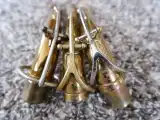
The necks with octave keys: (early Comm I to left, Comm ? in the middle and Comm II to the right. )
View attachment 17585
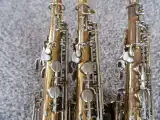
Body octave
View attachment 17586
It's mot my saxes and pictures. I asked the sax owner if it's ok to use the pictures.
Again, not to belabor the point, this is interesting and I do not disparage anyone's observations...but the fact remains, proof is in the pudding only if someone literally MEASURES the two models to see if in fact a II is just a dressed-up I.
Well, I just purchased a II Tenor, so I will measure the body up and save the data until a I comes in....I just found this post by Jorns Bergenson. He has made a lot of measurements on 1930's Martin tenors and stencils and says that the differences in the bodies between the Committee I and II are small, but that there are manufacturing differences between the necks which affect the sound.
![]()
Comparing 1932 to 1939 Martin tenors, once again
This may be interesting to some Martin aficionados, probably not. I've stated many times about how Martin kept with the same acoustic design throughout the years, and here I'm going back up on my soapbox for a moment. I'm in the process of overhauling 5 Martin tenors in tandem, all made from...www.saxontheweb.net
BTW, I took these pics and have current examples of most (if not all) Martin horns mentioned here (in various states of repair/dis-repair). The neck in the middle is from a "Comm I" (engraved on Bell "Comm 1" but has elements of both a Comm I and Comm II. I'm glad some of the photos are of some use in this discussion.Most of the american saxophone manufactors came with new models in the late 30's based on earlier models. Conn 26m and 30M, H.N. White King Zehyr Special, Buescher 400 (complete new models inclusing baris) and Martin Handcraft Comm II. I have been trying to find out the difference between a Handcraft (Comm 1) and a Handcraft Comm II. I have a Handcraft that's it's made when the Comm II model already was on the market. From what I know they are pretty much the same horns (neck, body and bell). Some changes were made on the keyworks. A Comm II is a good looking horn. Some changes:
The necks with octave keys: (early Comm I to left, Comm ? in the middle and Comm II to the right. )
View attachment 17585
Body octave
View attachment 17586
It's mot my saxes and pictures. I asked the sax owner if it's ok to use the pictures.