



 acebook
 (bottom of page)


- Messages
- 40
- Location
- Chester County, PA USA
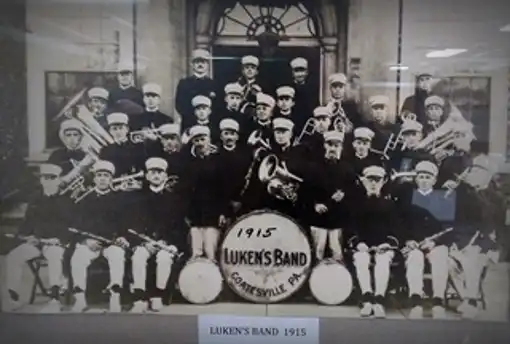
I joined a community band in September - it was founded over 100 years ago with the benevolence of the local steel company. It's a 35 person concert band when all are present and meets in the basement of the steel company's former HQ building, now an iron and steel museum. (I've never been upstairs, although I think access is low cost or free.) When I signed up, the conductor told me they had two altos and two tenors. I'm primarily an alto player, so we settled on that. He did ask if I play baritone. I’ve never done so, as I’ve never had access to one. Otherwise, I'd be delighted. But he didn't offer a baritone; he said alto. When I attended the first practice, only 1st alto was there. Two things were immediately clear:
1) This band's tempos were vastly beyond my playing ability, and they wait for no one to catch up. I'm a musical retread, returning to the horn after a long absence. Our first tune had a timing of 148. Fast for them. Unattainable for me.
2) 1st alto was a light year beyond me in skill. He was a very pleasant chap -- but also quiet and introspective, so not a lot of direct support or "how to" counsel. I mostly listened to him as I couldn't play many of the passages. (I later learned he's been playing for 50 years.)
I walked out of practice a little stunned on day 1. I've always enjoyed ensemble play (I've never been a soloist), but it was clear to me I had made very little (positive) impact on the band.
The next practice was only slightly better, although I'd practiced the material every day that week. I was at the point where I could work through most of the tougher passages at my usual tempo. A snail's pace behind the rest of the band. I was still left in a choking cloud of dust at the end of practice.
I've taken weekly lessons for the past 2 years. So I took my folder to my next lesson and got several pointers from my teacher, a long-retired, 80-something public school band director.
The third practice was only slightly better. Tempo still eluded me. My fingers won't move that fast. I clearly remember a time when I played tougher passages with casual ease. Remembering them so clearly while my physical skills keep coming up short is immensely frustrating.
The third or fourth practice session I was approached by one of the tenor sax players who shared that he would be out for a few months for knee surgery. He asked if I would fill in for him and gave me his folder to look through. I'm not tenor fluent, but the parts looked a little simpler than alto. I agreed.
It wasn't until November that I felt I could manage most of the tunes. By that time, we had a new set of material to work on for the holidays, and I had unearthed my '57 Martin tenor, setting my 6M aside. (My Dad played professionally in the 40's and 50's on a 1942 10M; I had wanted to play it but the octave mechanism wasn't activating the body tube vent; so I went for the Martin.) I had identified particularly difficult passages to target for my lessons -- and I was right about tenor parts vs. alto. About 80% of the material was within my grasp now, even at something close to tempo. Now I found timing to be my bugaboo. Short, staccato, syncopated rhythms simply must be precisely aligned with the rest of the band and all-too-often I shot off a random ill-timed note: the kind of note where everyone turns and glances at you. I began working through timing with my teacher each week.
By the beginning of November, I had realized that most of my band mates were educators or former educators. Many were school music teachers or school band directors with skills far beyond mine. 1st alto was a retired IT guy. They and the conductor talked music theory in class, which I had never learned in my tiny Oklahoma town in the 60's and 70's. The good news was they were very patient, as they mostly dealt with kids all day (irony). The band was bracketed by a couple of 20 somethings (trumpet and French horn) and a very skilled 87 year old (trumpet), plus a bunch of late middle aged fellows on low brass and a mix of people on clarinet, flute, oboe, bassoon. (Last night, we were joined by a new player on bass clarinet.) My teacher had advised me to follow the trombones if I ever got lost in the music (not in a good way) and I'd learned he was right. The trombones sat right behind me and often had the same rhythm.
Our performances don't start until early December. We perform on a flatbed truck in the community Christmas parade, and at a couple of old folks’ homes in the area. There aren't a lot of performances, but I'm still too focused on raising my game to think about performance much anyway. My newest challenge is just toting the tenor around, as I walk with a cane and it throws me off balance. I still struggle with the difficult passages but I don't really fret about them because they'll work out in due time. I can hear myself slowly closing in on them. Slooowly. They haven't kicked me out of the band yet in any case.
A couple of overall observations: I've progressed as a player far more rapidly than I would have done with private lessons alone. The other band members are pleasant, tolerant, and patient, but they're pushing me hard by example. You need both practice and lessons for fighting back, so to speak. I find I also enjoy ensemble playing as much as I did as a youngster. There's a feeling of belonging and of delivering a piece, however small, of the whole so the outcome is more than just the sum of its parts.
If folks are interested, I can update once we've got a few concerts behind us.
My community band at my last practice:
1) This band's tempos were vastly beyond my playing ability, and they wait for no one to catch up. I'm a musical retread, returning to the horn after a long absence. Our first tune had a timing of 148. Fast for them. Unattainable for me.
2) 1st alto was a light year beyond me in skill. He was a very pleasant chap -- but also quiet and introspective, so not a lot of direct support or "how to" counsel. I mostly listened to him as I couldn't play many of the passages. (I later learned he's been playing for 50 years.)
I walked out of practice a little stunned on day 1. I've always enjoyed ensemble play (I've never been a soloist), but it was clear to me I had made very little (positive) impact on the band.
The next practice was only slightly better, although I'd practiced the material every day that week. I was at the point where I could work through most of the tougher passages at my usual tempo. A snail's pace behind the rest of the band. I was still left in a choking cloud of dust at the end of practice.
I've taken weekly lessons for the past 2 years. So I took my folder to my next lesson and got several pointers from my teacher, a long-retired, 80-something public school band director.
The third practice was only slightly better. Tempo still eluded me. My fingers won't move that fast. I clearly remember a time when I played tougher passages with casual ease. Remembering them so clearly while my physical skills keep coming up short is immensely frustrating.
The third or fourth practice session I was approached by one of the tenor sax players who shared that he would be out for a few months for knee surgery. He asked if I would fill in for him and gave me his folder to look through. I'm not tenor fluent, but the parts looked a little simpler than alto. I agreed.
It wasn't until November that I felt I could manage most of the tunes. By that time, we had a new set of material to work on for the holidays, and I had unearthed my '57 Martin tenor, setting my 6M aside. (My Dad played professionally in the 40's and 50's on a 1942 10M; I had wanted to play it but the octave mechanism wasn't activating the body tube vent; so I went for the Martin.) I had identified particularly difficult passages to target for my lessons -- and I was right about tenor parts vs. alto. About 80% of the material was within my grasp now, even at something close to tempo. Now I found timing to be my bugaboo. Short, staccato, syncopated rhythms simply must be precisely aligned with the rest of the band and all-too-often I shot off a random ill-timed note: the kind of note where everyone turns and glances at you. I began working through timing with my teacher each week.
By the beginning of November, I had realized that most of my band mates were educators or former educators. Many were school music teachers or school band directors with skills far beyond mine. 1st alto was a retired IT guy. They and the conductor talked music theory in class, which I had never learned in my tiny Oklahoma town in the 60's and 70's. The good news was they were very patient, as they mostly dealt with kids all day (irony). The band was bracketed by a couple of 20 somethings (trumpet and French horn) and a very skilled 87 year old (trumpet), plus a bunch of late middle aged fellows on low brass and a mix of people on clarinet, flute, oboe, bassoon. (Last night, we were joined by a new player on bass clarinet.) My teacher had advised me to follow the trombones if I ever got lost in the music (not in a good way) and I'd learned he was right. The trombones sat right behind me and often had the same rhythm.
Our performances don't start until early December. We perform on a flatbed truck in the community Christmas parade, and at a couple of old folks’ homes in the area. There aren't a lot of performances, but I'm still too focused on raising my game to think about performance much anyway. My newest challenge is just toting the tenor around, as I walk with a cane and it throws me off balance. I still struggle with the difficult passages but I don't really fret about them because they'll work out in due time. I can hear myself slowly closing in on them. Slooowly. They haven't kicked me out of the band yet in any case.
A couple of overall observations: I've progressed as a player far more rapidly than I would have done with private lessons alone. The other band members are pleasant, tolerant, and patient, but they're pushing me hard by example. You need both practice and lessons for fighting back, so to speak. I find I also enjoy ensemble playing as much as I did as a youngster. There's a feeling of belonging and of delivering a piece, however small, of the whole so the outcome is more than just the sum of its parts.
If folks are interested, I can update once we've got a few concerts behind us.
My community band at my last practice:


