Saxophones MARTIN Comm-III finish ?

Messages
28
Location
MI, US
Question:

Bought a Martin Committee III alto s/n 204xxx (1959?) that needs work. I am having a tech look at it next week.

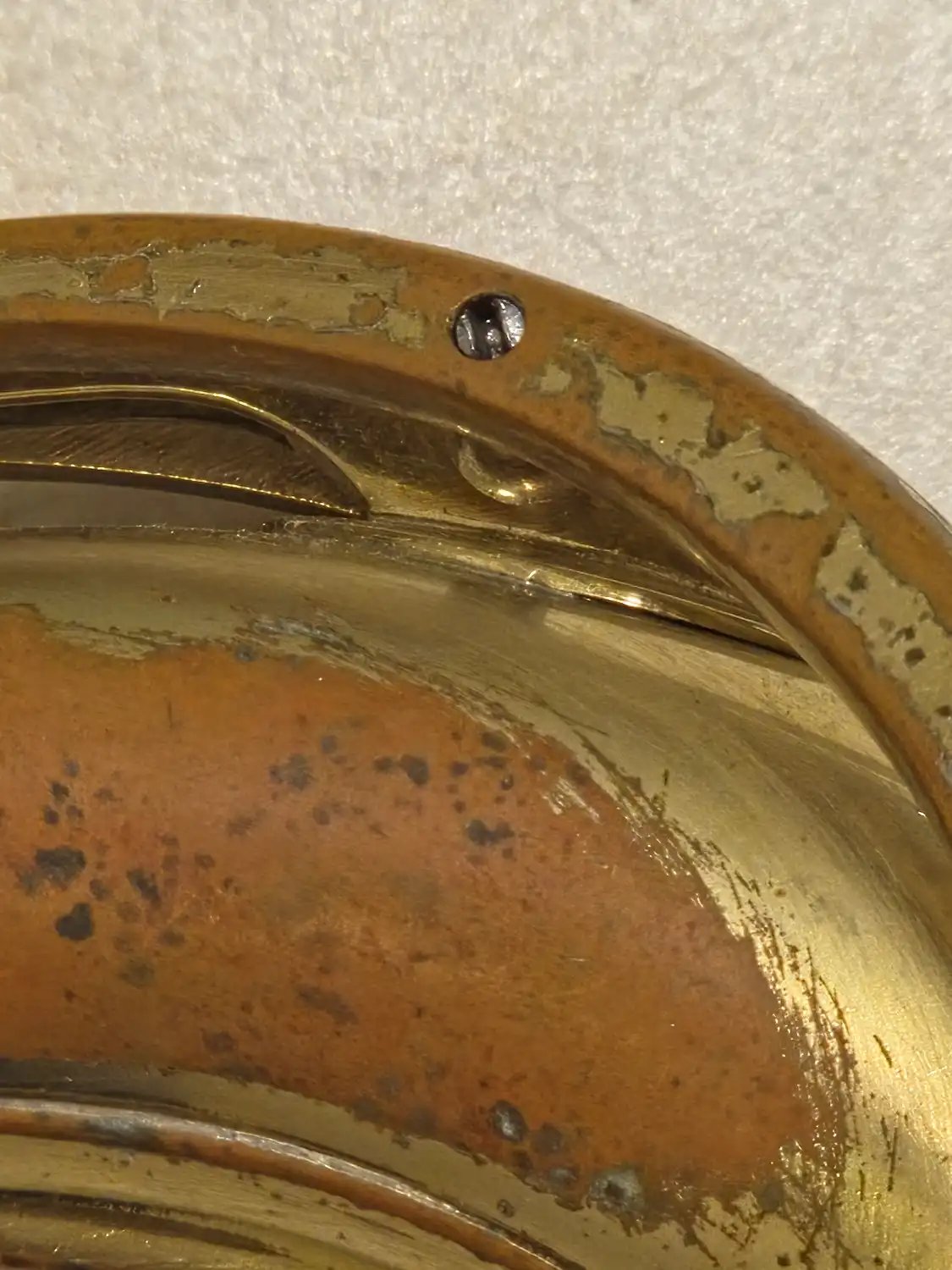
Included is a picture of the neck finish.

I am curious if someone can tell me whether the missing gold with scratches at the edges was gold lacquer or gold plating, and if the rust color is the bare brass or the 'red rot' peasants with pitchforks and torches get up in arms about?

Thank you

Murray
9829.webp
 
Question:

Bought a Martin Committee III alto s/n 204xxx (1959?) that needs work. I am having a tech look at it next week.

Included is a picture of the neck finish.

I am curious if someone can tell me whether the missing gold with scratches at the edges was gold lacquer or gold plating, and if the rust color is the bare brass or the 'red rot' peasants with pitchforks and torches get up in arms about?

Thank you

Murray
View attachment 38285
Does the neck have a serial number on it ? If so see if it matches the body number. Oddly yours looks plated. Like the gold is flaking off.
Your SN# 204,xxx appears to date to the second half of 1959. Gold plating finish option ended in 1958. The ‘58 price list doesn’t indicate silver base plating. Just “Burnished Gold”.
IMG_4113.webp


January 1959 price list only shows two options. Lacquer or silver with gold bell (inside ?)
IMG_4111.webp


Same thing for August 1959.
IMG_4112.webp
 
The s/n's match, but strangely were two digits off what the eBay seller stated. His eyesight was worse than mine?

Well, I swatted my phone twice this AM, thinking a insect was running across the screen.

It was bats, Halloween-themed moving background image. Glad I didn't get too aggressive.
 
The s/n's match, but strangely were two digits off what the eBay seller stated. His eyesight was worse than mine?
Any signs of gold on the body or keywork ? Look under a palm key.
Well, I swatted my phone twice this AM, thinking a insect was running across the screen.

It was bats, Halloween-themed moving background image. Glad I didn't get too aggressive.
Sax player at bat and nobody on, the count is 0-2, no outs.
 
I will look again. The body is not as bad, but different kind of scratches. Some white spots that look like road salt well, you're in CA, but I am in MI. I tried to wipe one off with a finger dipped in tap water and that didn't come off. Fingernail scratch didn't do anything. There is much less 'redness'.

I thought in the seller photos something squarish (a rod post or music lyre clamp screw?) looked extra corroded but I didn't notice or forgot to inspect upon arrival and the body s/n looked like lacquer was blisterig. It was harder to read but matched. Last three I think were 742.

Strange thing about the Pan Am tenor. It was sold as a Pan Am Martin stencil, 1947 s/n. Chart agreed.

Then it arrives & an excitable moderator on SOTW, Bandmommy was adamant it was a 1957 Martin Indiana from Martin serialization because she has one.

I said it looked like a saxophone to me and asked the group what details in addition to the soldered tone holes I could cite when telling someone more knowlegeable than me, or insurance, why it was a different brand than as-marked and why Martin would use their serialization if it's not marked anywhere as anything but a Pan American.

Things went downhill from there and a bunch of people told good old boy stories about Martin doing Conn a favor behind the scenes with no recordkeeping over a 2000 digit serial range and that they were very old stock Indiana bodies. I don't understand the logic of using s/n's 'secretly' from Martin's sequence because the same numbers appeared earlier in normal Pan Am sequence...1947, making it more likely that duplicate numbers could exist. & did Conn or Martin do the Pan Am engraving? Conn had a union & a strike in 1947. That's a possible reason for outsourcing, more believable to me than a back-room deal that didn't seem to alarm workers at either company or nobody knew they were alarmed.

People were getting hostile for a bit about it being obviously a Martin & questioning their supreme knowledge. I blocked one for a day after she ranted to others telling me things, 'what makes you think he'll believe you? Because you're not a woman?'

I went back a day later & politely refuted all that & that I couldn't convince anyone on the basis of some expert on the internet alone when I am unfamiliar with the obvious characteristics other than beveled tone holes & said I was going back to lurking.

One person acknowleged jumping on board without reading the whole thread.

Another said I could not learn the differences by reading a list needed to look at online photos from similar angles & distances. Hmmm.

Apparently I stayed logged on because months later a different moderator sent me an email asking if I was OK and whether i left for some reason I'd be willing to share.

I didn't want to backstab one moderator to another because I didn't see the point. That wouldn't benefit me. A new member bitching about an honored moderator?
 
OK, well, we can just skip over the historical recounting; what your photo shows looks to me like an original finish that's flaked/been scraped off, exposing bare brass that's turned brown, as bare brass does.

Gold plating is almost always going to have a coat of silver plating under it. Your photo shows no evidence of this, so it's almost certainly not factory-applied gold plate.

It is possible that it's been gold plated aftermarket and not done very well, i.e., without the standard silver (or other) flash undercoat. But I don't think this is the case.

I think that what you've got there is original (or refinished) lacquer that's flaking off. Under the lacquer it's keeping the brass shiny, and where the lacquer's come off, the brass is turning brown. Usually, old lacquer turns brownish too, which makes me suspect that this horn's been refinished, using a more durable lacquer that is less prone to turning brown; but maybe the surface prep wasn't very good, so the new lacquer is coming off.

Full-body views of the instrument would go VERY much further in assessing the probable nature of the finish.

So-called "red rot" is a normal version of oxidation of brass with an unnecessarily inflammatory name. When brass tarnishes it can form one of three different oxides: green (verdigris), brown, and red. It's extremely common for a single brass article to show all three of these. In the case of a saxophone the red form is what some have recently taken to calling "red rot".

The REAL "red rot" phenomenon is something that occurs in the lead pipes of trumpets and trombones where you have a long small diameter tube that's constantly wet on the inside, and corrosion can lead to pinholes in the tube, which will then have to be replaced. This doesn't happen in saxophones because the tube is so large, and pierced with large holes down its length, that it dries out and doesn't stay constantly wet on the ID. The reddish corrosion you'll see on a saxophone may look unsightly to you; and if you rub it on your white shirt it will make an orangish stain that's difficult to get out; but it does not presage some kind of imminent destruction of the horn. At least, not for the next few hundred or thousand years.
 

Social

New! Social Feeds

Look out for the navigation icon:

Follow CafeSaxophone

Trending

Forum statistics

Topics
32,014
Messages
576,856
Members
8,109
Latest member
MGBBOY
Back
Top Bottom