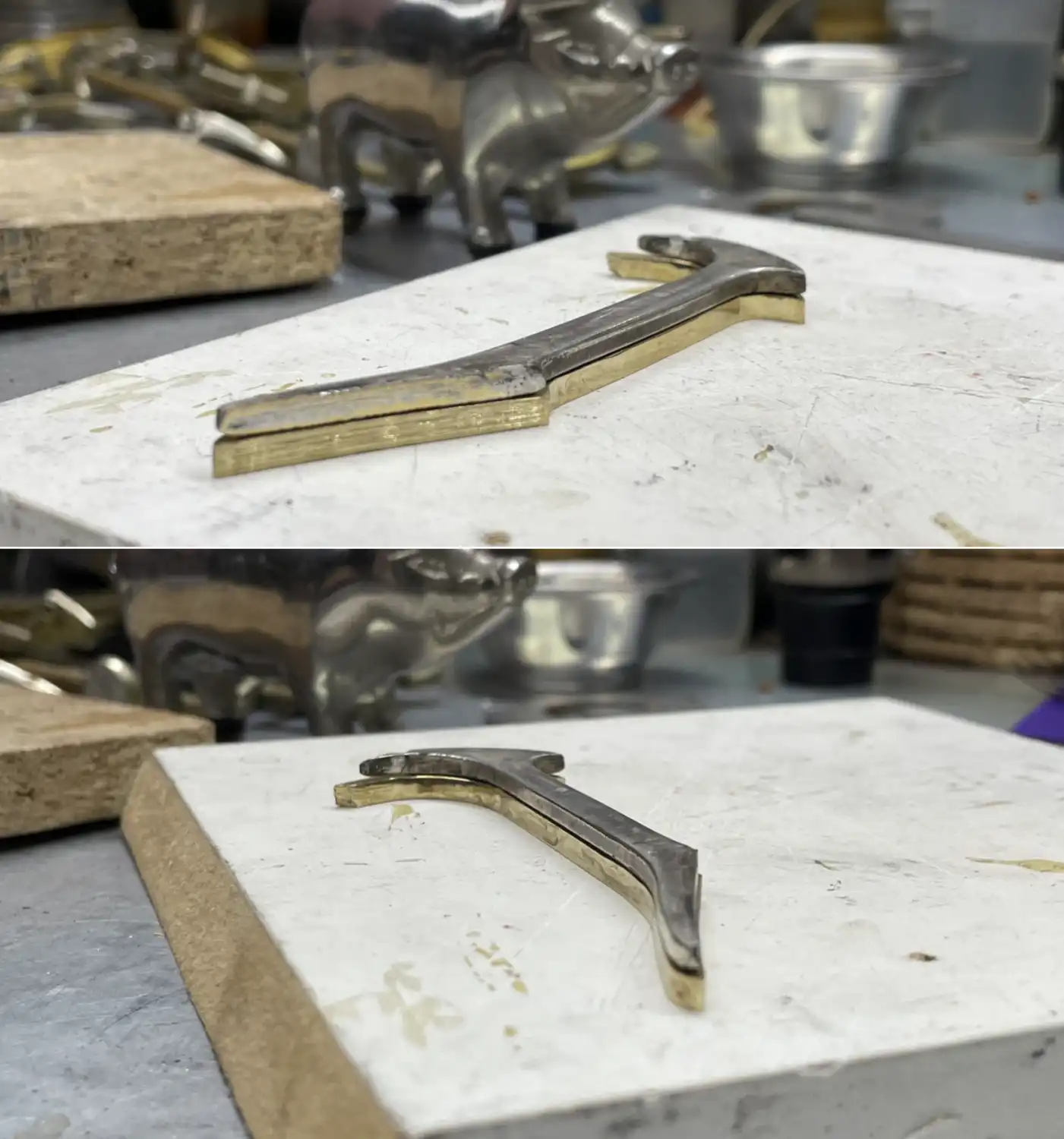
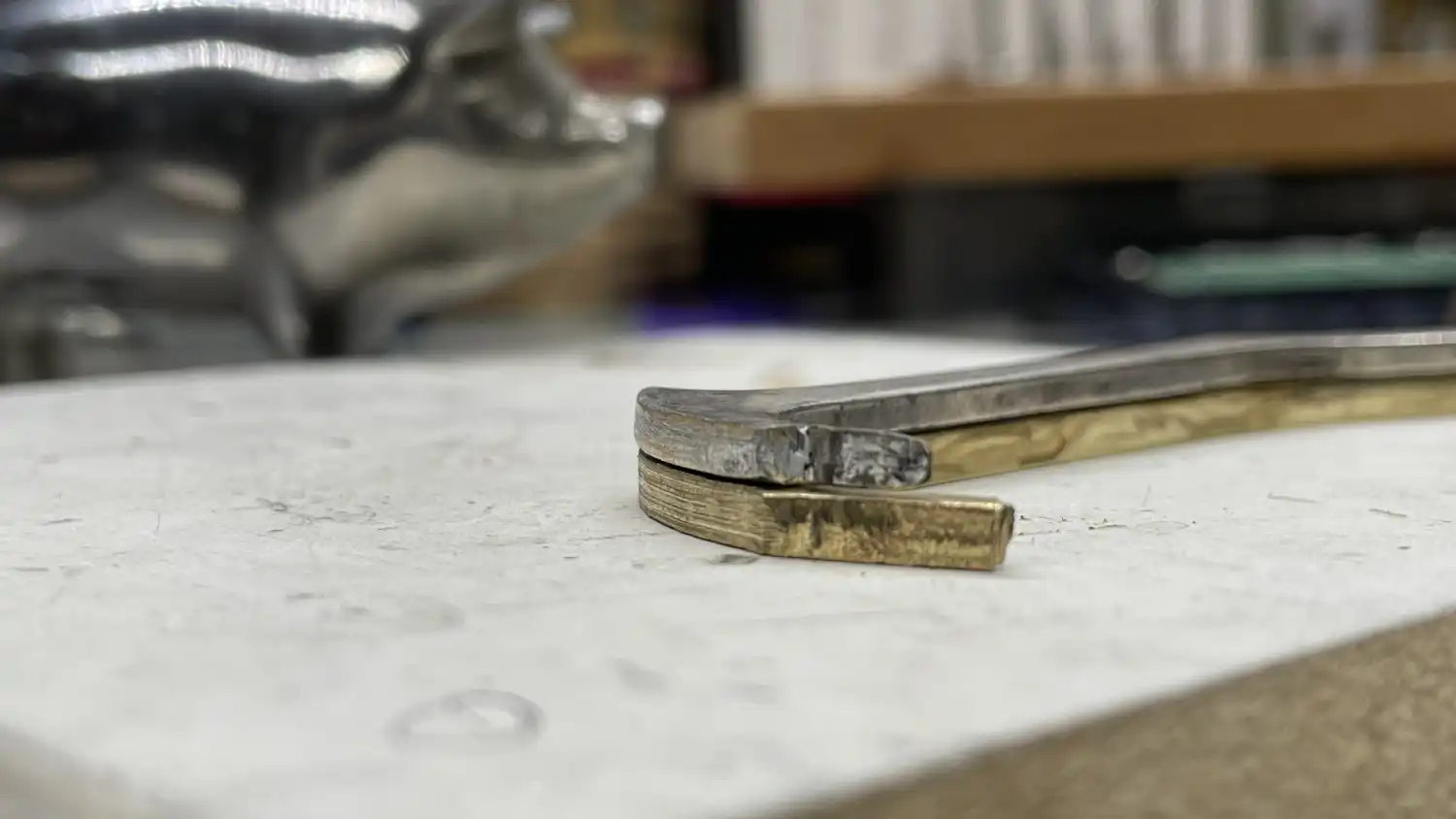
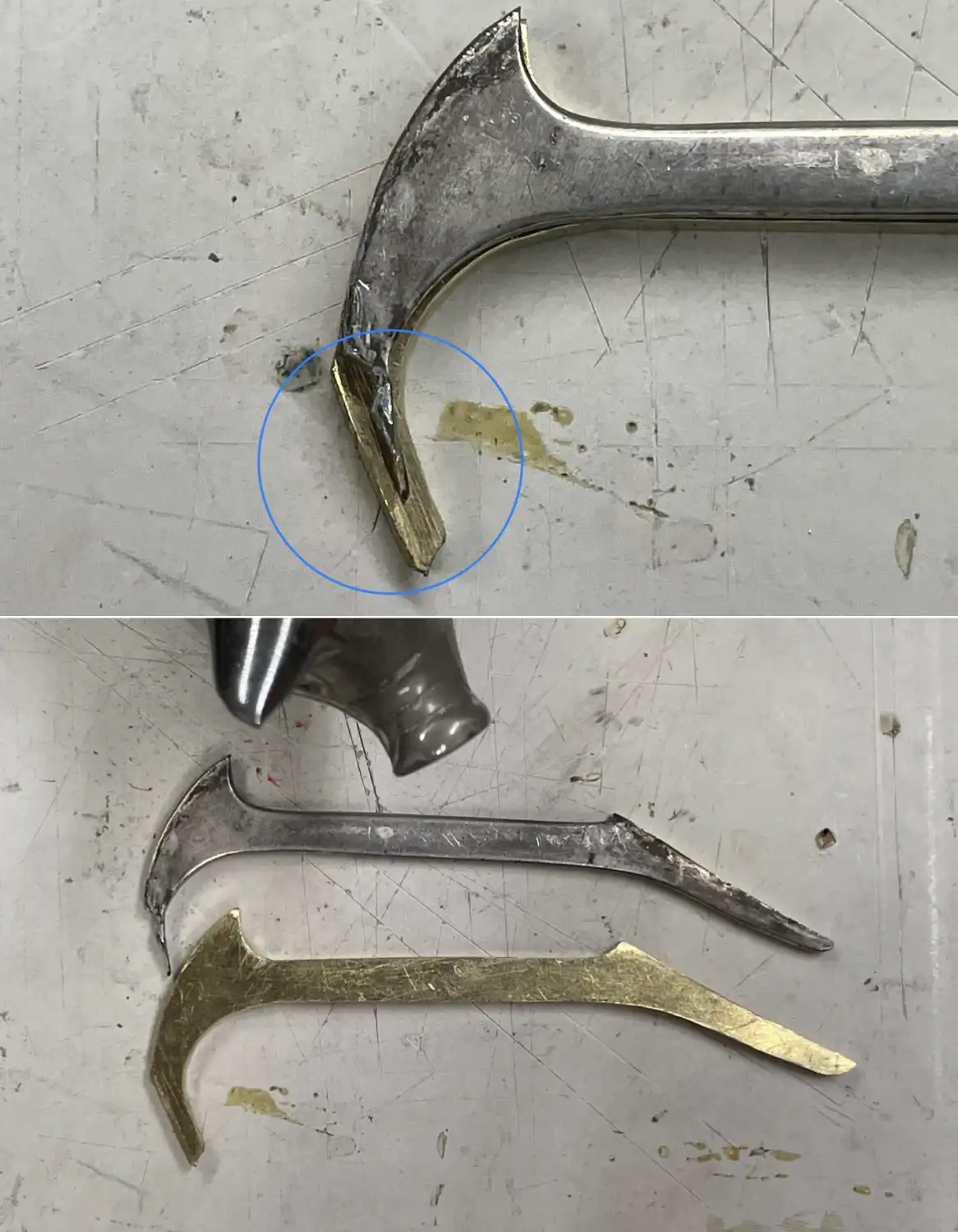
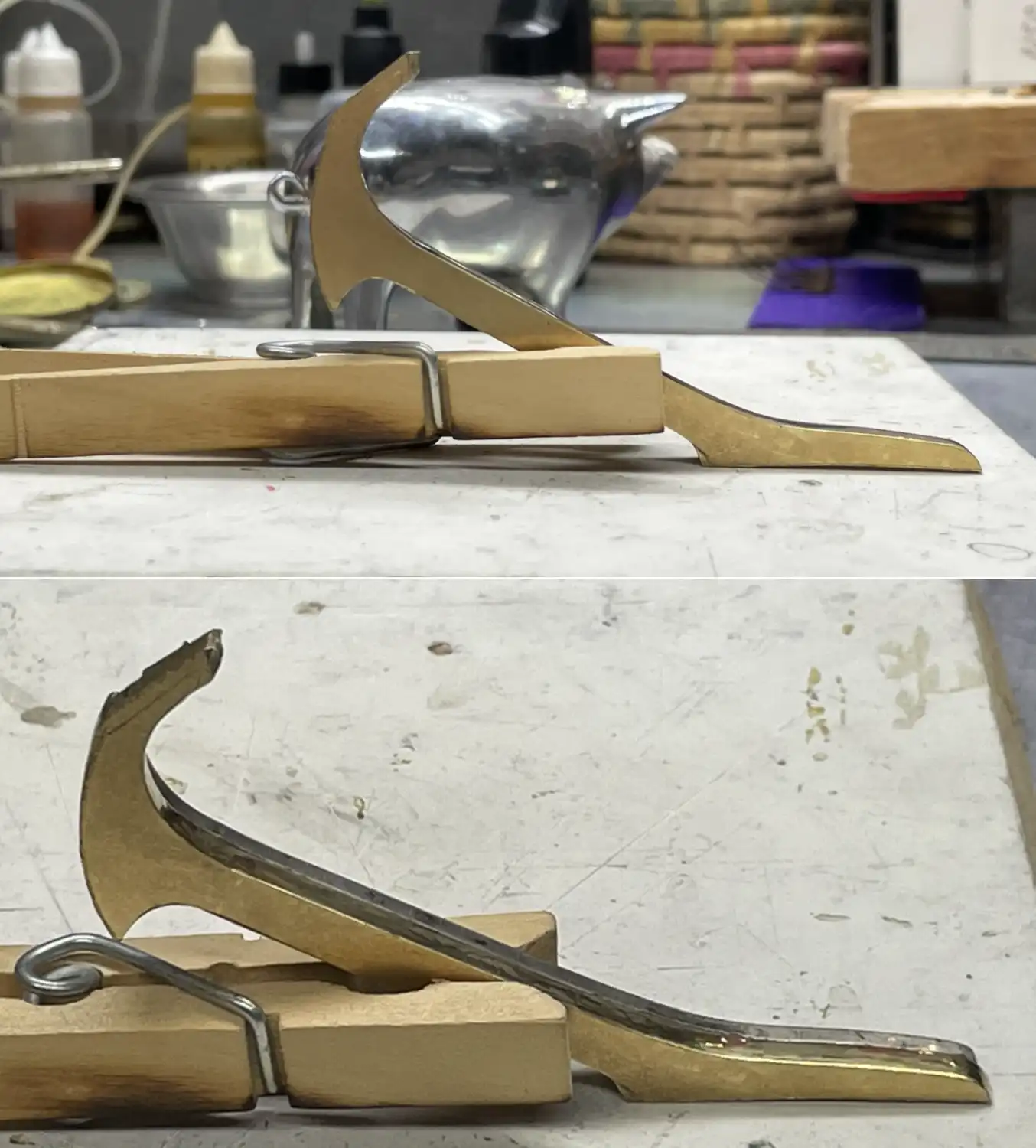
Time to check against the pattern sample.
This area below will be hand fit in place.
Is this a saxophone thumb rest ?Making parts you can't get as well as making things/parts that don't exist, though you might know what they look like, as in Unicorns.
So to create the left side of this thumb rest handle, the master is shaped by hand, and to duplicate, on a manual carving machine, both the master and copy material, must be rotated 90 degrees.
Area between the red lined requires this.
Two 8"x 8"x 3/4" plates are bolted and glued together.
1/4" holes will be drilled at 20 degree intervals.
Each plate is mounted on a 5"x 5"x 1/2" aluminum angle stock.
Two 3/8" holes to mount each plate to the angle stock and two 1/4" holes for each plate, so they can be rotated and be aligned.
Master and copy material, can be mounted various ways.
IIRC these might be called indexing plates?
View attachment 38014
View attachment 38017

I like your 'Jeweller's Peg' up a bit on the thread. Every time I see one I think 'that would be handy' and then forget about it again 🙂With the part edges squared it’s time to make them straight and level. For this I sandwiched the part in between wood blocks. This being positioned just above flush. @mark_addy the files are out now.
View attachment 37993
Work down the high spots.
View attachment 37994
Then burnish.
View attachment 37995
Repeat on other side.
View attachment 37996
Handy tool I make from 1/2” scraps.I like your 'Jeweller's Peg' up a bit on the thread. Every time I see one I think 'that would be handy' and then forget about it again 🙂
I wouldn't call that a "jeweler's peg" I'd call it a "fishmouth" and I can't see why anyone who can do work for which it'd be handy wouldn't just cut it out of a piece of wood with a coping saw like you did. At least 75% of the stuff people say "3d print it" can be made faster and easier other ways. (The other 25%, though, will save your bacon when it comes up.)Handy tool I make from 1/2” scraps.
See if you can print this @ 100% ?
View attachment 38031View attachment 38032
A generic description of a bench tool. No rules design. Who said anything about 3D printing ? Print the drawing. The ruler is for scale to check at 100%.I wouldn't call that a "jeweler's peg" I'd call it a "fishmouth" and I can't see why anyone who can do work for which it'd be handy wouldn't just cut it out of a piece of wood with a coping saw like you did. At least 75% of the stuff people say "3d print it" can be made faster and easier other ways. (The other 25%, though, will save your bacon when it comes up.)
Ah - I have one of those slightly crappy folded-up mini G-clamps which I suppose I could employ for just this purpose. I inherited it from my late F-in-L about 25 years ago, and I might not have 25 years left to put it to something useful!A generic description of a bench tool. No rules design. Who said anything about 3D printing ? Print the drawing. The ruler is for scale to check at 100%.
View attachment 38033
That's useful, given the number of USA instruments around here. Here, we generally see BSW (BS Whitworth, which is coarse), BSF (British Standard Fine), BSP (BS Pipe, also known in Europe as 'G' for Gas) and of course 'normal' metric and then various types of Metric Fine. Oh, and BA (British Association) which is small and metric, kind-of, masquerading as being not-metric - very common on old electronics / radios / test instruments etc. I think we call your NC and NF 'UNC' and 'UNF'; both are unusual these days and only UNF turned up reliably (in my limited experience) on older automotive hydraulic brake fittings - maybe those were bought in from a US company (Girling?) post-war and it stuck. That flipping Chinese oxy-propane torch was 'your' NPT, but is now 'our' BSP - and it works without drama, thank goodness.A handy chart for wall art.
View attachment 38061
Flash inside of hole with solder and re-tap proper. Will be 2.5-.45 or 2.6-.45On my own instruments, I foresee re-tapping things for BA where stripped