Saxophones Looking for info on CG Conn (sole agents JR LaFleur & Sons

Tania

Member
Messages
10
Location
London
Hello all,

First post and am looking for some help/info on a Conn alto that my friend owns. I have posted some pictures below.
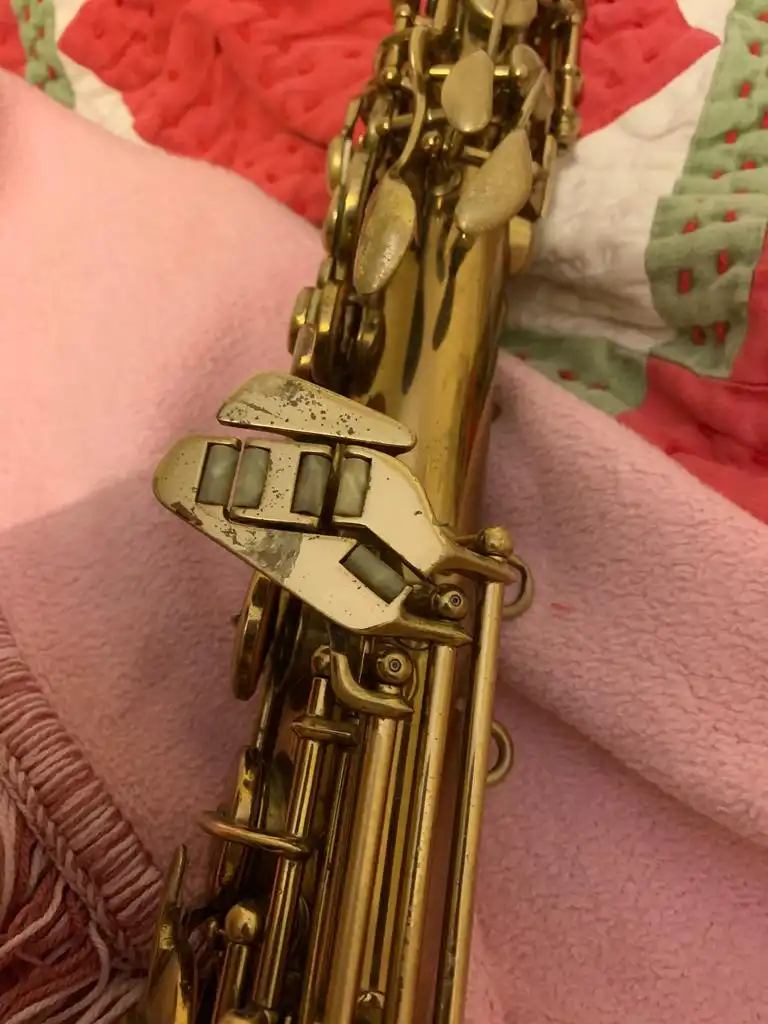
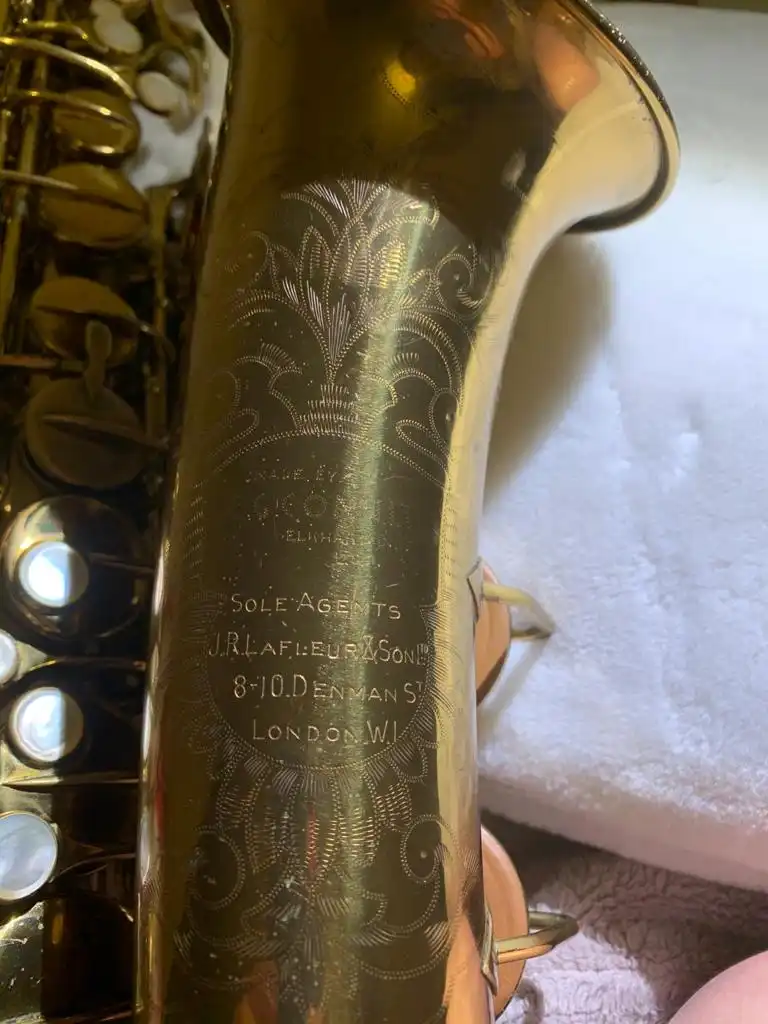
The serial number (M251317) and styling seems to imply that it is a 1932/33 model (so maybe transitional?) However, the LH pinky keys seem to imply a 6M model. Engraving is certainly not the art deco style of the 6Ms. Also the engraving has reference to JR LaFleur & Sons, 8-10 Denman Street, London W1 being sole agents.

Are any of you vintage experts out there able to shed any light please?
Conn_1.webp
cda5fd5d-6615-4e2b-9545-d2ed881bbd8c.webp
 
Lafleur & Sons was owned by Hawkes, who joined with Boosey in 1930 to become Boosey and Hawkes. They used the Lafleur brand name for foreign imports. So this saxophone was presumably imported into the UK by Boosey and Hawkes.
 
That's an unusual find, because most "stencils" of that era will have a mixture of 6M and New Wonder parts, and usually a LH table that is more like the NW's.

That's neato that the set-screws (the small screws that hold the pivot screws in place, and prevent them from backing out) appear to have hex-heads. I have never seen that on a 6M before. The heads are normally single-slotted.

The photos are limited in scope, but I don't see anything to differentiate that alto from what a 251K would look like without "OEM" branding, i.e. with normal Conn branding, other than the set-screw difference.

I would not be surprised if the neck was straight, with no tuning barrel, and either a stepped area where the neck cork goes, with a sharp dividing line, or a more rounded transition into a similarly sort of separated cork area on the neck pipe, i.e. a "New York Style" neck was common around that serial number. That is my favorite part of the Conn alto run, personally.
 
I've never seen the hex screws either, and I very much suspect that someone's realised what a complete pile of pants this locking mechanism is and has taken some small steps to improve up the situation. They'll still come loose though.

As it happens I have a 'tranny' on the bench at the moment (yeah, I know...I know..). This one's a 258xxx.
If I remember rightly the client bought it from the Wichita Band Co - and if it was them that overhauled (or at least repadded) it, I'm quite impressed. It's a neat job.

silver transitional conn.webp
 
I've never seen the hex screws either, and I very much suspect that someone's realised what a complete pile of pants this locking mechanism is and has taken some small steps to improve up the situation. They'll still come loose though.

As it happens I have a 'tranny' on the bench at the moment (yeah, I know...I know..). This one's a 258xxx.
If I remember rightly the client bought it from the Wichita Band Co - and if it was them that overhauled (or at least repadded) it, I'm quite impressed. It's a neat job.

View attachment 15858

HA! When I saw your mention of Wichita Band in the email alert I got my kneejerk reaction was, Huh...aren't those the guys that used to do the nice looking restorations on silverplated horns?

I think I've had some of their work in before, too, but nothing stands out in memory (which is a good rating, in my memory's auto-meter).

Another cool thing about the hex heads, which I'm sure already occurred to you: if the allen wrench fit is good, no more old fingers struggling to get the set-screws to sit properly to be installed! It does look like there would be a high incidence of breaking allen wrenches, with a sizing that fine.

I'm going to have to try and find a source for those screws. If you happen to beat me to it, let me know? I did see your recent post about discovering a treasure trove of set-screws for Conn....

Yep, it's a decent-enough job. Very impressed to see they replaced all the point and grub screws.
Not sure what brand of resopad they've used (unmarked on rear) but they've done a reasonable job of setting them. They could have spent more time levelling the toneholes though - there were one or two leaks here and there, and it's nigh on impossible to 'spot tweak' a resopad seat.
But compared to a very great deal of work from other repairers I've seen over the years, it's some way ahead of the field.

Swings and roundabouts with the hex screws. There's more of a chance you (or more likely a punter) could over-tighten them and strip the thread in the pillar - and if you round out the hex hole you're going to be in trouble (though you do have a handily-centred hole to get a drill in).

Either way, the system doesn't work in the long term - the point screws always come loose eventually - which is why I degrease the pillars and screws and secure each screw with a drop of Loctite 243.
 
If it's a resopad with the ring, it's likely either Ferree's (plain white carboard if I recall) or made onsite. I remember corresponding with them, and it being pleasant, but it's so long ago I can't recall about what lol. It's hard to imagine anybody spending the time to make ring-implanted Resopads if doing work for profit/income. Wichita (if you guys are reading, now), I enjoyed your work on eBay, back in the DIzzay. :cheers:

Indeed, re the hex screws. I didn't think of that, but that would be unpleasant, to strip the screws and not be able to back them out (but solvable, by you before by some hahaha).

What is your take on the best way to immobilize screws such as on YTS/YAS 23 (or Armstrong cylindrical, LeBlanc/Vito Rationel, etc.) screws? This dovetails of course with our common work on AS-PDs, but I do not presume those tell the story on what you would say is the ideal solution. I mind the set-screws less than you do, but that is a genuine question, not just chit-chat.
 
Yep, it was a Resopad with a ring and a white card base. Probably Ferrees then.

Securing shoulderless screws? The most elegant way is that used by Yamaha - a cross-drilled hole through the thread with a piece of nylon cord in it. As an aftermarket mod though, it's way too much work - so I resort to chemical means.
I use Loctite 243 - medium strength threadlock. You could use 222 (low strength), but it has poor resistance to oil and will dissolve over the course of a year or so. I tend to confine its use to adjusting screws.

The trick with 243 is to thoroughly degrease both the screw and the pillar before application. Sure, it'll work even if you skip this step - but if there's any oil on the screw it'll shorten the time over which the Loctite remains effective.
And less is more - there's no need to drench the screw.
 

Social

New! Social Feeds

Look out for the navigation icon:

Follow CafeSaxophone

Latest Song of the Month

Trending

Forum statistics

Topics
32,083
Messages
578,858
Members
8,140
Latest member
AnnaR
Back
Top Bottom