Saxophones Left Hand Pinky Table Opinions?

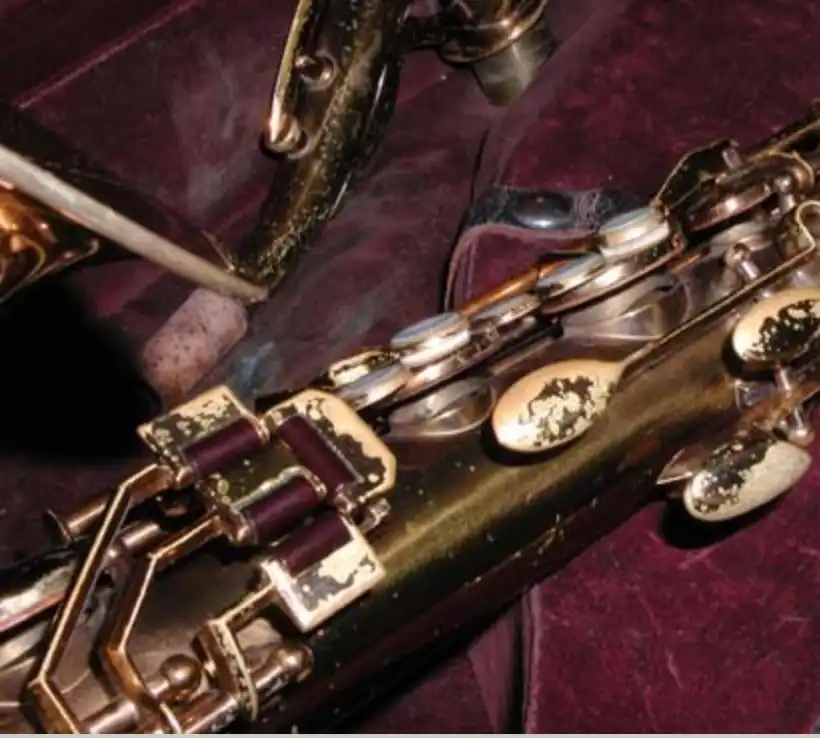
Just for kicks, posterity, and being a wiseguy.....here is yet ANOTHER configuration, sorta infamous to King fans....from the first generation of Zephyrs. Not sure WHAT 😳 they were thinking with this one.....

Early Zeph Table.webp
 
I'll give my 2d worth, I hate the Selmer etc type 'pinky table' ..having short stubby fingers.
For example, on what's a (presumably) Yanigasawa copy type tenor I have, I simply cannot play a low Bb as I can't reach it, end of story ! On the Conn baritone however, with a 'straight across' American style design, no problem.
With my relative short pinkies I also prefer the C#,B,Bb in line.

The leverage of the C# is sometimes short, which makes it too heavy.
Reducing the springs on G# and C# can help to a certain extent. The low C# cup spring needs enough strength to avoid it being pushed open by internal air pressure. I calculated it at around 20 g for a tenor.

My understanding of basic mechanics. The longer the lever, the less force you need for the same effect.
This seems to have been a driving motivation in Selmer's "xxx action" steps on keywork. Indirect action on the bell keys (alto & tenor) was a great breakthrough. BA-> SA-> MKVI.
Our little fingers clearly have limited muscular strength, therefore giving them more lever makes sense.
Selmer's MkVII tenor obviously missed that target.
On the other hand (pun intended), Yamaha's continuous work (kaizen) gave us the famous YSS61/62 sopranos, which really achieved a similar comfort as contemporary altos. This was a breakthrough in the 80s. The MkVI soprano still had
In the Selmer style tableau the posts for the C#,B,Bb group went to the right, which improved the leverage for the C# but made it worse for the Bb which is the reason why the Bb had to move to the lower end. This caused the thumb to pinkie spread of my left hand to be 2 cm longer than my right hand. So this change is not ergonomic for everybody. Another consequence was the change from in line to off line for the right hand main stack. This is often described as an ergonomic improvement, but I doubt that. Until now I haven't found a good reason why it is.
 
Yes basically you can just hit the G# fingering to get C# given that of course to get C# your lower satack keys are closed, thus preventing G# from opening. This was around 10 years ago but I do not believe there is any linkage between the low B and the C#/G# touch.

I always found this a pretty clever idea, actually. Someone once pointed out that going from one particular interval to another, a specific set of notes I do not remember what they were, creates an inconvenience/oddity, but I guess I never found that in my playing.
Low B to G# requires a slide. Not a real common interval.
 
Just for kicks, posterity, and being a wiseguy.....here is yet ANOTHER configuration, sorta infamous to King fans....from the first generation of Zephyrs. Not sure WHAT 😳 they were thinking with this one.....

View attachment 32711
It's the same as the Conn layout except without the plate to slide from C# to Bb. You can just jump over B without too much trouble.
 
It surprises me that nearly everyone hates the Mk VI style. I prefer it by a very wide margin. Makes moving among all those notes effortless compared to the older styles. And for those with small hands, seems like the Mk VI style would be easiest of all given the compact footprint.
 
It surprises me that nearly everyone hates the Mk VI style. I prefer it by a very wide margin. Makes moving among all those notes effortless compared to the older styles. And for those with small hands, seems like the Mk VI style would be easiest of all given the compact footprint.
The Mark VI style is very well designed. It's the tilting table I have a problem with. It makes Bb uncomfortable for my small hands. The Conn style is much easier to reach, and I didn't find it hard to get used to.
 
The Mark VI style is very well designed. It's the tilting table I have a problem with. It makes Bb uncomfortable for my small hands. The Conn style is much easier to reach, and I didn't find it hard to get used to.
Hate is a big word. It is just a design that doesn't work for everybody.
 
It's the same as the Conn layout except without the plate to slide from C# to Bb. You can just jump over B without too much trouble.
It's pretty bizarre really....the omission of a way to slide C# to Bb is really not great...now, what I usually do is extend the Bb touchpiece so it sits below the B....but it isn't as easy a mod as it might seem, due to the shape of the top of the arms coming off of the touchpieces (they are pentagonal & pointy at the top, if looking in cross section).

I mean, I agree with you to a degree...it's not like one CANNOT acclimate ...OK...it's just a stupid design IMHO...

I can think of no sax that came before it (besides the VT-2 which it is identical to)....that did not have the Bb set below the B to some degree.
The Voll-True 1 and New Voll-True, their immediate predecessors, had 'normal' vintage tables...why you would supercede those with this one...is just baffling.
Fortunately they dumped that table pretty quickly
 
I'll give my 2d worth, I hate the Selmer etc type 'pinky table' ..having short stubby fingers.
For example, on what's a (presumably) Yanigasawa copy type tenor I have, I simply cannot play a low Bb as I can't reach it, end of story ! On the Conn baritone however, with a 'straight across' American style design, no problem.
I will say this, semantics aside.....REACH IS AN ISSUE on a LOT of modern tables, and for the life of me I cannot FATHOM WHY.

I mean, a modern table CAN be located in a place were one need not:

a) have to raise their elbow to avoid grazing the wrong touch

b) REACH all touches comfortably without having to stretch a finger completely (even kid-sized hand, honestly)

There's just no excuse really. I DO appreciate the fluidity of a nice modern table and the relatively lighter spring tensions...I do not mind a tilted or scooped Bb, either (although honestly I do NOT see it as any improvement over a table with all touch surfaces sitting in the same plane).

But since so many companies have gone to the trouble of over-engineering and overthinking them, one would have expected they would have made the reaches a no-brainer.
 
But since so many companies have gone to the trouble of over-engineering and overthinking them, one would have expected they would have made the reaches a no-brainer.
In the protoype development phase of the Cafesaxophone saxophone, we were going to eschew the horrible tilting table and go back to the Selmer BA or Conn design. That concept may have risen up to bight me on the bum but I still belive it was better then.
 
No idea why they got rid of the extra “across” Bb anyway. If you prefer to catch the Bb at the bottom, you can still do so. Why does anyone prefer fewer options? 🤷‍♂️
 
I have a confession. When I started this thread, I had a (semi-hidden) agenda. Namely, to find out what people thought of the tilting table low Bb, with the C# linkage, vs. the BA/SBA style, also used on later King Super 20’s and Yamaha YxS-21, 23 etc. And Beaugnier model 38 and 39, though that one is angled differently.

I own a Mark VI, and owned another previously, and additionally have played countless others, either for a gig (rental or borrowed) or just a brief blow. I don’t find them too objectionable, and the primary reason is the entire table is smaller than most modern horns. Selmer started the “larger is better” trend with the Mark VII, and while they shrunk that monstrosity with the subsequent SA80 models, it’s still significantly larger than the VI.

I’d like to know why so many modern horns have large tables, and I’d also like a good discussion on BA vs. tilting table pinky tables. So far only one person has explicitly called out this comparison. Next time I start a thread I won’t hide my agenda.

The Mark VI style is very well designed. It's the tilting table I have a problem with. It makes Bb uncomfortable for my small hands. The Conn style is much easier to reach, and I didn't find it hard to get used to.


BTW, several people have commented that they prefer the inline style pinky table. I understand this, though with pants-side bell keys, these touches tend to be a bit stiff feeling, especially C#. I don’t prefer it, but I understand that’s a valid preference.

The Mark VI table was adopted by virtually all manufacturers as soon as the patent expired, and is now the de facto standard, though the size usually ranges from too big to gargantuan... I for one wish that weren’t the case. This has been an enlightening discussion for me, I hope it continues.

 
This is the first that I have heard on it. Is this a future product you plan on offering? Is there a forum thread or article about it?
No it’s a past project:

 
The longer the lever, the less force you need for the same effect
It's true that
Work = Force X Distance
and
Work = Power X Time
So, to do the same amount of work you can apply more Force over a shorter distance or less Force over a long distance. And the little finger can't produce so much Force.
The work, I guess, is to both shift the big Bell keys quite far and quickly; and, at the same time to load up the spring so that the caps move up quite far and quickly. It's a bit of a rubbish situation. I guess every design of the table layout is different compromises...
I suppose, to really improve things, something fundamental has to change vis a vis the spring; and someone has tried and failed.

Do clarinetists fuss over the pinky table - well, ok, it's confusing; but not much work and quite quick.
 
I’d like to know why so many modern horns have large tables, and I’d also like a good discussion on BA vs. tilting table pinky tables. So far only one person has explicitly called out this comparison. Next time I start a thread I won’t hide my agenda.
I don't know how the table size is determined, but if I develop a new saxophone reach will be a point.
The tilting table has the advantage that you can use more pinkie muscles to move it, which I appreciate.
The extra moving parts reduce the leverage problem, but not the reach, that has to be done by changing sizes and location.
The obvious disadvantages are a more complex system, more things that can go wrong and more sensory touch stimulation to the pinkie.
 

Social

New! Social Feeds

Look out for the navigation icon:

Follow CafeSaxophone

Latest Song of the Month

Trending

Forum statistics

Topics
32,045
Messages
577,871
Members
8,112
Latest member
FelixKatJazx
Back
Top Bottom