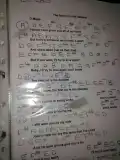
We've another colleague, @eb424, who's fond of that approach. There are many threads, here, discussing questions arising you might find useful to read.so I write out a song lyric and add the note above the syllable.
Why rail against reading music so much? Most songs that you’ll play with a backing track will hopefully be in a key that sounds best for the instrument - written “in the meat of the instrument”.Everyone i know who uses backing tracks does it.. no one is saying that reading music isn't important or at least i havent..the backing track is your music, timing, rhythm, all you need are notes. Distinguishing octaves i just circle the note..issue is for me the length of the scores and how to fit 9 pages on a stand. Also the backing tracks are usually slightly different from the score re copyright. Backing track with words first notes are only syllaballs, then remove the words, and play..
Not really. Some tunes have specific rhythms, which need to be adhered to, Unless one of the instruments on the backing track is playing that precise rhythm (which would be unusual, and in most cases, undesirable) you need to either memorise the rhythm or have it written down..the backing track is your music, timing, rhythm, all you need are notes
I know I’m gonna regret this… but why are you reading from either a piano score or an orchestral score? A backing track would be accompanied by either the tune itself (in treble clef) or a “top line and chords” - the tune in treble clef with chord symbols for impro guidance.issue is for me the length of the scores and how to fit 9 pages on a stand.
9 pages on a stand?Everyone i know who uses backing tracks does it.. no one is saying that reading music isn't important or at least i havent..the backing track is your music, timing, rhythm, all you need are notes. Distinguishing octaves i just circle the note..issue is for me the length of the scores and how to fit 9 pages on a stand. Also the backing tracks are usually slightly different from the score re copyright. Backing track with words first notes are only syllaballs, then remove the words, and play..
OP plays simple pop tunes, none of which would ever have more than a one page lead-sheet. I don’t understand where these scores are coming from.9 pages on a stand?
50+ years playing written music and I've run across that problem exactly once - there's a Bob Florence chart called "Willowbrook" that has page after page after page and flies like the wind and the way it's written out is like that - but that's it. I've played in orchestras, big bands, small bands, concert bands, and student piano and the length of the chart just hasn't been an issue I face on a regular basis.
I just use whatever score there is in the same key as karaoke version. I tend to play the whole song if its in a c instrument i can just transpose it up. The backing tracks aren't accompanied so its a seperate score which I have to match in. It works for me..never advocated not playing and reading music tbf. If i was playing with others who didn't use tracks ivwould learn. But for what i do what i do works..like i said i know pub players and most do the same.I know I’m gonna regret this… but why are you reading from either a piano score or an orchestral score? A backing track would be accompanied by either the tune itself (in treble clef) or a “top line and chords” - the tune in treble clef with chord symbols for impro guidance.
Like this:
View attachment 23979
If they are Karaoke backing tracks, they must come with a melody line, or is it that all the verses written out = 9 pages?I just use whatever score there is in the same key as karaoke version. I tend to play the whole song if its in a c instrument i can just transpose it up. The backing tracks aren't accompanied so its a seperate score which I have to match in. It works for me..never advocated not playing and reading music tbf. If i was playing with others who didn't use tracks ivwould learn. But for what i do what i do works..like i said i know pub players and most do the same.
If you have a look at karaoke version youll understand better. Currently im doing to love somebody by the bee gees..im playing the vocal part on the sax..the rest is covered on the backing track. So the rhythm is covered by drums strings etcNot really. Some tunes have specific rhythms, which need to be adhered to, Unless one of the instruments on the backing track is playing that precise rhythm (which would be unusual, and in most cases, undesirable) you need to either memorise the rhythm or have it written down.
Well, a lead sheet for a song with multiple stanzas will either have the various lines written under the staves, or set the words off on another page or the bottom of a single page.If they are Karaoke backing tracks, they must come with a melody line, or is it that all the verses written out = 9 pages?
The music itself, which will be repetitive of course, will be a page long.
Yes I know this. I have seen some very poor manuscripts for pop tunes though.Well, a lead sheet for a song with multiple stanzas will either have the various lines written under the staves, or set the words off on another page or the bottom of a single page.
So i play the vocals..there is a lot of repetition on the scores but how else can i condense it. Tbf 9 pages was me and bobby mcgee..as i said ive never said reading and learning music isn't worthwhile if needed..If they are Karaoke backing tracks, they must come with a melody line, or is it that all the verses written out = 9 pages?
The music itself, which will be repetitive of course, will be a page long.
Of course, that’s the melody. Can you post a photo of some of these scores you use?So i play the vocals
I have before and got a rollicking from pete. Just regular scores from music notes..transpose and put onto my lyricsOf course, that’s the melody. Can you post a photo of some of these scores you use?
But do you play to backing tracks and i.e. the whole melody inc improv..doing bee gees song 4 page score need to condense to 2 pages9 pages on a stand?
50+ years playing written music and I've run across that problem exactly once - there's a Bob Florence chart called "Willowbrook" that has page after page after page and flies like the wind and the way it's written out is like that - but that's it. I've played in orchestras, big bands, small bands, concert bands, and student piano and the length of the chart just hasn't been an issue I face on a regular basis.
But i dont do big band just rock pop etc..there really is no need to play from a score thats different to the backing trackWell, a lead sheet for a song with multiple stanzas will either have the various lines written under the staves, or set the words off on another page or the bottom of a single page.
Of course, copyists do screwball things on occasion; but those screwball things aren't the norm. For ordinary tunes to be played by instrumentalists, the standard for lead sheets is one or two pages. Even big band charts (except for piano bass and guitar) rarely exceed 4 pages, and if you tape them in standard big band manner it's trivial to reach up and flip one page turn.
Tbf you cant play a song you dont know..you have to learn it like everything.. ive learnt songs i didnt know. Surely making music is the important thing..i have taken it to a teacher who has played from the score out of time because the score and backing track arent a match..How do you sightread a song you don’t already know using the letter method? You’ve spared yourself a headache but given the audience one instead.
When you write down music, whatever method you choose, you need to convey the following in order to reproduce it accurately and fully - which pitch to play (including which octave), when to play it, how long to play it, how loud to play it and how to articulate it. Traditionally written music on those annoying lines gives you all of the above information. Letters only give you the pitch, not even which octave. All the rest depends on you already knowing the song or just making up all the other details.
No matter how annoying, I encourage all musicians to learn at least the basics of reading music, even if you play primarily by ear. It will enhance your understanding of rhythm, key and form and open the door to literally millions of written charts you may have never heard. A child can learn to read music in a couple of weeks, an adult not much longer. It’s well worth the small amount of effort.