



 acebook
 (bottom of page)


Stephen Howard
Well-Known Member
We all know the score - you see a nice horn on ebay or gumtree and the blurb says "Just been serviced".
Warms the heart, doesn't it? You can buy the horn, safe in the knowledge that when it arrives it'll good to go straight out of the box.
Well...
I've been working on a Martin tenor lately (for an unnamed celebrity client) - and it seems this horn had 'just been serviced'...to the tune of a couple of hundred quid's worth of work.
Now, that's not a lot in terms of vintage horn work - but it should be enough to cover some of the important bases...of which, on a Martin, are the toneholes.
First thing I noticed was a number of toneholes had visible solder remnants internally, and scruffy blobs around the outer perimeter of the bases. This is a sure-fire indication that a portion of the tonehole base has parted company with the body - but rather than remove the tonehole, clean the surfaces and resolder it in place, someone has attempted to fill the cracks in situ. This almost never works because you can never clean the surfaces sufficiently to allow the new solder to run.
And thus my standard test for leaky toneholes (drizzling lighter fluid around the joint) found three previously 'repaired' toneholes that were leaking.
The one shown below was a marginal pass, which is to say that it didn't appear to be leaking but was probably about two and half gigs away from failure - so I whipped it off as well (and I was right).
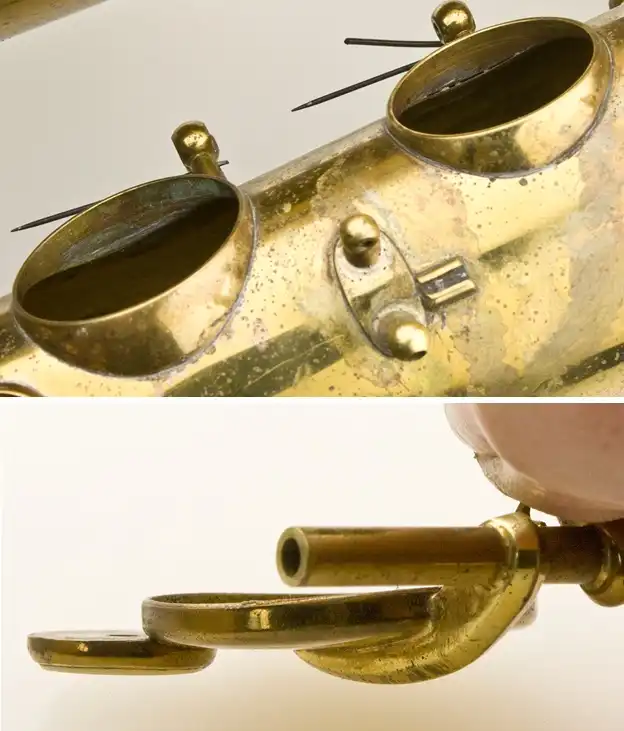
Plenty of wobbly action on this horn, little of which had been addressed. I opted for oversizing most of the rod screws to take up the wear and tear.
Few of the toneholes were level - and even fewer of the key cups were. Above is the top B key cup. The pad was leaking like a sieve. No surprises there - but what does surprise me is that anyone even attempted to seat a pad in this cup.
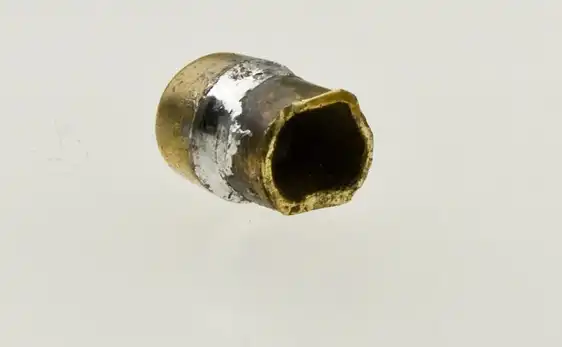
I found a nasty little bodge on the octave key pip. It had been resoldered (badly) - but the tube was pushed up around the base of the pip. This is a sign that someone's been rather careless with a dent bar down the horn...which usually means the octave pip tube has taken a pounding.
And yep, sure enough...
There were a whole heap of other faults too, such as a loose crook joint, undersized pads, over-thick pads, badly fitted springs, badly soldered fittings, offline bell and a 'setup' that surpassed the worst of any Ultra Cheap horn I've seen.
So it just goes to show....'just serviced' sometimes means diddly-squat.
But it's alright now...
Warms the heart, doesn't it? You can buy the horn, safe in the knowledge that when it arrives it'll good to go straight out of the box.
Well...
I've been working on a Martin tenor lately (for an unnamed celebrity client) - and it seems this horn had 'just been serviced'...to the tune of a couple of hundred quid's worth of work.
Now, that's not a lot in terms of vintage horn work - but it should be enough to cover some of the important bases...of which, on a Martin, are the toneholes.
First thing I noticed was a number of toneholes had visible solder remnants internally, and scruffy blobs around the outer perimeter of the bases. This is a sure-fire indication that a portion of the tonehole base has parted company with the body - but rather than remove the tonehole, clean the surfaces and resolder it in place, someone has attempted to fill the cracks in situ. This almost never works because you can never clean the surfaces sufficiently to allow the new solder to run.
And thus my standard test for leaky toneholes (drizzling lighter fluid around the joint) found three previously 'repaired' toneholes that were leaking.
The one shown below was a marginal pass, which is to say that it didn't appear to be leaking but was probably about two and half gigs away from failure - so I whipped it off as well (and I was right).
Plenty of wobbly action on this horn, little of which had been addressed. I opted for oversizing most of the rod screws to take up the wear and tear.
Few of the toneholes were level - and even fewer of the key cups were. Above is the top B key cup. The pad was leaking like a sieve. No surprises there - but what does surprise me is that anyone even attempted to seat a pad in this cup.
I found a nasty little bodge on the octave key pip. It had been resoldered (badly) - but the tube was pushed up around the base of the pip. This is a sign that someone's been rather careless with a dent bar down the horn...which usually means the octave pip tube has taken a pounding.
And yep, sure enough...
There were a whole heap of other faults too, such as a loose crook joint, undersized pads, over-thick pads, badly fitted springs, badly soldered fittings, offline bell and a 'setup' that surpassed the worst of any Ultra Cheap horn I've seen.
So it just goes to show....'just serviced' sometimes means diddly-squat.
But it's alright now...
Last edited:


