Saxophones Jumping jiving on Silver eggs: about materials

How to play a phrase expressively can be taught by modeling. In fact some of the most effective and efficient teaching in music is done non verbally. A fine conductor can teach the musicians in an orchestra the essence of the piece they are performing using only movements and facial expressions.

Always thought that conductors rehearsed the orchestra first which gave them time to explain their reading of the piece.
 
Demonstrating and modeling as a means of learning are as old as humanity itself. Think of how we all learn language, or dance, or sports or any number of skills and activities. I am speaking from empirical evidence gained in over 35 years of teaching students to play musical instruments. In my own experience, I grew up in a small town hundreds of miles away from the nearest University or saxophone teacher. Much of what I learned about playing the saxophone, I learned from listening to vinyl recordings of great players---both jazz and classical. Not one of them ever "described" what they were doing, nevertheless they gave me lessons and master classes each time I turned on their recordings.

that is what I am saying.

You have developed it yourself more than being taught that. Never mind.........communication among people appears to be difficult at times.:confused2:
 
Daveysaxboy wrote:
"After all that's what I enjoy the most, playing the horn."

I agree!

But I also like to know about how to make better saxes!

"Summary

In the past, musical instruments were developed over long periods of time by skilled craftsmen. Today, most instruments
are mass-produced. Design of musical instruments as mass-produced products requires using strategies
which make it easier to identify customer needs and develop exact specifications. To develop useful specifications
it is necessary to convert general descriptions into something which can be commonly understood and also be
interpretable in terms of acoustic metrics. In this study, methods for analysis and specification of steady state
parts of alto saxophone sounds were developed. Saxophonists’ use of verbal descriptions of saxophone sounds
was investigated. Sound stimuli were binaurally recorded. Judgements upon perceived qualities were made by
saxophonists and non-saxophonists using the method of verbal attribute magnitude estimation. Perceptual dimensions
were identified using principal component analysis of listening test data. Three prominent dimensions were
found and described using the verbal attributes: 1) warm/soft, 2) back vowel analogues and 3) sharp/rough. The
perceptual dimensions were modelled as linear functions of acoustic metrics. The results were validated through
listening tests with new subjects and new stimuli. Based on the findings, the method was seen as an approach
which can enhance the musical instrument design process."
("Modelling Perceptual Dimensions of Saxophone Sounds" by Arne Nykänen, Örjan Johansson, Jan Lundberg, Jan Berg (ACTA ACUSTICA UNITED WITH ACUSTICA)
 
But I also like to know about how to make better saxes!

Well, here is another issue.
It was actually sparked by Davey's purchase of the AS, and instrument that I tried and compared with my endorsee's.
Many comments on this website, indicate a preference for instruments (and often mouthpieces) I do not really like: nothing wrong about them, but it seems that while I am after warmth and flexibility (whatever this terms mean), many are after focus and "locked in" tuning (idem).

On mouthpieces again, I read a review of a mouthpiece I extensively tried, that lists my cons as pros. The lack of tonal flexibility is seen as consistency through the dynamic range.

An uncomfortable position, since I am supposed to sell saxophones.
My endorsee produces few different models to meet different kind of customers. The model I play, is hands up the best I can think of. Another model (booster) seems to go to a more pop-funk direction: more punchy and edgy. A third one, developed with a top classical player, is nice and polite.
Luckily he decided to produce (at least) three slightly different lines in a financially viable way; it also is a tiny production with some stages done personally by him, unthinkable in a larger company.
During my last visit I decided to select some instruments for the UK keeping in mind a "funkier" approach. I will let the classical guy selecting classical horns for me.

In the good old days, there were enough players to justify different sounding horns. Nowadays the mass production is necessarily in the Yanagisawa/Yamaha/MkVI direction. Some exceptions make me happy 🙂


 
"Summary
In the past, musical instruments were developed over long periods of time by skilled craftsmen. Today, most instruments
are mass-produced.

It is a common fallacy I think to equate mass production with lack of skill.

Mass production per se doesn't imply that skill or handcrafting isn't employed. All it means is that a possibly more efficient method of production is used, often using a production line as opposed to one person doing everything so that parts of the work requiring skill are done by a person with those skills, and other parts requiring no or less skill are done by people with no or less skill.

I've spoken to Ed Pillinger about the efficiency of making mouthpieces and he agrees that his method is not at all efficient.

In order to make mass production possible he would employ other people as in efficient production it makes no sense for a skilled person to be doing unskilled work, however he chooses not to because if all he ever did was the skilled part, ie the hand finishing, he would be very bored so he also does the relatively unskilled job of molding.

What this means in terms of saxophone manufacture is that you don't need a master instrument maker to solder a keyguard foot onto the body, the instrument would be just as good if its done by a robot or a Chinese lady in her front room (provided she knows how to solder).

However other jobs such fashioning the bell with a hammer, seating pads, checking key heights and alignments all requite differing skills.
 
It is a common fallacy I think to equate mass production with lack of skill......

Especially because it isn’t true that the saxophone was NOT in its heyday a mass produced instrument! It ALWAYS was!

There were more brands which massively produced more saxophones that are produced nowadays!

The Saxophone is a product of the industrial revolution and its development coincided exactly with the growth of mass production. It is ONLY the relative crisis of this instrument now that favoured the birth and growth of relatively small handcraft operation facility producing saxophones.

Whereas nowadays companies like Rampone & Cazzani produce a bit more than 5000 saxophones a year the same companies produced more than 10 times as much in the ’70 for example.

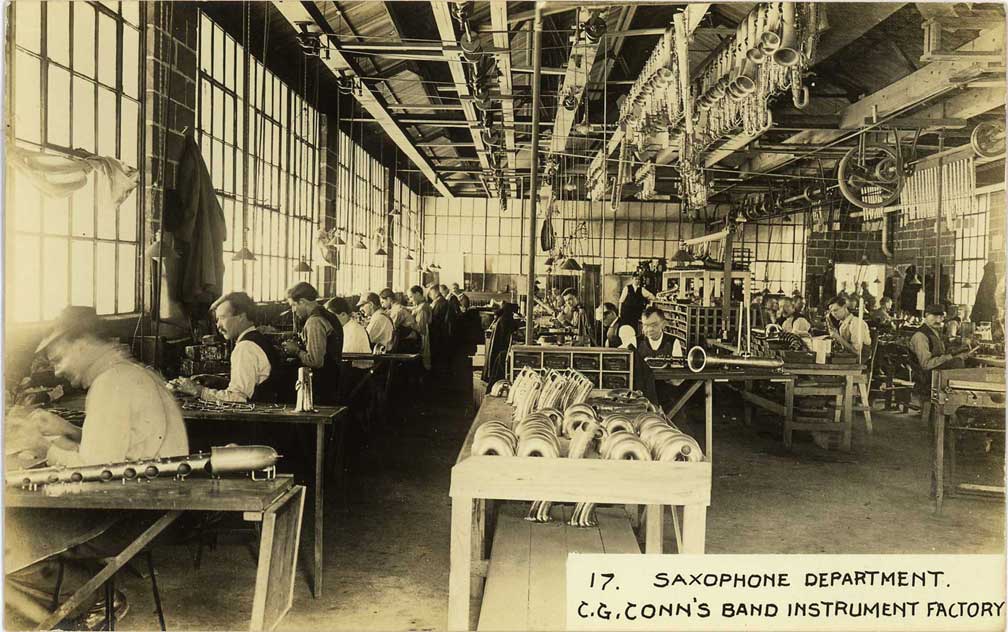
The picture shows the Conn factory. I can guarantee that that level of mass production common then is nowadays ONLY achieved in China!


See how similar production still is as it ever was!

CGConn-17.jpg


This is Buescher


AND this is Selmer TODAY


AND this are Antiguas made in CHINA

 
Last edited:
I can guarantee that that level of mass production common then is nowadays ONLY achieved in China!

I also expect many people think that Chinese saxophones are all machine made, whereas there is probably a lot more hand making of instruments there than other countries. Mainly because the one thing that is very cheap over there (currently) are human beings so provided that the production line is run efficiently (not wasting skilled workers on unskilled parts of the job) then the result can be (but not always as we know) good hand made instruments.
 
exactly! Labour and energy costs are typically the areas in which the Asian industry has an edge over other countries industries.

When I was the export manager of an Italian coffee company I was given the task to buy some plastic expresso disposable cups in China.

I looked far and wide and the cheapest disposable cups in the world were.........in Italy! ( There are some huge companies making plastic and paper cups there).

The price in China was higher because there was little demand and the price of the plastic was more or less the same and any energy price advantage was completely eaten up by the shipping costs.

The real difference would have been labour cost but in this petrochemical branch labour is a minimal part of the production cost.
 
This thread has taken a wonderful course and brought out some excellent information and ideas. From a repair tech's point of view a great deal of the quality inherent in manufactured instruments has to do with attention to detail, quality control, and finishing. Those who are turning out saxophones on an assembly line are under time constraints in order to make the largest profit they can. It is the time spent on the small details that makes a big difference in the quality of the finished product when there is a good design to begin with. Some manufacturers do better than others in this regard.

The factory that makes Cannonball saxophones in Taiwan is one of the best. Nevertheless, each saxophone before it is sent to a dealer is gone completely through by a team of specialists at Cannonball's Utah headquarter to check quality, and to adjust for any changes that occurred during shipping. Once each sax is checked and adjusted it is played by one of the professional level players to insure it is in excellent playing condition and to make further "acoustic adjustments" on the professional models.
 
The factory that makes Cannonball saxophones in Taiwan is one of the best. Nevertheless, each saxophone before it is sent to a dealer is gone completely through by a team of specialists at Cannonball's Utah headquarter to check quality, and to adjust for any changes that occurred during shipping. Once each sax is checked and adjusted it is played by one of the professional level players to insure it is in excellent playing condition and to make further "acoustic adjustments" on the professional models.

+1 for this. In my experience the attention to detail and quality of my Cannonball alto is second to none, and I'm lucky to own and previously owned some very special saxes. I checked out their sops recently and can say that my alto is not a one off. For soprano, I chose Yani for sop, but I was happy to sell my Yani A992 alto to buy the Cannonball alto.

They are also very robust. I'm ashamed to say I dropped it at a lesson not long after getting it. New teacher, a bit flustered, hadn't zipped my case and as I picked it up to leave the sax rolled out and hit the floor from about 2.5ft. Not a scratch, nothing moved, played perfectly. I was very fortunate but I'm not sure something not as well built would have been damaged. When I got it checked, just to be sure, the tech was impressed. I have carried it in my Hiscox case since. No more zips!
 
and yet would be so nice to see videos and pictures of both productions in Taiwan and in Utah especially to understand what is that the technicians in Utah know and do that the ones in Taiwan cannot achieve.
 
John said "" to check quality, and to adjust for any changes that occurred during shipping."

he didn`t say anything about Taiwan not being able to achieve anything , they`d do the same if the horn was made in the USA, there are always friday-nighters wherever things are made (yes even Yam and Yani) and when something is shipped all the way from Taiwan to the USA a full setup would be essential I`d think as would a severe checkover from sax.co when the things reach the UK fom the USA . .
 
Not necessarily anything more to set up on a Cannonball than on any other Taiwanese horn which is shipped, without any stop in between, to any distributor that then does the set up prior to selling, (by the way the environmental considerations might play a role here too).


In any case, if the logic is that shipping at a distance causes the need to set up, what about the horns shipped from Taiwan to Utah and then Shipped to Thailand? Do they need to be set up in Utah again?
 
Perhaps it's an additional level of quality control to protect their reputation. If stuff goes from Taiwan to distributor then any problems will bypass them until the retailer then distributor complain. It's one way to keep an eye on the standards upheld in the factory. Maybe that's why they deliberately keep production and advertising at a lower level.

I don't need to see production in either Taiwan or Utah to appreciate the quality.

Sax.co and others say that Yani is the only company whose saxes consistently play straight out of the box - from Japan. Perhaps Cannonball want that reputation too.
 

Social

New! Social Feeds

Look out for the navigation icon:

Follow CafeSaxophone

Latest Song of the Month

Trending

Forum statistics

Topics
32,084
Messages
578,923
Members
8,141
Latest member
Alisanna
Back
Top Bottom