



 (bottom of page)

Speaking of improvising with rhythm to communicate, have you ever thought about Morse Code? On a single note, rhythmic patterns were devised to represent letter, numbers and punctuation. In the days when Morse was used on the Great Lakes region of the uS, operators could recognise each other by their style, their "fist" as it was called, and there was a style called "Swing"!
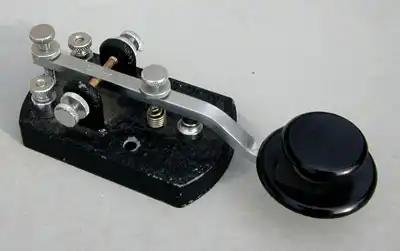
A great exercise to play is to use a track or a metronome and play on a single note. I sometimes play in Morse Code, since I learned it when I was 13 on a key like the one above. Here's achart of the symbols:
 www.electronics-notes.com
The length of a dash is approximately three dots. A dot is short staccato note. When you express it with a voice, it's said with "dit" and "dah" for dot and dash.
The letter 'U' is dit dit dah or . . _
Try playing with one or two letters, it's very musical. You can send secret messages on the sax. There was a Blood Sweat and Tears tune that had a line
dit dit dit, dir dit dit dit, dit dit, dah
That word would be * out on this forum.
A great exercise to play is to use a track or a metronome and play on a single note. I sometimes play in Morse Code, since I learned it when I was 13 on a key like the one above. Here's achart of the symbols:
Morse Code Chart: alphabet, numbers, characters, etc » Electronics Notes
A Morse code chart or table giving the Morse signals for the alphabet or letters, numbers, punctuation, accented letters and procedural signals.
The length of a dash is approximately three dots. A dot is short staccato note. When you express it with a voice, it's said with "dit" and "dah" for dot and dash.
The letter 'U' is dit dit dah or . . _
Try playing with one or two letters, it's very musical. You can send secret messages on the sax. There was a Blood Sweat and Tears tune that had a line
dit dit dit, dir dit dit dit, dit dit, dah
That word would be * out on this forum.


