

Playing the saxophone I'm not in the mood

Messages
144
Location
UK
I'm playing second alto in a big band, one of the pieces is in the mood. All should be simple enough.

I'm struggling with the main bit:
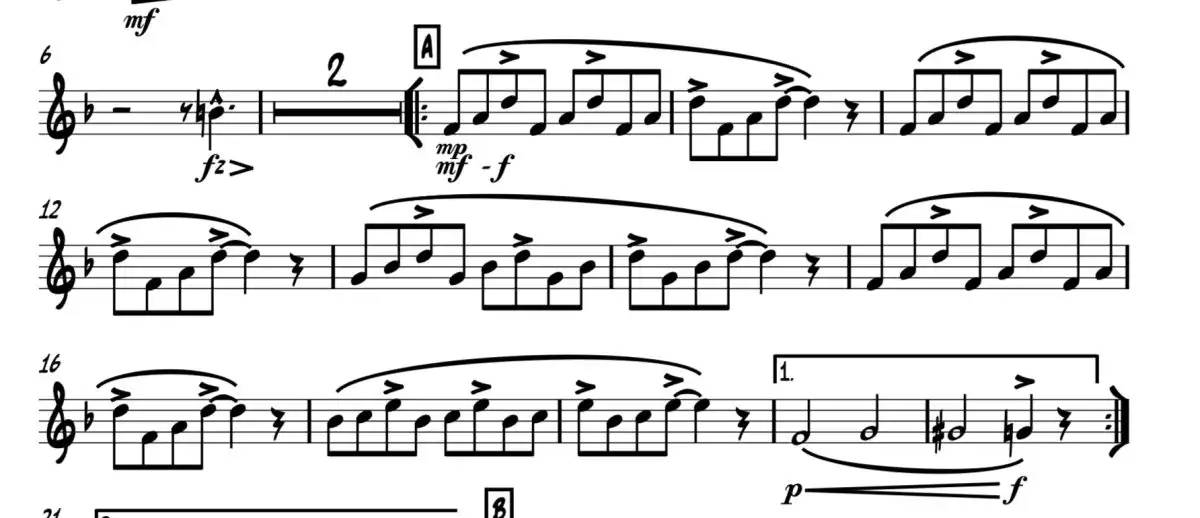
1701269357614.webp


We play it quite fast, and I can't play it cleanly even at slower tempos. The first part is the worse, slurring down from the D to F, it's glitchy and if I speed it up the F has a tendency to stay the octave up. I get in a horrible mess with my fingers falling over each other.

This has been on my music stand for longer than I care to mention. I've tried: Playing it really slow, slowly increasing tempo, practicing the hard transitions (D to F and back over and over), tried using the side key for D instead (awkward) and skipping the octave key and voicing the D up the octave. I'm still too slow and too messy.

Does anyone have any additional tips, or suggestions.

Thanks,

Richard
 
Solution
Play the D with the palm D and no octave key. If this pushes your hand too far out of position, either your hand position isn't right or you need to add a riser to that key (common).

Second four, play the Bb with bis.

Third four, you probably just have to flip fingers, but you might be able to make that E with the palm F (but probably will be too flat even at speed).
All good replies so far. More 'qualified' than I can give! As an amateur, I once rehearsed and performed this piece (on tenor sax) with my Big Band. So the key, notes and fingering positions are different on alto than on tenor. Still. I could well imagine playing this sheet music on tenor!

In my (humble, amateur) experience, learning to bridge 'intervals' (at speed) relies on 2 main things:
- learning to 'voice' the different notes (perhaps lowering your embouchure slightly to get from the D to the F and then tightening your embouchure again to get back to the higher notes; I fully realize that sax teachers emphasize the importance of maintaining a 'stable embouchure'. But my (amateur) experience is that I tend to adjust my embouchure depending on whether I'm playing lower or higher notes
- practice: quickly switching between D and F (voicing, embouchure)
 
Vote:
Upvote 1
Thing about this is that if you have the slightest leak on your slurring from D down to F is probably going to be impossible. One of my favourite warmups is something a flute teach got me doing, slurring up and down octaves which in some cases is even harder on flute as there is no octave mechanism as a "helper."

Note, that is what the octave key is, it's a helper not a switch as some beginners believe as in "I pressed/released the octave key and nothing happened.

Back on topic. In this case, if I was on 2nd alto (which I hate) I might give the F a subtle "kick" with my tongue. But to do this you have to have total control of very light tonguing.

Alternatively, knowing that the F is the least important harmony note of that chord I might ghost it or leave it out altogether. Nobody will notice as the main color of the chord will be supplied by the lead alto on the 3rd and 1st tenor on the 6th.
 
Vote:
Upvote 0
Thing about this is that if you have the slightest leak on your slurring from D down to F is probably going to be impossible. One of my favourite warmups is something a flute teach got me doing, slurring up and down octaves which in some cases is even harder on flute as there is no octave mechanism as a "helper."

Note, that is what the octave key is, it's a helper not a switch as some beginners believe as in "I pressed/released the octave key and nothing happened.

Back on topic. In this case, if I was on 2nd alto (which I hate) I might give the F a subtle "kick" with my tongue. But to do this you have to have total control of very light tonguing.

Alternatively, knowing that the F is the least important harmony note of that chord I might ghost it or leave it out altogether. Nobody will notice as the main color of the chord will be supplied by the lead alto on the 3rd and 1st tenor on the 6th.
The ghosting is probably better advice than mine on the tonguing, though the soft tongue flick is a good technique to learn. As my old friend Rico used to say “Duck is better than clam.” Try to keep the flow though. Remember you are serving the music - listen, blend, enjoy.
 
Vote:
Upvote 0
I find it interesting to accent the up beats, which sometimes seems contrary, but can be very effective for older jazz music of the Miller / Count Bassie / Artie Shaw and etc. era.

Being one who's been more of a hands on learner than say educated with a 4+ year college music degree, I may not always get the terms right. This is why I like the Café, because folks here are much more tolerant than some other forums I have attempted to participate in but got blasted for my " blatant ignorance".

The following is a cellphone audio clip by a church member who video'd me whilst playing at a church's banquet, 9 years ago. I downloaded the video they posted from their church's social media site. Yes as pointed out, to do the arpegiated notes, the only way to do it is to use alternate fingerings. At first one may feel a little fumble fingered, but by selecting the right alternate fingerings is the only way to do it successfully.

If one is struggling, this is normal, it seems counterintuitive. It takes getting used to, but over time, you'll master it. Then, you'll find yourself applying lessons learned to other pieces, increasing the agility of your fingers and enjoyment of play thereof.

 
Vote:
Upvote 0

Similar threads... or are they? Maybe not but they could be worth reading anyway 😀

Social

New! Social Feeds

Look out for the navigation icon:

Follow CafeSaxophone

Latest Song of the Month

Trending

Forum statistics

Topics
32,063
Messages
578,429
Members
8,129
Latest member
Bartman
Back
Top Bottom