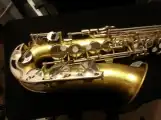
I think Martins need looking at individually. Generally they are goods but some are knackered or messed with so you can't judge by the model type. I have an Indiana and it is a great little alto. Ergos are fine for me. It lacks the adjustable thumbrest.
The student horns tend to have pivot screws rather than point screws i.e. the pivots screw have a cylindrical point which allows no adjustement of play in the mechanism. A point screw has a conical end which allows for play to be taken up.
Martin stencils tend to be a simplified version of the earlier Handcraft. The mechanism usually lacks those extra keys like the Eb or extra G# trill etc, which can make it a bit more reliable. I had a Martin stencil tenor which sounded great but it needed some posts fitting to stop the long keywork from flexing (C# also the RH C / Eb flexed). Also the LH thumbrest was a real pain - literally. I moved it and extended the octave key. Sounded great though.
So anyway, the earlier Martins sound great but I find them a bit tricky to play in tune over the range. The more modern ones are easier to play in tune. (But others are better at playing in tune than me!)
I'm not sure there's a great difference between a Comm I and II so far as keywork is concerned. Comm II are often though of as being better but any of the Martins with the bell keys on the same side tend to be good.
But, like we all say, you need to try them for yourself. A horn I like may feel like a lump of Lego in your hands. Ergos are a personal thing. The Martin I had sold to a lady with small hands who couldn't reach round the palm keys of a modern sax. The Martin suited her and she liked the sound so much more.
Intonation can vary with different players and mouthpeices. Some people can play in tune on anything. For me the older Handcrafts need that bit more work but they can have a nicer sound, so it all depends on what you're after.




 acebook
 (bottom of page)