Theory & Impro How to jazz (or not to jazz)

Pete Thomas

Admin
Cafe Moderator
Messages
23,582
Location
London
Level
Retired professional
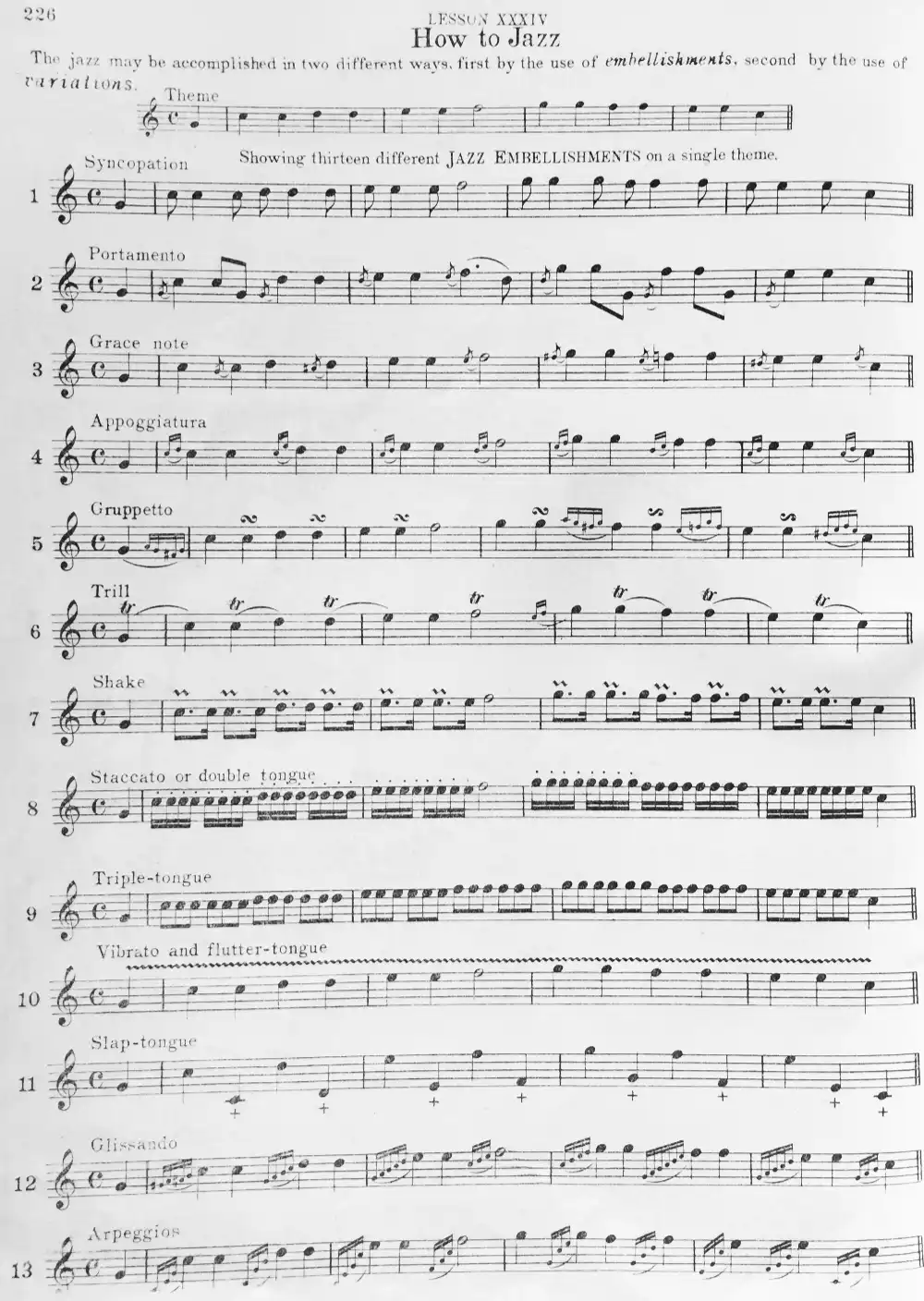
For those of you who may have forgotten

howtojazz1.webp
 
Great resource Pete and many thanks for this!

I play in an a very amateur Big Band. Our 'sheets' mostly fall into category 1 and occasionally into categories 2 or 3. FWIW, our main challenges in improvement are in:
- (collective) interpretation of 'timing' ('laid back/lazy vs 'driving') in version 1
- (collective) 'timing' of variations in versions 2 and 3.

With your permission, I'll post this overview to my Big Band MD and to other Band members.
 
FWIW, our amateur Big Band MD continually reminds us that to get a good 'jazz feel' (and sound), we need to get more used to - intuitively - stressing the 'afternotes' (or 'backbeat') rather than the notes 'on the beat'. Or making no distinction between the two. Most of our scores don't make this explicit. So - according to our MD - this is something we all need to practice. Both by listening to recordings and by playing at home. Until it becomes a habit that becomes 'automatic'.

One of the few scores we play that IMHO illustrates this is the excerpt below from Paul Murtha's arrangement of 'Black Orpheus'. The yellow highlights on the 'afterbeat' stresses are mine for this illustration.

Most Big Band members still find stressing the 'afterbeats' a big challenge and counter-intuitive compared to how they've always played. Yesterday, we decided to spend 10 minutes of each rehearsal just playing some simple exercises with the focus on stressing the 'afterbeat'.
Jaxz- mike 2.webp
 
There is a kind unwritten rule
stressing the 'afternotes' (or 'backbeat')
I have never heard of afternotes, but backbeat can be a bit confusing. In my experience the backbeat is the notes on 2 and 4 of e.g. a 4/4 bar as opposed to what you are showing =with the highlighted yellow accents.

ie the backbeat notes are 1/4 notes not 1/8 notes and they are on the beat, just not on beats 1 and 3. To put it another way this is where the snare drum beats go in rock and roll and some jazz/swing (other times it may be the pedalled hi hat marking the backbeat)

In your example I would say rather than backbeat these are accented "ands" of 1/8 notes . I'm not sure if there is a proper technical term for the 1/8th note "ands" of 1 and 2 and 3 and 4 and so I'll call them ands for now.

There isn't really a rule to emphasise the ands in general, but often they can be emphasised - sometimes by so-called "bebop" tonguing that can be used but not necessarily in bebop (and often is very very slight). With faster tempos it becomes less possible.

What your example does illustrate is that an "and" followed be a rest is extremely likely to be accented (almost a rule in this style I'd say). And likewise when another and follows immediately after the 1/8th rest, even when it's long

ie doodat and doodat dah
 
The "ands" aren't always accented. But when you have a series of 8th notes the last one (even if only two of them) is almost always short. I think, in your example of Black Orpheus, the yellow notes should be shortened rather than accented otherwise it will sound very lumpy. This will give good feel. There is a case for them being slightly pushed a bit, but accent, for me, is the wrong word.
Pete uses the word "doodat" - note the "t" is the clipped ending. It's rarely marked on parts, but interestingly the other 8ths are all marked full value and therefore legato tongued. Correct. The accent would be better written as a staccato dot as far as I'm concerned and the play decides whether to accent (and to what degree).

 

Social

New! Social Feeds

Look out for the navigation icon:

Follow CafeSaxophone

Latest Song of the Month

Trending

Forum statistics

Topics
32,045
Messages
577,836
Members
8,111
Latest member
Simonob
Back
Top Bottom