Saxophones Help identifying Conn Alto

Royston

Member
Messages
614
Location
Wirral, United Kingdom
Hi
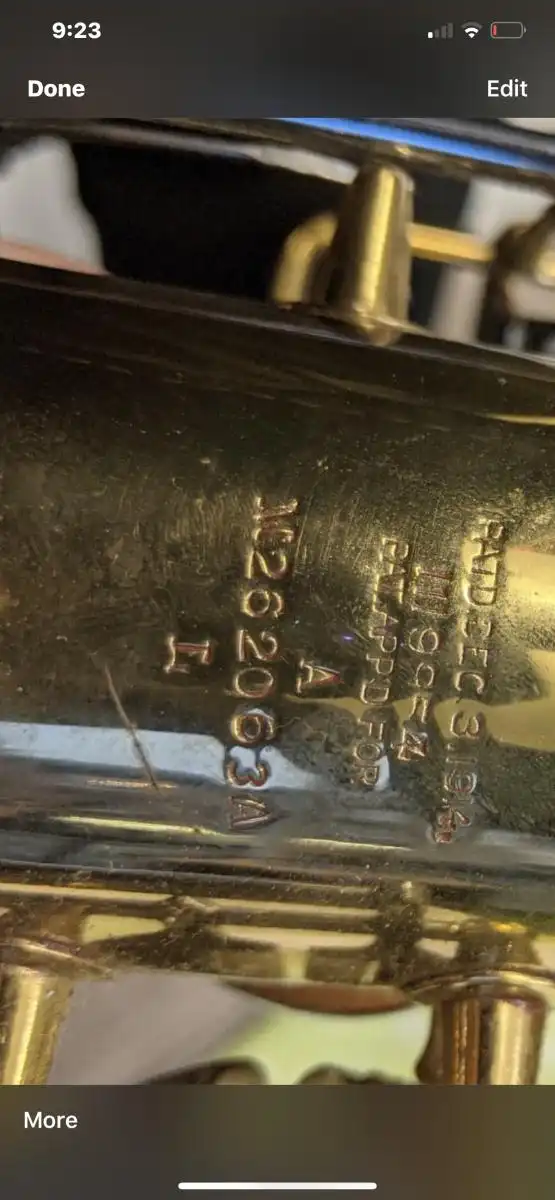
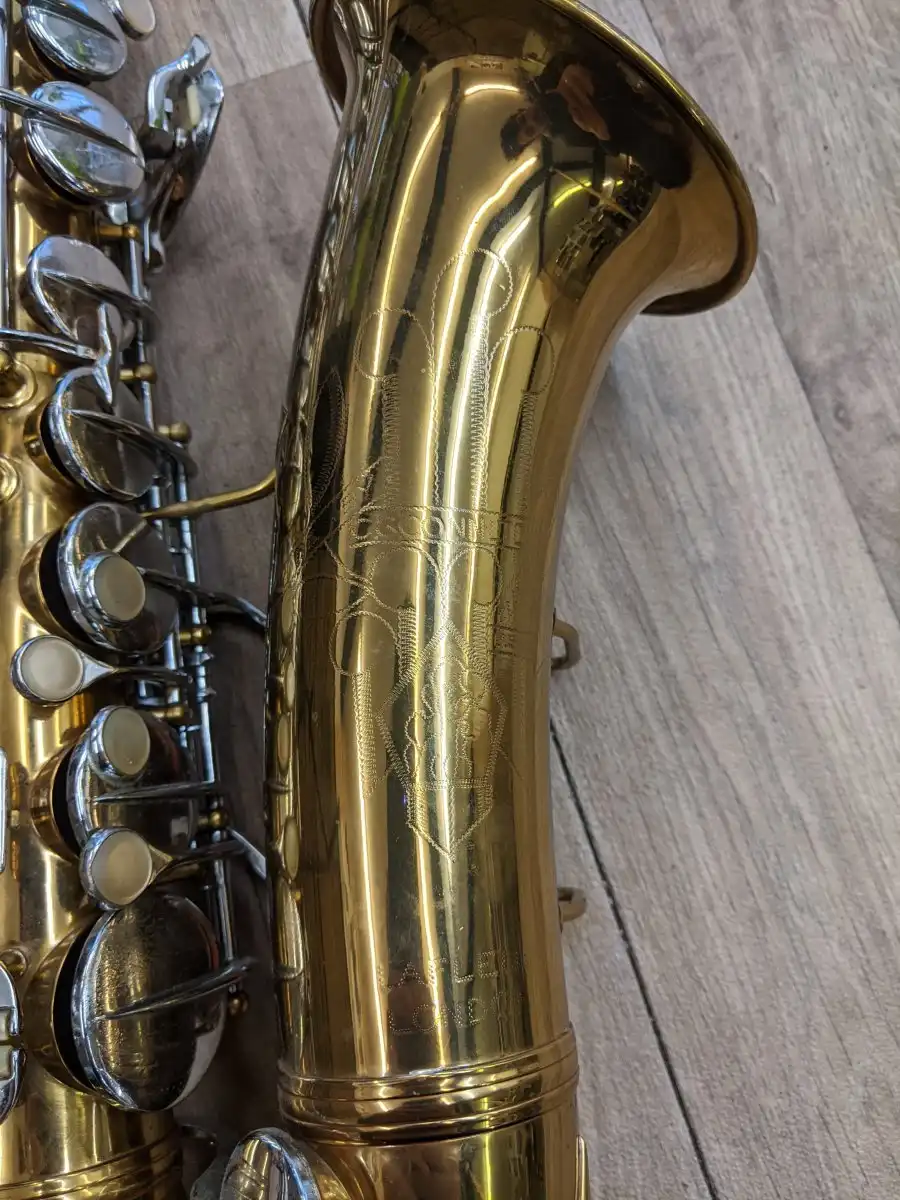
I’m looking at what appears to be a 6M C1934/5 which has the lady face engraving but also has LAFLEUR LONDON engraved on the bell. It is in gold with silver keywork. The neck also doesn’t have the microtuner.
D60E4EBB-8B33-4825-B1A9-F9E20DE494A7.png
11EF7878-6994-4F67-BF79-ECA320FA1D9F.jpeg
 
This is close to my personal favorite run of 6Ms in serial number (my fave year is 1932, with the New York neck -- no tuning barrel). I don't know what your question is. I can't really say much myself about other things, unrelated to your question, without better & more detailed photos.

Maybe post more photos and detail what your questions are? It could be within the "transitional" period, or not, depending on the features.

Thanks
Will try and post more photos. It was the “LAFLEUR” that threw me. Not heard or seen before.
 
Lafleur was a UK music shop that was taken over by Hawkes and Son early in the 20th century. The Lafleur name was used as a brand name by Hawkes, and then later by Boosey and Hawkes (after the merger) for imported stencil instruments. The Lafleur brand is best known for Boosey and Hawkes stencil East German instruments after the second world war, but it was used from the 1920's on.

If the serial number on your saxophone in a Conn serial number then this dates it to about 1934, so it is a Conn transitional or 6M that was imported into the UK and sold by Boosey and Hawkes of London, who engraved their Lafleur brand name on the bell.
 
Last edited:
Lafleur was a UK instrument seller which was taken over by Hawkes and Son early in the 20th century. The Lafleur name was used as a brand name by Hawkes, and then later by Boosey and Hawkes (after the merger) for imported stencil instruments. The Lafleur brand is best known for Boosey and Hawkes stencil East German instruments after the second world war, but it was used from the 20's on.

If the serial number on your saxophone in a Conn serial number then this dates it to about 1934, so it is a Conn transitional or 6M that was sold by Boosey and Hawkes in London.

Thanks Nigel
I was thinking along those lines myself. Thinking Stencil but then wouldn’t have C.G. Conn engraving and naked lady.
 
was thinking along those lines myself. Thinking Stencil but then wouldn’t have C.G. Conn engraving and naked lady.

Yes, I have a French-made Hawkes Lafleur soprano from the mid-1920's which is a proper stencil - it only has the Lafleur name. In this case they just seem to have added their name to a Conn-branded horn.
 
You might find this useful: Conn 6M “Transitional” Saxophones « Stohrer Music

Are you looking to buy it? If so, how much are they asking as I've seen another, 1932, also with LaFleur marking at £2,000 and a 1931 at £1,000, both trannys, both overhauled recently.

Me being me... I'd pay maybe £500 for one.

Here's the £2,000 one. Pretty in brushed and polished silver...


Last edited:
Awesome -- good to see some more pics. I wonder if the neck is original. Probably it is, some necks of that style were also produced later, I think. I can't remember right now. The later ones may have been single socket, though.

It's an authentic Conn with a "stencil" added, and probably it was refinished as far as nickel plated or even some other unexpected finish for the keywork. A closer photo of the left hand table would make this clearer to draw a conclusion about. The tables for this period are sharper at the edges of the touches than later tables, so if the edges look rounded off that is likely from machine buffing.

Should be a very nice alto, freeblowing, resonant, wide/warm/powerful core.

It will play best when the double-socket is closely and properly fitted. How that is done: 1) fit the body (male) tenon to the outer socket first, then 2) snug up the inner socket to the inside of the body tenon. It won't work in the opposite order, and just snugging up the outer socket will not produce the result that can be produced when you properly fit the inner socket to the inside of body tenon.

The double-socket was a cool design, because it plays better than single socket when the fit isn't very good, but it's a real pain in terms of upkeep for best performance, which you'll come to appreciate if you do get it fitted closely, because that fit will inevitably gradually deteriorate, and you have to disassemble (unless you have a very good assistant) to touch it back up.

You may find, when the neck is leaking, that the horn still plays well and feels good but your octaves are out of tune with each other.

 
I've had a few Conns with J.R. Lafleur engraved on them, usually as "imported by...JRL, with address" They would have been Conn's London or English Agents at the time. The crook may have had the tuner removed at some time - they can be a total pain when they get old and rusty inside. The sax has the typical '50's/'60's relacquer with the, to my eyes, awful nickel-plated keywork, but the engraving looks nice and crisp and the condition looks super, so rejoice - these are beautiful altos!
 
I don’t think the tuner has been removed in this case.
Often when you see one with the tuner removed it looks as if the local butcher has done it.
It was an option to have a 6m without the tuner. There are pictures of Charlie Parker playing one.

although it is always hard to tell from pictures, I also think it is a relacquer. But not overly buffed, which is good, but should be reflected in the purchase price.

Should be a great sounding sax.

Agree. Unlikely the tuner has been replaced. I have seen necks just like that one, and there is a really small chance that I saw that one. In my hand. Because I sold the one I had, which was just like it.

Many (all?) of the NY necks look like they may have had a barrel removed, because they have a step in them.
 

Similar threads... or are they? Maybe not but they could be worth reading anyway 😀

Social

New! Social Feeds

Look out for the navigation icon:

Follow CafeSaxophone

Latest Song of the Month

Trending

Forum statistics

Topics
32,084
Messages
578,939
Members
8,141
Latest member
Alisanna
Back
Top Bottom