Mouthpieces Counterfeits, knockoffs, etc.

Well, the sort of demographic I'd think about is more like; teenager, somewhere like South Korea or Singapore - consumer oriented with a wide income range, in bands / school bands, internet savvy but not internet wise... For all we know there are Influencers singing (well, playing) the praise of TW mouthpieces and offering, fully branded, bargains for kinds who can't quite afford the genuine pieces their richer mats have, or just believe they're getting a great deal.
Chance of them logging into Cafe Sax, zero. Chance of anyone here swimming in the same TikTok pool as them? Zero.
I think the demographic is much wider than South Korea or Singapore and includes the parents of said teenagers and plenty of others who think playing the saxophone would be a bit of fun as long as it doesn't cost too much.
 
I think the demographic is much wider than South Korea or Singapore and includes the parents of said teenagers and plenty of others who think playing the saxophone would be a bit of fun as long as it doesn't cost too much.
Sure. That's just examples. What the demographic isn't is anglophile butlletten boards populated by gentlefolk
 
In a way I can understand someone buying a fake Rolex, badged "Rolex", to show off but although a fake Yani 9937 looks all glitzy on the pages of AliExpress or DHGate its glitzyness won't perhaps cut it unless performing for deaf people or if the performer themselves can't tell the difference between £250 and £10,000.

I do find it amusing that most MkVI fakes have "Elkmart" and not Elkhart on the bell.

Serves branded fake buyers right when I message them and explain they can only keep, scrap, or return their horn.

Some are grateful and unaware, others have threatened to hurt me.
 
I find a bit of safety by purchasing mouthpieces through reputable sellers. They tend to be a bit more particular in what they sell, as they have a reputation to maintain. They may use store fronts such as Amazon, E-Bay, Reverb, etc. as well as their own websites. The Café classifieds is another place to look. The readers and mods here keep tabs to make sure sales items are legitimate.

And of course there is the professional brand, PPT, available here:

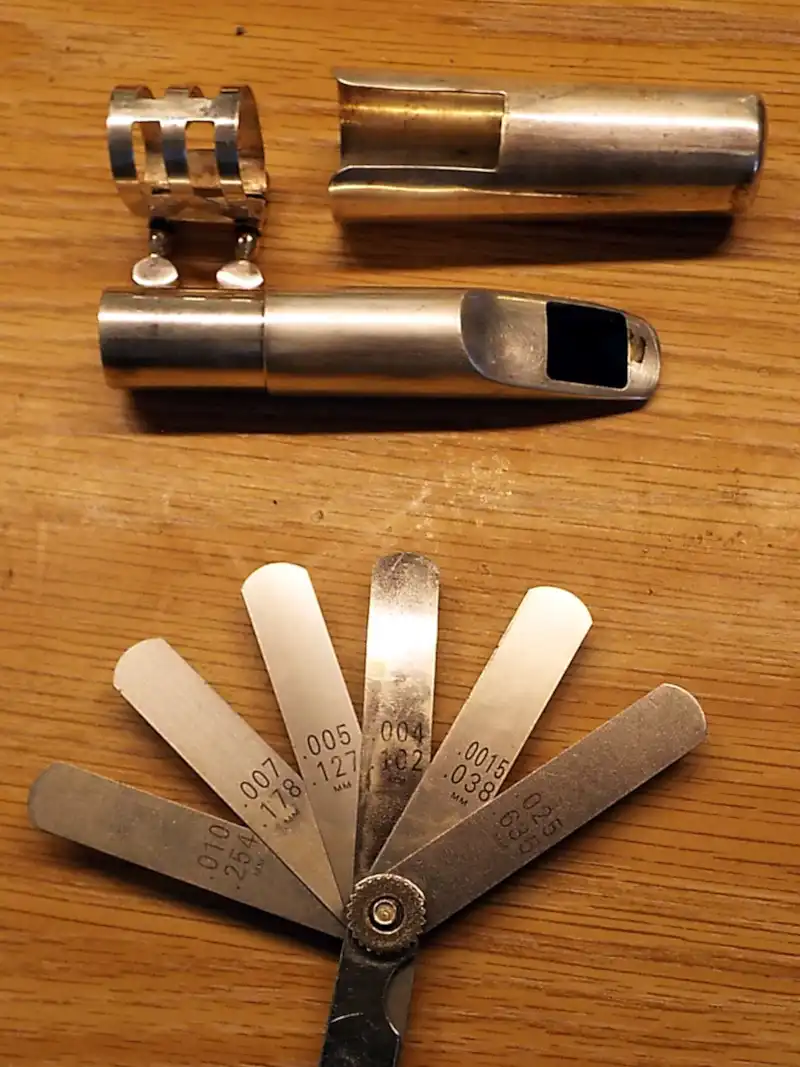
About 8 years ago, I purchased from an unknown seller, a tenor saxophone nickel plated brass metal mouthpiece on an Internet auction site. It did not mention any specifications, mentioned no name brands, was generic. I think I paid less than $35 for it shipping included. The seller had a store with musical instrument accessories from the Orient. Feedback comments seemed favourable, so I bought.

2025-10-18 Boquilla metal sax tenor2.webp

Unbranded tenor sax metal mouthpiece with feeler gauge elements combined for gap measurement.

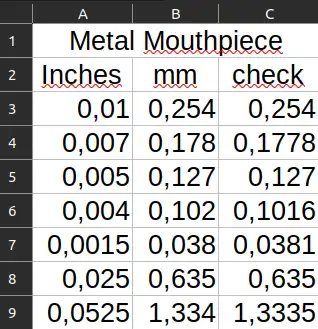
It played like a beginner mouthpiece. Using my feeler gauge set used for automotive work, I came up with the following measurements. (One stacks the gauge elements until just a very slight drag occurs when sliding under the tip similar to setting valve tappet clearances on an engine head):

2025-10-18 Boquilla metal sax tenor metros.webp


I came up with a tip measurement of 0.053 inch or 1.33 mm. A Yamaha 4C, a common beginner mouthpiece has a slightly greater gap of 0.066 in. (1.70mm). This verifies why it played like a beginner mouthpiece.

Shortly after using it a month or two, the nickel plating on it started to peel. I quickly retired it. It resembles the Berg Larson (BL) metal mouthpiece I used back in the 1970's, but certainly did not play like it.

I would have been better to not purchased it, but it was a lesson to me. Given its low price, it was not a great loss. I would have been more disappointed if I had say, paid over $100 for it and if it claimed to be a BL. Today, a metal BL with lig and cap can cost from $350 to $500 US. (I was going to add, someone may save a bit of quid by going to the PPT.) 😉

Thus having my senses sharpened from a "school of hard knocks" experience, resort to buying mouthpieces from proven reputable sources. Also I have learned that one can have a satisfying experience with less cost brand name alternatives.
 
I'm simply curious what goes through people's heads when they plop down their $$ and decide to support counterfeiters. If you have any ideas, please share.
Most buyers does not know that they are buying an illegal thing. Was Yani double arm on low C key legal or illegal? H,N, White patent (Super 20) and appear on Yani T-880 40 years later. Maybe they were allow to use it? Keilwerth had a neck close to "The Martin" combined neck (patent). I'm afraid we don't have the complete history ...... .
 
Last edited:
..... I am frankly astonished at how many people will rationalize stealing the intellectual property of others by buying counterfeit goods, just because "well, it works for me". I mean, pulling a gun on the liquor store clerk and walking away with the afternoon's receipts works well too, you get a bunch of money for very little effort...

Yup, that's what shocks me too. But then over the last 20 or so years we have noticed on all legal fronts--criminal as well as civil--¨the law doesn't apply to me" kind of thinking.

I am sure there are thesis, dissertations, and research papers published already in the fields of ethics, communications, sociology, neuroscience, crim, etc, that look at how things like the Internet, social media, et al are fraying the social fabric and changing the way we literally think, process info, and rationalize our decisions. I suspect it isn't pretty.
I guess some people don't care....

The Otto Link Tone edge as one example has been famously faked in it's desirable guises and unless you are really vigilant with a decent knowledge about the genuine product you can unwittingly fall for that one let alone consider buying something you believe to be fake.
....

BINGO! I think you are 100% on the money there.

But even being knowledgeable about the genuine product, even dealers can be dupped. I remember getting seeing all kinds of things in the shop that were so close to the original that I sent pics off to other dealers in my personal network of specialists for a :thumb: or not. Some fake products are simply that good.

What is a fake is a different question to why folks buy fakes, often turning a blind eye or even just taking it as read. I thought Helen was wondering the latter.
If so. It's interesting. There's a huge world of Commerce in fake luxury goods. I think some people just want to fool others into thinking they have genuine a Louis Gucci bag or it's an agreed, unspoken, lie. Others know that a lot of "fake" stuff is actually from the same factory as on-brand schmutter, but left from the back door.

These are worlds I have no interaction with other then trough reading - and I'm sure most people here are the same - so don't really know the mindset of the above.
But it is huge in some places and for many products; and I wouldn't be surprised if it applied to musical instruments.

Yes, I am indeed interested in WHY people buy this crap. What is the psychology/reasoning/thought process that makes people decide: I will spend $50 on a fake Dukoff, but not $500 on a real one. (Substitute any brand name & $ amount you want.) 😉
I’ve never bought a counterfeit and share your puzzlement. I think it generally comes down to greed or stupidity, perhaps both. Stupidity is the lesser of the two I think because greed comes from thinking you are buying from someone who doesn’t know the value of what they have and expect to turn a profit.

I remember someone selling sets of three rare Links for something like $1000 dollars; you bought them in threes. They would have been worth at least three times that if they were genuine. People bought them and they turned out to be decent mouthpieces but they were fake. So the buyers complained they had been cheated. Really, I strongly suspect, they thought they were buying from a sucker and would make a handsome profit selling them on. The likelihood of someone having such a large number is ridiculous but because they were priced within a believable margin they took people in. I have never had any sympathy for those people, they were out to sucker somebody and got suckered.

Other folks who knows; gullible, don't care, maybe just innocents, for which you can substitute ignorant if you like.
Interesting, and very sadly true. I hadn't thought of that side of it.
 
Yes, I am indeed interested in WHY people buy this crap.
I'm no insider, obviously. But consider the following:

Someone knows a foreman in the factory manufacturing Yamaha 6CMs And can arrange for a box of "wastage" every so often. Preferably before the branding has been etched.
These could be floged as no-name MPs for, let's say £20 Inc p&p. Lovely jubbly
Or they know someone with an etching machine who can etch TW on - and can now flog them for £100. Cushti
1/ They're not crap - no one here thinks Yamaha products are crap.
2/ the purchasers aren't idiots - they know they're getting a discount 6CM or such with a bonus branding that'll be fun in school band practice. After all, their mate got one with a squiggly V on it, from the same outfit and it was fine - and there are kids with rich parents getting ripped of by TW Inc. Or V plc or whatever.
2.b/ or someone buys it as part of their "mouthpiece journey" (see a million threads here) likes it fine, but it's missing whatever; stuffs it in a draw and moves on.

Maybe
 
100% No it isn't ..
( tho I don't know what the situation is in Americky of course)
If I was offered a MP cheap and it worked for me, couldn't care less what it says on it, if it's silly cheap then I'm obviously aware it's very likely not 'genuine' ..as long as I'm not knowingly trying to flog it on subsequently as the real thing there's no foul.
I'd agree with this, and I do not think if one knowingly purchases a counterfeit, aware it is counterfeit, it IS actually a crime, here (especially given the US is now a completely lawless state).

So I would not really be committing any skullduggery ...UNLESS I bought the fake, emblazoned with the brand name it was faking...THEN RESOLD IT, representing it as the ORIGINAL.

But if I knowingly purchased the counterfeit, because I liked how it performed, then after a while SOLD it but identified it as a counterfeit...morally, for me, nothing bad done there.

I DO realize that others have different litmus tests. A customer once buy-traded in a clearly fake, Chinese (?) Selmer, France alto on a horn purchase, I gave him $100 credit towards the purchase for it.

I DID discover, upon trying to re-sell it, that I had made an error PURELY FROM a horn dealer perspective. Although I clearly identified it as a fraud, and even stated "understand: despite the engraving, this is not a Selmer, it is a forgery"...I had my ads pulled down by a few platforms when I somewhat naively though I would have covered my bases by stating that.

Started a thread on that experience, git a lotta opinion but the majority was in agreement - I should not really do that even with the disclaimers I noted. I should have at least obliterated the engraving, or added an engraving which stated "counterfeit of", etc...

Also, and this was another really valid point - if you sell the fake to someone and you know its fake and they know it's fake...what is to stop them from taking that $25 mouthpiece or $150 sax and reselling it as original for $200-300 or $3000 ?
Once it is out of your hands, you have no leverage on that any longer. So, this is where the moral argument comes in: despite your (my) honest attempt to reveal it as fake, you (I) may have unwittingly supported conning someoneelse (or several people) down the line, thus you HAVE actually supported the counterfeit industry.

Moral of story - I am NOT gonna do that ever again.

MY suggestion to others - you gonna sell your fake link or fake Yani or Selmer to ANYONE but a close friend who would not turn it as the original ?....remove or alter out the engraving or printed logo.

 
I am frankly astonished at how many people will rationalize stealing the intellectual property of others by buying counterfeit goods, just because "well, it works for me". I mean, pulling a gun on the liquor store clerk and walking away with the afternoon's receipts works well too, you get a bunch of money for very little effort...
Initially, I do not see the two as (im)moral equivalents, though. And I GUARANTEE YOU MOST PEOPLE do not either, regardless of their culture.

Sticking up a bank, mugging someone - vs. buying a mouthpiece engraved Link which you know is not one, but you like how it plays ....(?)

Are those really "the same thing" ? Is one really as much of a trespass or succumbing to 'wrong' as the other ?

Superficially, given a quick thinking over, most folks would say "no", and some of their reasoning would certainly have a bit of foundation.

To me, again, the argument which won the day was the potential for reselling the object down the line...hard to come up with any solid rebuttal to that. You become part of the mechanism which keeps counterfeit sales afloat....oomph. No escaping that.
 
My thinking on this has evolved.

If the counterfeiters could only sell to people who knew THEY could never resell the product, then that would cut their sales a lot.

I believe that allowing a counterfeit product to be re-sold, EVEN with the fake name obliterated, means that the product is still marketable; thus the producer is not hindered in any way.

If everyone knew that counterfeits could only be destroyed by the first user, never sold on, then I think that would go a long way against counterfeiting goods. (I know, that is an extreme case, or fantasy, but that's how you evaluate these things, is to push the knob to the extreme.)

Let's not forget that lives have been lost due to counterfeit goods such as high risk fasteners and aircraft components. Again, the whole mentality of "it doesn't matter whether it is what it says it is, as long as the price is low" is fed by all such purchases of fake products.

Remember, "strait is the gate and narrow the way". Just don't buy this kind of thing.

Heck, when perfectly functional saxophones are available for something like $500, with non-counterfeit names on, and perfectly functional mouthpieces for $50, with non-counterfeit names on, it's not like the buyer of a fake is doing something wrong in order to feed their family or stop a mass murderer. The only motivation is to get something that you can pass off as something of greater value, without paying the cost you need to. I'm sorry, but it's just flat wrong.
 
...Yes, I am indeed interested in WHY people buy this crap.
One otherr thing to mention..is the obvious..SOME people ACTUALLY BELIEVE THAT THEY REALLY DID FIND A YAMAHA 62 on Alibaba for $499.

They actually did five minutes of research, discovered Yamaha, Yani, Jupiter, Selmer, whatever...is a really respected brand...then searched "buy", looked at the results, there eye was caught by the cheapest price...and they actually believed that in that moment the stars aligned and they got a $5000 sax for $500.

It's beyond baffling to conceive of this happening, but...it does...a lot, I would posit.

I have seen countless threads on the Evil Sax Forum of buyer remorse, asking "hey is this Yama/Yani/whatever...REAL ?"..after they plunked down the $ and have the horn.

Inconceivable to you and I, but.....
 
If everyone knew that counterfeits could only be destroyed by the first user, never sold on, then I think that would go a long way against counterfeiting goods. (I know, that is an extreme case, or fantasy, but that's how you evaluate these things, is to push the knob to the extreme.)
You think ? I guess I have no such faith in that, really. The countefieter will have gotten his/her ca-ching upon the initial sale of the item, so what do they care whether it gets melted down in 6 months afterward ?

Now, an argument supporting your premise might be: the reality that, I dunno, 70% these do get identified and destroyed quickly might make a CONSUMER purchasing a known fake think twice about doing that anymore....(?)
The point would be that purchasers are a lot less likely to buy a saxophone if they know it cannot ever be resold.

Of course, we're doing thought exercises here, but the purpose is to evaluate the validity of the statement "reselling counterfeit items, even with counterfeit marks obliterated, supports the counterfeit industry" and I believe this does so.

The real thing here is that we all understand it can be acceptable to commit a small crime to prevent a bigger one, or to maintain life. Thus the starving person steals bread. This is FAR from that. This is someone who wants something (a name) for nothing, not because they desperately need that fake saxophone to feed their family, but just because they WANT it and don't WANT to pay for it. Well, tough tookie! I WANT a 63 split window Corvette coupe in mint condition, but I don't WANT to pay for it; so I GO WITHOUT.
 
So I would not really be committing any skullduggery ...UNLESS I bought the fake, emblazoned with the brand name it was faking...THEN RESOLD IT, representing it as the ORIGINAL.
I would never advise to sell on even disclosing as a fake. Somewhere down the line later it's going to be resold without such a disclosure.
"reselling counterfeit items, even with counterfeit marks obliterated, supports the counterfeit industry" and I believe this does so.
I don't know about that. Provided it's completely and permanently obliterated it renders the object no longer a counterfeit, and whether it's then sold or not has no effect on the original counterfeiter.
 
I would never advise to sell on even disclosing as a fake. Somewhere down the line later it's going to be resold without such a disclosure.

I don't know about that. Provided it's completely and permanently obliterated it renders the object no longer a counterfeit, and whether it's then sold or not has no effect on the original counterfeiter.
Yes, it does. The existence of a secondary market means that people are more likely to buy the object - especially something like a saxophone where the ability to sell it on is expected.

Let's look at it another way. If you had a choice between buying a saxophone, from the original seller, and one of them would self-destruct if you sold it to anyone else, and the other one you could always expect to be able to resell it, for something at least, which one would you buy?

If no one would buy or sell counterfeit saxophones on the secondary market, their value on the primary market would drop, because people would not want to buy something they couldn't resell.

In the past I thought like you - if you obliterate the fake mark, so it's just "a saxophone, no name on", that this would be OK. But upon thinking about it more, I realized the secondary market does support the primary market.

How much does the hope to be able to resell the fake Selmer as a real Selmer weigh into the purchase decision of a fake Selmer? I don't know. I'm sure that's a greater incentive to the initial buye

At any rate, I am opposed to "letting it slide" when people come on here and either admit (always defensively) to having bought a fake, or when they ask opinions about doing it.
 

Social

New! Social Feeds

Look out for the navigation icon:

Follow CafeSaxophone

Latest Song of the Month

Trending

Forum statistics

Topics
32,051
Messages
577,975
Members
8,120
Latest member
lundalux
Back
Top Bottom