Tech/maintenance Better late than never...

There was a guy here in Athens that made a great job on a tortured Selmer Soloist using a polishing oil for smoking pipes mouthpieces!!!! or that's what he said.
He made it totally black! I was astonished.

I will try to locate him and ask him what it was.
The result was amazing....
Oils will work, but for the most part they just tend to fill the pores. After a while the oil disappears and you're back where you started. Unless he's come up with something different?
OF course, you can also use a polish to cut through the green...but tests I've done indicate that the material is more inclined to green up than fresh/new ebonite.
 
No. IPA works best at within a certain range of concentration (%). Off the top of my head I think it's 70-75% for IPA. Too weak is as ineffective as too strong. Much the same is true for ethanol, though with different percentages.
Can it just be watered down to 70%?

This is what I have: ISOPROPYL ALCOHOL BP MSDS Download - Sevron Safety Software

Would this be the right stuff, as I can't find the above: First Aid Antiseptic Rubbing Alcohol ISOPROPYL 70% IPA Isopropanol - 500ml: Amazon.co.uk: Health & Personal Care

Or please direct me to what you use?

Thanks again.
That's the right stuff.

Yes, it can be watered down - but you'd need to be reasonably accurate about it. Best just to buy the 70% stuff.
I generally get mine from Minerals-Water on ebay.
 
I beg to differ

OK, I was wrong.

80% ethanol or 75% IPA. It says minimum so I'm not convinced there is a maximum. However, the hand sanitizer formulas typically contain glycerine to make it jelly like so that I think would impose a max. amount of ethanol or isopropanol in the mix.
 
OK, I was wrong.

80% ethanol or 75% IPA. It says minimum so I'm not convinced there is a maximum. However, the hand sanitizer formulas typically contain glycerine to make it jelly like so that I think would impose a max. amount of ethanol or isopropanol in the mix.

Too low a percentage of ethanol/IPA and the virus just shrugs it off. Too high and its 'skin' hardens and protects it against the fluids. Just right and the magic happens.
This, at least, seems to be the current consensus.
 
I had a client give me a lovely Christmas present one year - a dozen little sampler bottles of whisky from around the world. As well as the usual Scottish drams there were samples from Japan, Finland...and even India. And it was all incredibly good.
At least until I went to the website to order a couple of full-sized bottles. Wasn't anything much less than £60.
I've been getting into whisky the last couple of years, attended a few tastings of our local whisky appreciation society. And in my experience, the whisky's that I like tend to be between 30 and 50 euro's. And I have tried some that were more expensive, but never bought anything over 60 euro's
I don't like peated whisky, don't like anything that tastes "smoked". Only exception to that rule is smoked salmon.
My favourite so far is Old Pulteney Navigator.
 
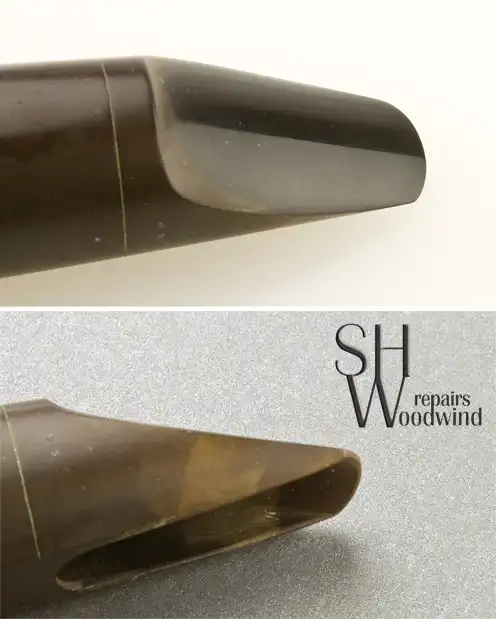
Here's an old unmarked tenor piece that's had 7 hours in Dettol.
There's some darkening, though it's not as evident on the beak as in the previous example. You can just about see the band if you squint. Shows up more clearly on the side though, where the ebonite hasn't been polished.

old tenor dettox 7 hours smaller.webp
 
And here's the result of the first ethanol test. I've used 96% strength to make it a tough test.
There IS some darkening, similar to what's been seen with the Dettol, but it's less evident. It also occurs immediately - but thereafter doesn't seem to get any worse.
And...it seems to rub off.

lafleur ethanol 17 hours smaller.webp


But this next shot is interesting.
I was mucking about with the old Selmer piece and breathed on it prior to giving it a wipe. I noticed that the condensation formed in bands - with the section treated only with Dettol showing up as a darker band.
I wiped the beak over with lighter fluid (in case there was some sort of oil contamination at work) but got exactly the same results when I breathed on the piece again.
Not sure what conclusions can be drawn from this, but it looks as though Dettol modifies the surface in some way.

breath test smaller.webp
 
Next result in - and this time it's the Selmer piece that's had 24 hours in the ethanol.
There was a faint band on it when it came out of the solvent but it rubbed right off when I was drying the piece.
No discolouration at all.

selmer ethanol 24 hours smaller.webp
 
Went for a tougher final test for the ethanol.
This is a Vandoren tenor piece - and the ebonite is at that stage where you get that acidic taste when you put it in your mouth. When it's in this state it'll go green at the drop of a hat, so I thought it would make a good candidate for testing.

vandoren multiple smaller.webp


For this test I dunked the piece in and pulled it out straightaway.
You can see that the post dunk shot (after the ethanol had been left to evaporate) shows a distinct dark line at the margin between the fluid and the air. There also seem to be a little bit of darkening towards the tip of the piece.
After wiping the beak the darker area has lightened, but you can still see a very faint line at the margin.
It's perhaps a little hard to see from the shots (you have to get the light just right) but I would say that there is some evidence of a very slight colour change. But then this is a particularly 'volatile' piece - and none of the other tests showed anything.

I have one more test to do - on some virgin ebonite. I've turned down a rod from stock - so it's as fresh as can be. I'll divide it up into sections and do a weekend soak test in all three solutions.
 
Re M/P cleaning I have recently been using white vinegar and cold/cool water for clarinet pieces. Often I acquire a variety with CL's I buy and they can be pretty tatty and mucky. Immerse fully in a jar of solution and a couple of hours later they appear to come up clean and colour intact. I then give a good rinse in warm mild soapy water. Also run a mouthpiece brush through so any remaining debris can be gently exhumed. I can see no reason why this will not work with sax pieces too? Dilution around 15% white vinegar to water. If you live in a hard water area it may help to use filtered water or even bottled water. I cannot imagine they have any germs remaining at all. But then I am applying educated guesswork. You can drink the IPA (Double Diamond or Watneys Red ?) while waiting.
 
Oh dear, you must be old too! I so covet :w00t: those days of slipping into a Watneys pub, trying to look older than my 16 years of age, then asking for a pint of Starlight or DD..........top gas appalling keg beer.....of course the piece de resistance......... a Party Seven...emergency holes in top with a screwdriver, beer everywhere. Still it was hard work to get drunk! The vinegar is "not for human consumption type" although whilst not cooking with it, I do not think it would kill you outright if you ingested!! Maybe the m/p in the Watneys? Closer to vinegr if the landlord neglected his beer pipes and cellar!
 
Oh dear, you must be old too! I so covet :w00t: those days of slipping into a Watneys pub, trying to look older than my 16 years of age, then asking for a pint of Starlight or DD..........top gas appalling keg beer.....of course the piece de resistance......... a Party Seven...emergency holes in top with a screwdriver, beer everywhere.
I fear so.
The experiences you describe are all too familiar.
 

Social

New! Social Feeds

Look out for the navigation icon:

Follow CafeSaxophone

Latest Song of the Month

Trending

Forum statistics

Topics
32,082
Messages
578,825
Members
8,139
Latest member
Gary Boudreau2
Back
Top Bottom