



 acebook
 (bottom of page)


jrintaha
Member
- Messages
- 278
- Location
- Helsinki, Finland
Good beef jerky is probably the best thing in the world after single malt scotch and saxophones. However, at least in this part of the world, it is also terribly expensive, and most of the pre-packaged varieties are rather dull in flavour. Every now and then I buy a big chunk of meat and go through the rather labour-intensive process of turning it into dried strips of goodness. I vary the recipe every time, but this is roughly how I prepared it last week.
You will need something like:
1 kg of lean beef (round / rump is good, doesn't matter if it's a bit tough)
1 - 1½ dl of soy sauce
Some salt
1-3 tbsp black pepper, preferrably freshly ground
2-4 cloves of garlic
A pinch of dried rosemary
As many chillies / as much chilli sauce as you can tolerate
½ dl of freshly squeezed pineapple (or other sweet and acidic fruit) juice
A dash of vinegar or red wine
...and a bit of onion juice if you like
Start by cutting the meat into relatively thin slices, and you can pound them even thinner if you like. Try to cut away the biggest pieces of ligaments and fat, they go rancid relatively quickly and don't taste good when cured. Slicing the meat is easier if you put it in the freezer for an hour or so, so it gets a bit stiffer. Then cut the slices into roughly inch-wide strips and put aside.
Either use a garlic press or a knife and some elbow grease to get the garlic (and possibly chillies) as fine as you can. Mix with the rest of the ingredients to make the marinade.
The marinade has to be salty. I mean real salty. Depending on the amount of other liquids there are in the marinade besides the soy sauce, you will have to add more salt. Try to keep the marinade about as salty as the soy sauce is (~15% of weight).
For the end product, you're shooting for around 3% of salt, so if you've got around 2 dl ~ 200g of marinade for a kilogram of meat, your marinade has to contain around 35 grams of salt, which for 2 dl would be 17.5% of its weight. Of course, if you think beef jerky is usually too salty for your taste, you can use less salt. The curing itself will preserve the meat, it does not have to be thoroughly salted.
You'll notice there'll be quite a bit of ground black pepper floating around, and it's all good. Don't go overboard with the rosemary, better to use too little than too much. About the chillies, the marinade should ideally be so hot you can barely tolerate tasting it. There's very little fat in the meat and little to no fat in the marinade, and capsaicin, the chemical that makes the chillies feel hot, is not soluble in water, so most of the perceived hotness will not seep into the meat. (Capsaicin is soluble in alcohol, so if you use wine, you'll probably need less chillies.)
Put the meat strips and marinade in a plastic bag and let marinate in the fridge for 24 hours. When you take them out, you'll notice the meat goes quite dark, and if you used pineapple juice, the surface has become smoother and slightly glistening. The enzymes in the soy sauce and pineapple juice are working on the proteins in the meat.
Take an oven tray, put it at the bottom of your oven, and put baking paper or tin foil on it, in case you don't want to scrub your oven afterwards. Then start laying out the strips of meat on oven racks. Set the racks as high as you can. Don't let the strips of meat overlap each other.
If you have a convection oven, great; it makes the curing so much faster. Just turn on the fan and leave the oven door completely open. Assuming the humidity in your kitchen is reasonable, you don't need to use any heat at all.
If you have a conventional oven, put bottom heat on minimum. Don't heat from the top! Wedge the door ajar with something. You want to cure the meat, not cook it - the heat is there just to make the air move faster. If you have a tabletop fan, you can use that to help too.
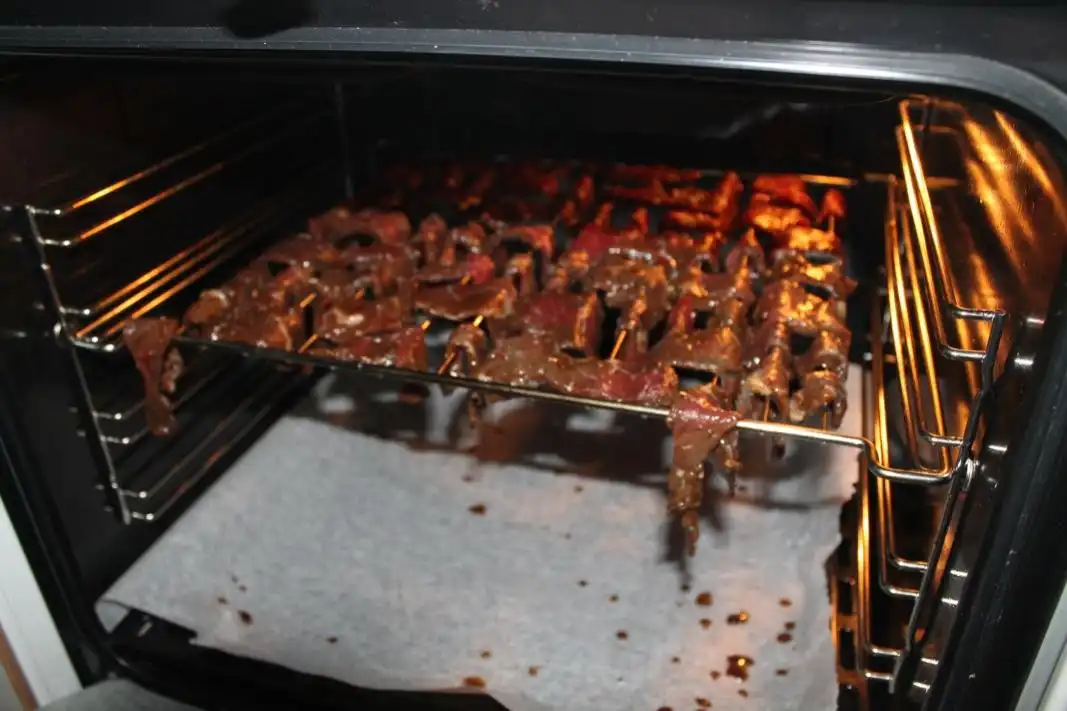
Here is a picture of the meat strips hung on the oven rack.
The time it takes for the meat to cure varies greatly. A convection oven is very fast. A regular oven in a humid atmosphere is not. Since it was raining non-stop here, I left the meat to cure in the oven overnight. After the meat looks cured on the top side, you need to flip each and every one of them over, so the part that was contacting the oven rack is cured as well.
After they're done, you can store them in plastic bags, either in the fridge or in the cupboard, but if you put them in the fridge, be sure not to tie or otherwise close the bag, because otherwise condensed water will cause your jerky to rot in a matter of days or weeks. I am not sure how long they will keep, because I've never managed not to eat all of them within a week or two.
Time to put on your war face and start digging through your delicious beef jerky! And if you used as much chilli as I did, it's time to put on your war face again when you go to the loo roughly eight hours afterwards.
You will need something like:
1 kg of lean beef (round / rump is good, doesn't matter if it's a bit tough)
1 - 1½ dl of soy sauce
Some salt
1-3 tbsp black pepper, preferrably freshly ground
2-4 cloves of garlic
A pinch of dried rosemary
As many chillies / as much chilli sauce as you can tolerate
½ dl of freshly squeezed pineapple (or other sweet and acidic fruit) juice
A dash of vinegar or red wine
...and a bit of onion juice if you like
Start by cutting the meat into relatively thin slices, and you can pound them even thinner if you like. Try to cut away the biggest pieces of ligaments and fat, they go rancid relatively quickly and don't taste good when cured. Slicing the meat is easier if you put it in the freezer for an hour or so, so it gets a bit stiffer. Then cut the slices into roughly inch-wide strips and put aside.
Either use a garlic press or a knife and some elbow grease to get the garlic (and possibly chillies) as fine as you can. Mix with the rest of the ingredients to make the marinade.
The marinade has to be salty. I mean real salty. Depending on the amount of other liquids there are in the marinade besides the soy sauce, you will have to add more salt. Try to keep the marinade about as salty as the soy sauce is (~15% of weight).
For the end product, you're shooting for around 3% of salt, so if you've got around 2 dl ~ 200g of marinade for a kilogram of meat, your marinade has to contain around 35 grams of salt, which for 2 dl would be 17.5% of its weight. Of course, if you think beef jerky is usually too salty for your taste, you can use less salt. The curing itself will preserve the meat, it does not have to be thoroughly salted.
You'll notice there'll be quite a bit of ground black pepper floating around, and it's all good. Don't go overboard with the rosemary, better to use too little than too much. About the chillies, the marinade should ideally be so hot you can barely tolerate tasting it. There's very little fat in the meat and little to no fat in the marinade, and capsaicin, the chemical that makes the chillies feel hot, is not soluble in water, so most of the perceived hotness will not seep into the meat. (Capsaicin is soluble in alcohol, so if you use wine, you'll probably need less chillies.)
Put the meat strips and marinade in a plastic bag and let marinate in the fridge for 24 hours. When you take them out, you'll notice the meat goes quite dark, and if you used pineapple juice, the surface has become smoother and slightly glistening. The enzymes in the soy sauce and pineapple juice are working on the proteins in the meat.
Take an oven tray, put it at the bottom of your oven, and put baking paper or tin foil on it, in case you don't want to scrub your oven afterwards. Then start laying out the strips of meat on oven racks. Set the racks as high as you can. Don't let the strips of meat overlap each other.
If you have a convection oven, great; it makes the curing so much faster. Just turn on the fan and leave the oven door completely open. Assuming the humidity in your kitchen is reasonable, you don't need to use any heat at all.
If you have a conventional oven, put bottom heat on minimum. Don't heat from the top! Wedge the door ajar with something. You want to cure the meat, not cook it - the heat is there just to make the air move faster. If you have a tabletop fan, you can use that to help too.
Here is a picture of the meat strips hung on the oven rack.
The time it takes for the meat to cure varies greatly. A convection oven is very fast. A regular oven in a humid atmosphere is not. Since it was raining non-stop here, I left the meat to cure in the oven overnight. After the meat looks cured on the top side, you need to flip each and every one of them over, so the part that was contacting the oven rack is cured as well.
After they're done, you can store them in plastic bags, either in the fridge or in the cupboard, but if you put them in the fridge, be sure not to tie or otherwise close the bag, because otherwise condensed water will cause your jerky to rot in a matter of days or weeks. I am not sure how long they will keep, because I've never managed not to eat all of them within a week or two.
Time to put on your war face and start digging through your delicious beef jerky! And if you used as much chilli as I did, it's time to put on your war face again when you go to the loo roughly eight hours afterwards.


