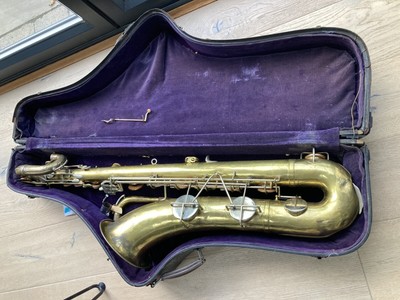
Miscellaneous Advice on a The Martin Baritone

Tania

Member
Messages
10
Location
London
Hi everyone,

I'm looking for a little bit of advice here.

For some time I have been hankering after a "The Martin Baritone".
I have the option of buying one in pretty good condition (a 1957 horn). By the time I've arranged for a courier and paid the import charges the cost to me would be around £1,800 - £1,900. My question really is would this model horn in good condition be worth the best part of £2,000?

Thanks all for your time and expertise.
 
The Martin Bari+ mport charges = £ 1900.00?

I'm a Martin man. The Martin Baritone is good baris. They can be a little bit "swaying" in the upper register But the low tones are nearly as good as an old Conn 12M Artist. I had provlems to find a good mouthpiece to my bari. The Dukoff D9 was good in low and mid register, But didn't sing so well in the upper register. The mpc I'm playing nowadays is better. But still best for Low Ride(s). I like my Martin bari. Good luck.
 
Spotted this earlier. Could be an easy fix?:

 
I pretty much echo the comments of the above gentlemen.

They are good vintage Baritones (I have refurbished four). Sound is really good. I find the ergos to be fine (some folks say they do not like the pinky tables of III's, I have no problem with them but honestly, I prefer the Martin tables on the Handcrafts, I's and II's...there's just more surface area on those).

I am sure you (@Tania) realize there is no alt F# key, as III's didn't have them....if that matters. (oops, Pete mentioned that above already).

One thing which did ...I won't say 'disappoint' ....but 'surprise' me.....is that the horn does require some proper mouthpiece matching. A number of common mouthpieces do not match well with it at all (same of course can be said for the 12M or Bueschers) and I was hoping that the III would be less mouthpiece-finicky than a 12M or the Handcrafts or I's....but it isn't. You need a good mouthpiece match. III Altos and Tenors are great, intonation-wise, I was expecting the Baritone to exhibit the same attribute.....it isn't bad, just again can be bad with the wrong mouthpiece (and there are a fair number of wrong mouthpieces for it).

For the price you note, the seller should absolutely guarantee the horn will arrive to you in good playing shape, no servicing required. If seller will not do this....it is priced too high.

You write "in pretty good condition". Have the seller specify. Because this could mean "yes, it plays, but....", it could also mean "plays well but there's some typical body damage you find on old baritones"...

Both of those sorta descriptions are innocuous-sounding enough. I would also bet my wallet both of those sorta descriptions would mean the horn needs £300-400 of work once you get it.
For that price, it should be CLEAN, pads GOOD, horn speaking UP & DOWN all registers no problem, and no significant body damage (particularly: no significant dents to upper bow/crook....no sign of any bellbrace impaction into tube or bell....no significant dents along the body tube....and no sign of any damage/pulldown to neck.
Dings all over the place? Some mild to moderate denting to bow or bellpiece ? Some resoldered feet or guards ? A lotta lacq wear ? Those are not big issues...but significant dents, crook twists, impactions...those are).


Best of luck in your decision !

 
Last edited:
My first baritone was a "The Martin" from the late 50s and the sound was wonderful. I played it with a Brilhart Level Air metal mouthpiece (older one before the design was changed) that matched superbly. I played it back-to-back with a friend's Conn 12M and would say there was nothing to choose between those two vintage American horns.

The sound was rich and big, the ergonomics were fine but the well-known tuning issues affecting E2 and F2 were annoying. Those notes on The Martin were noticeably sharp, but I mainly sorted that out with crescents in the relevant tone holes.

I sold it after I got a Selmer Serie II baritone, but still regret letting my The Martin go.

In answer to your question I would say that it could/should be worth £2k, provided that:
  • You don't need the low A
  • You can find a mouthpiece that matches it well
  • You are aware of the tuning issues and can overcome them
  • It really is in reasonably good condition (lots of older baritones have had hard lives)

Pete is right about the RH F# trill key being absent, but that didn't worry me.

Rhys
 
Hi Tania : I've had plenty of baris over the years and watched the prices go higher and higher...
Two grand ? I'd say it is borderline dependant on condition ; you've gone from pretty good to good if I'm reading correctly ? Some shots would really help and a rundown of exactly what needs doing . Also a courier for a bari is never a good idea unless it is packed expertly !! They may be big but they do damage easily ; be careful....Yeah ; can you get some shots ?
 
A Martin (Comm I) bari. Sold nickel silver keys. But need lots of works. I think our CS leader is playing a Comm I bari as well.
I actually like how these FEEL at the table compared to the III. However, no Front F, and the available space to add one, and the way the upper stack barrels are designed... makes adding one a slightly trickier proposition than on some other vintage baris.
Also, they are quite mouthpiece picky.
I still like 'em, but....
 
I had one, I actually preferred my previous Handcraft and 12M.

Also bear in mind it has no alternative RH F# (trill) key
I sported a Handcraft bari for many years, and always felt it was more responsive than a 'The Martin' - but it didn't look quite as cool.
 
I actually like how these FEEL at the table compared to the III. However, no Front F, and the available space to add one, and the way the upper stack barrels are designed... makes adding one a slightly trickier proposition than on some other vintage baris.
Also, they are quite mouthpiece picky.
I still like 'em, but....
I've never tried/played a Comm I bari. But it looks as the bell is a little bit thinner than Comm III. And Comm I have a side alt F# key!!! Not on Comm III. They didn't make Comm II baris. If it follow the Comm I and II tradition the neck should be a little bit longer on Comm III baris. Harder to find mouthpieces to Comm I and II compared to Comm III.
 
Bari 1.webp
Bari 2.webp
 

Social

New! Social Feeds

Look out for the navigation icon:

Follow CafeSaxophone

Latest Song of the Month

Trending

Forum statistics

Topics
32,072
Messages
578,577
Members
8,133
Latest member
walthang
Back
Top Bottom