

Tech/maintenance A new way to see a saxophone - the missing cone

jbtsax

R.I.P. in memoriam 1947 - 2023
Messages
8,985
Location
Beautiful Springville, Utah USA
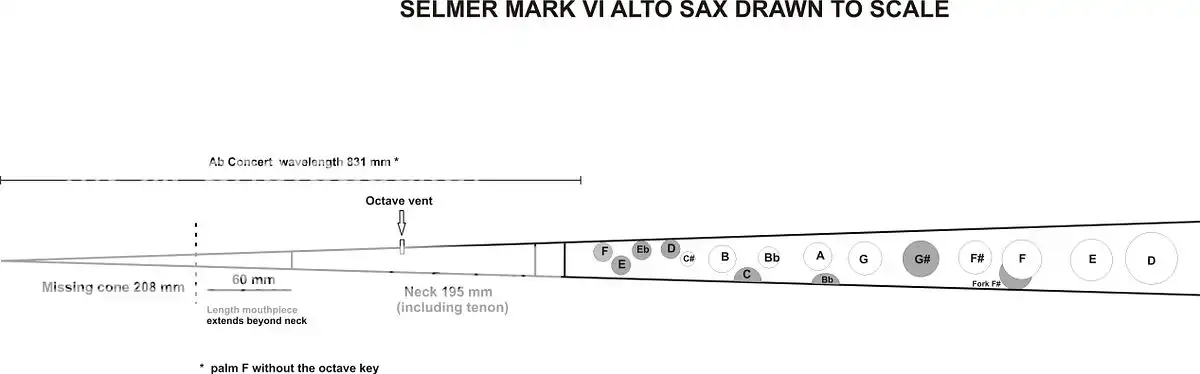
Notice how the wavelength for the note Ab concert behaves as if it begins at the apex of the "imaginary" missing cone. What a cool instrument we play. The "missing cone" is also longer than the neck itself.
missing-cone.webp
 
Last edited by a moderator:
It is fascinating how the saxophone's notes wavelengths can behave as if they started at the point of the "imaginary missing cone". It has to do with the fact that the reed when it is "beating" (opening and closing the end of the mouthpiece) is not open 50% of the time and closed 50% of the time as it is on the clarinet. On a saxophone the open part of the reed's oscillation is longer than the closed portion. In fact the closed portion is equal to the time it would take the sound wave to travel from the end of the neck to the apex of the missing cone and back. Since the wavelength is a function of the speed of sound and time, this is how the wavelength of notes can seem to reach the tip of the missing cone and return.
 
I tried to fathom this then asked by husband to explain it. I still think a missing cone is something to do with ice cream. Walks away blushing ...
 
I tried to fathom this then asked by husband to explain it. I still think a missing cone is something to do with ice cream. Walks away blushing ...

A sax behaves musically as if it's a cone. A very long cone. However such a long cone is impractical, and too narrow to get any useful amount of air (vibrations really) into it. Some clever person a few years back discovered that if he cut the sharp end off the cone and replaced it with a mouthpiece from a clarinet, it would play in tune if the air volume inside the mouthpiece was the same as the air volume in the cut off cone. That was of course Antoine-Joseph "Adolphe" Sax...
 
It is important to remember that Antoine Joseph was also very expert at designing and making conical brass instruments, and he was also very familiar with the "ophicleide" which was a large conical bore keyed bugle. Some speculate that he first experimented with putting a large bass clarinet type mouthpiece on an ophicleide and went from there. The first prototype saxophones were very large and then he continued making them progressively smaller and more refined.
 
It all revolves around the Bernoulli principle, air pressure, creation of a standing wave, and altering the standing wave length. The Bernoulli principle explained by blowing between two sheets of paper is a fun way to show children how the principles work. If anyone here really wants to know the physics behind how saxophones work, I studied music at university and would be happy to copy my notes on this (yawn) amazingly fascinating stuff that really had me riveted to my seat. Actually it was fun to study. So if you want it, let me know. Not at home for a couple of weeks, but all my books are at hand when I get there.
 
Please excuse my tardiness in being so late with the promised info. Lost my old mum not long after I posted here last.
Anyway I scanned the main points of standing wave creation and created a pdf file. I have no idea how to upload it here so I just uploaded it to a share site.
http://rapidshare.com/share/F88A0B14372858F2838D4C9A1CF5E727
It is just over 8Mb in size and 9 pages long. Just the basics, and it assumes you know a little about waves and air pressure, school stuff.
 
Great information. Thanks for sharing. "RapidShare" however is a bit of an exaggeration. It took over 10 minutes to open that pdf file! I like how the information is given in clear, easy to understand fashion for those with no acoustics background.

Surely the laws of physics regarding standing waves applies to all wave theories?

Just don't ask me, I'm a state registered idiot.
 

Similar threads... or are they? Maybe not but they could be worth reading anyway 😀

Social

New! Social Feeds

Look out for the navigation icon:

Follow CafeSaxophone

Latest Song of the Month

Trending

Forum statistics

Topics
32,056
Messages
578,183
Members
8,127
Latest member
PJ2116
Back
Top Bottom