

Tech/maintenance YAS 280 (lever support cushion/material)

daski

New Member
Messages
3
Hi, just a quick one. I was cleaning my sax and there was like sort of maybe material (looks like tissue) around lever on sort of support bolt (can't find a proper name for it) which I removed thinking it is a piece of cloth or something that was left on it after cleaning. There is still bit left and I looked at the other one and apparently something is there as well. I am struggling to find it on any photos on internet for this sax and wondering if lack of it will cause any ratling or anything. Please see photo below. Thanks
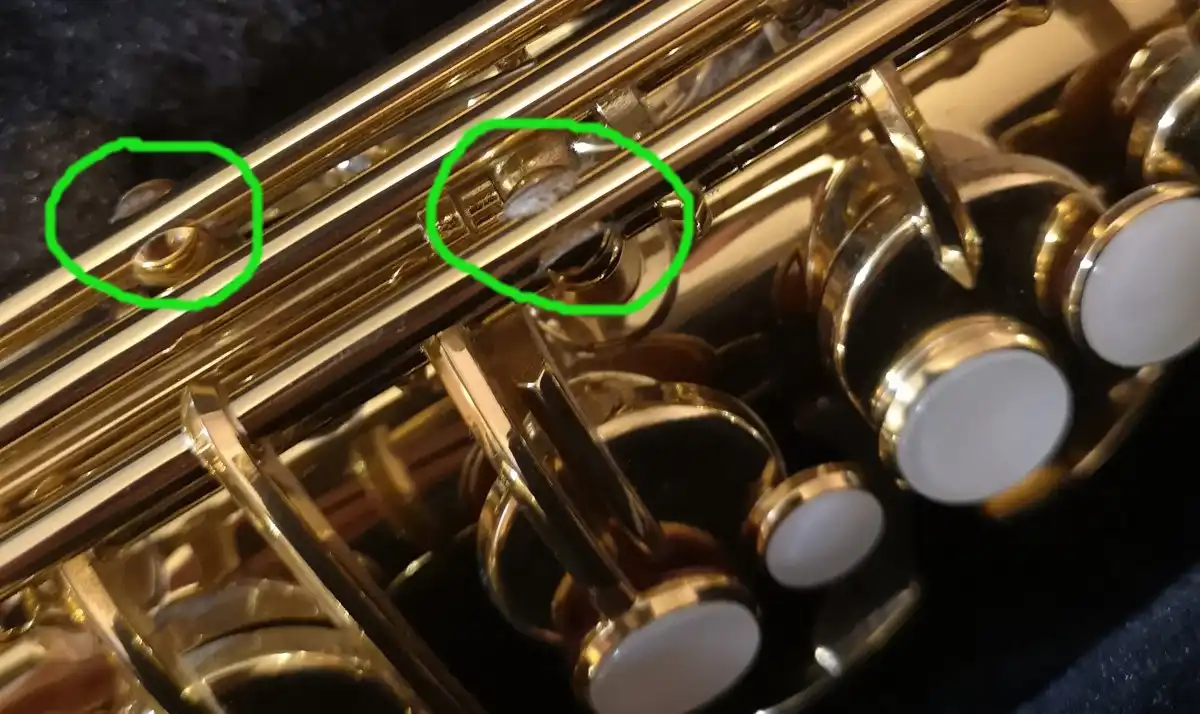
IMG_20220705_220437_m.webp
 
Hi, just a quick one. I was cleaning my sax and there was like sort of maybe material (looks like tissue) around lever on sort of support bolt (can't find a proper name for it) which I removed thinking it is a piece of cloth or something that was left on it after cleaning. There is still bit left and I looked at the other one and apparently something is there as well. I am struggling to find it on any photos on internet for this sax and wondering if lack of it will cause any ratling or anything. Please see photo below. Thanks

View attachment 20657
Welcome to the Café.
yes those supports have a factory installed felt lining. It helps keep the tube from rubbing & rattling in the saddle.
B06522A2-CE8C-483F-8CFD-04618280E97B.webp
09C144E1-6A8B-4B0F-AAA2-6612B5E2EE16.webp
A521FBD3-5148-4FD3-AB21-51E2C68ED9E4.webp
 
Thanks, I guess mine was not properly cut or something ... shouldn't go all way around the lever I guess. Some still left after I accidentally removed the excess so should be good 🙂
 
I've always called those key supports "saddles". I like to use JL Smith synthetic felt .5mm thick attached with contact cement. I used to get frustrated trying to trim the felt after installation to look good using a single edge razor blade. Then I came up with the idea to pre-cut the felt to the desired shape before gluing it in place with the tool(s) shown below. The brass tubing was all I had at the time. I have since made new ones with steel tubing that hold up much better. A wooden dowel is fitted to the end to provide a surface to tap with a mallet to punch out the shape.

felt cutters.jpg
 
That's what I use. Only difference is, I have a small bench press rather than use a mallet.

The larger one was made from just any old bit of scrap steel tube - but the smaller one I made from silver steel and used the bench press to shape it before heat-treating the punch.

EDIT. I call those saddle things key guides, but that's because I call two pillars fixed to a common base a saddle.

oval punches.jpg
 
Great idea ! I’ve made plenty of punches for other things. I never thought about making a oval one.
What size tube you guys using 10 mm? I assume you’re sharpening the edge before elongating the shape?
i’ve also recently tried the Teflon material for the saddles. Not that much difference in friction. They don’t really rattle that I notice. But boy I’m telling you they’re a bugger to trim.
1657100676701.webp

1657100706761.webp
 
On the smaller one I put the edge (or at least the chamfer) on first and sharpened after it was pressed into shape.
It's so worth making an oval punch, it saves so much time and always results in a neater job. A larger oval is handy for making key felts that are stuck to the body. Just looks a bit neater compared to round felts.
 
Great idea ! I’ve made plenty of punches for other things. I never thought about making a oval one.
What size tube you guys using 10 mm? I assume you’re sharpening the edge before elongating the shape?
i’ve also recently tried the Teflon material for the saddles. Not that much difference in friction. They don’t really rattle that I notice. But boy I’m telling you they’re a bugger to trim.
I sharpen the round tube by spinning it in my bench motor and using a file/sharpening stone before squeezing it to an oval shape. The diameter of the tubing is determined by the length of the "U" in the support. I used to use teflon until my friend the late Gordon Palmer on SOTW pointed out that there is no issue with friction at that location, only the possibility of noise---especially if the long rod is slightly bent. Based on that logic I have used thin synthetic felt ever since. Some techs use "ultrasuede" which I have tried, but have found it harder to cut and glue with contact cement.
 
I also find it hard to reliably glue Teflon in place - at least so that it lasts any great length of time.
Roughing up both surfaces and using flexible superglue seems to be about the best bet...but even then I've seen the stuff fall off within a year or so.
 
I also find it hard to reliably glue Teflon in place - at least so that it lasts any great length of time.
Roughing up both surfaces and using flexible superglue seems to be about the best bet...but even then I've seen the stuff fall off within a year or so.
Roughing up one side definitely makes a difference. Overall it’s not the most friendly material.
. I used to use teflon until my friend the late Gordon Palmer on SOTW pointed out that there is no issue with friction at that location, only the possibility of noise---especially if the long rod is slightly bent. Based on that logic I have used thin synthetic felt ever since. Some techs use "ultrasuede" which I have tried, but have found it harder to cut and glue with contact cement.
I completely agree.
 

Similar threads... or are they? Maybe not but they could be worth reading anyway 😀

Social

New! Social Feeds

Look out for the navigation icon:

Follow CafeSaxophone

Latest Song of the Month

Trending

Forum statistics

Topics
32,077
Messages
578,683
Members
8,136
Latest member
peterdehelegrote
Back
Top Bottom