Playing the saxophone To learn new songs

thomsax

Well-Known Member
Messages
7,446
Location
Sweden
I've started a new Blues and Rock project. Some new guys that joined us. Now we are going to have 20 songs on our songlist to start with. Classic blues and rock songs. How do you learn and work with songs? I use to send out the copies in advance so they can prepare oneself. I'm asking because the some guys thinks I'm pushing to hard. If you are going to play with 7-8 persons, I think you must have "structure".

- Lead sheet/rhythm page.
- Lyrics.
- Horn arrangements.
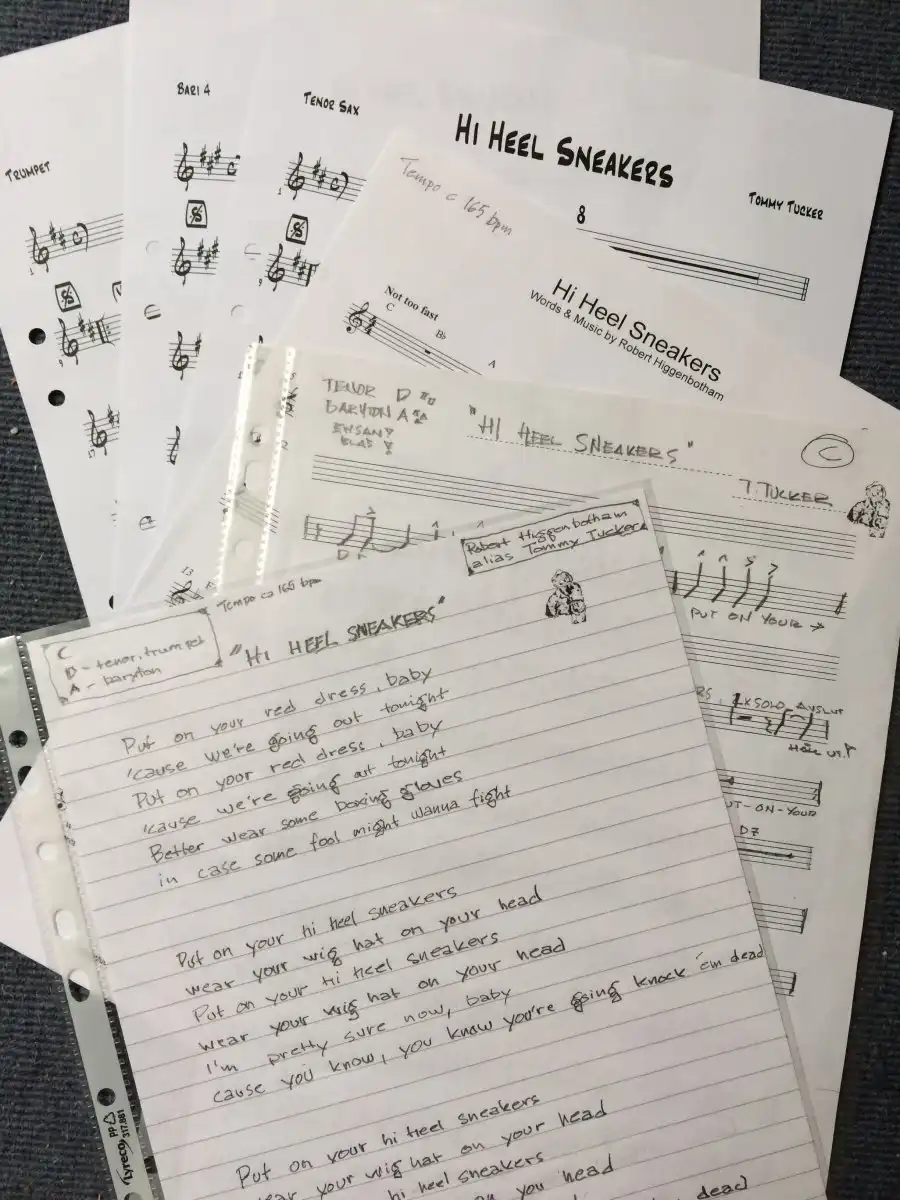
- My own notes. (Riffs, the form of the song, both bari and tenor, solos, how to play if I'm the only hornplayer. This paper is what I use to have on the floor in front of me.)

A sample "Hi-Heel Sneakers", Robert Higgenbotham a k a Tommy Tucker (Chess, 1964):
HiHeel.JPG
 
For new material in our band it takes various forms because sometimes the guitarists will have researched something and will come back with a suggestion so then it's a matter of devising an arrangement for the horn section. But I have no hesitation sending around lyrics, chord charts and horn arrangements - I generally leave the bass and drums to sort themselves out as they know best. Then it's a question of judging how/if it works during rehearsal and what refinements may be needed. It does help if everyone has at least looked at the arrangement and listened to the song before we try it. And lastly, we generally introduce new material in small doses but that's because we have a considerable catalogue to keep us going. New material is good to keep enthusiasm levels up though.
 
Some nice band politics before you've even started!

One of the first things is whether all the band members have the same vision of how good, or prepared they want to be. Do they want a polished performance, or is it a 'busking' band, or perhaps somewhere in the middle.

People learn tunes in a number of ways -

- find the tunes themselves;
- have mp3 files sent around;
- mp3 + chord chart;
- whole arrangement

One guy I know used to make personalised CD's for each of the backing singers with him sat at the piano. He'd sing their line and then sing the tune so that they could practice their line along with him.

Or perhaps some prefer to learn in a rehearsal. Play and talk it through. Is your objective to play with no music for anyone on stage? In most people's eyes this looks the best. It also de-clutters the stage enormously when music stands are taken away. If you're 'old school' and play with wedge monitors on stage, as a horn player the combination of wedge, mic stand, music stand and horn stand is difficult. Even on a normal size stage, and because they largely need to occupy the same space.

Learning a set of 20 - 30 tunes is daunting for most horn players as we're used to reading the music, and relying on that. It's an excuse really. Guitarists, bass players, drummers - they always know the songs..

If there are enough gigs to merit the time to learn the tunes it doesn't take as long as you'd think. My method is to repeat each horn line 5 - 10 times and then turn away from the music and play another 5 - 10 times. Repeat for a number of days/weeks. Most horn lines are pretty short, so it's quite easy really. The difficulty can be more along the lines of remembering where they come if the arrangement is complex, or if the line changes slightly each time. In most music there will be lots of repetition.

I also listen to the tracks all the time. At home, in the car, train - this is the biggest part of learning a set. Us readers learn a lot slower than 'ear' players. Like I say, we rely on the music and if this is always available something just doesn't switch on in the brain telling us to remember it. Well, that's me anyhow.

If you have a horn section, then unless the lines are nothing more than unison blues riffs you'll need arrangements. You'll need to decide on phrasing too, unless it's obvious - this can be notated though if everyone reads. If you're the only horn player then you can be more soloistic and in some cases you'll have to be as some horn lines played by one person will sound like the others failed to turn up - i.e. a section of one, rather than a sax player.

 
If you are going to play with 7-8 persons, I think you must have "structure".

My .limited experience has been that you can't treat readers and non-readers in the same way. If you give readers charts then there's no real reason why you shouldn't be able to have at least 10 songs ready to rehearse* within a relatively short space of time. Non-readers, however, usually require a lot longer.

I've found it's best to choose just five songs to concentrate on for the first rehearsal, especially if you have a mix of readers and non-readers. See how that goes and slowly add more songs. You also have to take into consideration the musicians' other obligations. They may also be in other bands, their work may take up a huge amount of their life leaving little time to practice, family demands etc.

The one thing I've really learned since starting a 9-piece rhythm & blues band is patience. And even though it's definitely best to give everyone as much information as you possibly can so that they have as little to do/learn as possible, at least one person will still turn up and play the wrong arrangement, in the wrong key etc.

* I'm very much of the opinion the rehearsal room is where you rehearse and perfect songs, not where you learn them.
 

Social

New! Social Feeds

Look out for the navigation icon:

Follow CafeSaxophone

Latest Song of the Month

Trending

Forum statistics

Topics
32,088
Messages
579,077
Members
8,143
Latest member
ReneGuenotSale
Back
Top Bottom