Saxophones "Saxstuff" Replacement King Super 20 Necks

Tomasz, thanks for the information you have provided here, that's very interesting. It's definitely something for me to think about at some point in the future. Perhaps you can clear up one issue. it's been suggested to me that some of the Conn 10m tenons were slightly tapered into the receivers is this true? Also, I'm guessing as you are passionate about Conns as I am about S20s you must have some of these saxes then? If so could you perhaps post some neck photos from varying angles if you get the chance?

Thanks, Mike.

@Mikey B - I don't know about the Conn 10M necks being tapered into the receivers. I haven't seen any - but obviously that doesn't mean they don't exist. Taking measurements from different examples using a digital calliper would likely answer that question. Thing is, the Conn 10M was in production for a long, long time in saxophone terms and the design was "tweaked" as the years passed. Conn started out "true" 10M production with very late-model "Transitionals" in 1935 - and these are Conn 10Ms in all but name. To claim they're not really Conn 10Ms is being overly pedantid, because the only thing missing is the "10M" stamp near the serial number - which really is splitting hairs, eh? So, the Conn 10M versions with rolled-toneholes started in 1935 and went right through until the non-rolled tone-holes models began to appeari in 1947. Later, the neck design changed into the double-socket neck models in 1956, and finally into the (and I'm not kidding here!) underslung double-socket neck designs circa 1962, with sheet-metal keyguards. Yes, the final production Conn 10M tenors really did have underslung necks, just like Conn 6M altos. Here's an example:-

conn5.webp


An interesting fact for a would-be Conn 10M neck manufacturer:- the neck from a student-grade Conn 16M dating from the 1950s will fit (and play quite nicely) on a pre-1956 Conn 10M. Therefore, if you ever made a "quick & dirty" prototype of a Conn 10M neck for proof-of-concept purposes, you could make a swift start by replicating a Conn 16M neck from the 1950s. Of course it's a single-socket neck and the decade it was made is important. I'm not claiming that a Conn 16M neck is just as good as an original Conn 10M neck. I mention it purely because it's compatible. Be aware that Conn 16Ms made during the 1960s were made in Mexico and are referred to as "Mexi-Conns". There's not much love out there for Mexi-Conns because by then Conn had gone into a major decline. However, please note that all Conn 10Ms and 6Ms (whether produced in 1938 or 1968) were made in Elkhart, Indiana and not down in Mexico. Whatever, here's the proof that a Conn 16M neck on a Conn 10M is viable:-

.

Making necks for double-socket Conn 10Ms would obviously be much harder than for standard single-socket necks. Bear in mind that for any owner of a, say, 1959 Conn 10M that's missing its double-socket neck, there are simply no viable options out there other than to get another Conn-made neck of the same vintage. They either have to somehow track down a double-socket neck for their horn (which could take 20 years!) or regard the saxophone as a "wall-hanger" or donor horn for spare parts. Suffice to say neither of these are attractive options...

People get very worked up about how Conns with rolled toneholes (pre-1947) are much better than the ones without. I've got both types so am agnostic in that respect and don't want to start a bun-fight. All I can tell you from personal experience is that regardless of when they were made, whether it be 1935, 1955, 1961 or 1967 - all Conn 10Ms and 6Ms are professional grade horns through and through. They all come alive in your hands and start to "sing" - just like all pro-grade horns should. With that said, in purely financial terms, if you're looking for the "sweet spot" then you'd probably do best to concentrate on making replacement single-socket necks - because (in the eyes of owners/collectors) these are more sought after and therefore regarded as more valuable. To be honest, the later double-socket Conn 10Ms don't get the same attention/respect (particularly not the ones with underslung necks and sheet metal keyguards) - but they are still good players.

As regards providing photos of Conn necks, I'll send them directly via your website. Only thing is... our house is undergoing alterations at present so all my horns are piled up in a large stack of cases inside a small room. Bear in mind that I'm a saxophone collector, so it's a very large stack of horns! Getting to all the Conns would be a major pain. However, I've just checked and there's definitely a 1952 Conn 6m (no microtuner and is awaiting an overhaul) at the top of the stack, so I'll send you some photos of that one. As a bonus, I'll even include neck tenon measurements taken via a digital calliper. The other Conns are lower down in the stack and to be honest I don't want to disturb them. The good news is that Google images is your friend in such situations:-

Various photos of Conn 6M necks

Various photos of Conn 10M necks
 
Last edited:
Really, I thought they were made in former Best plant in Arizona, Nogales.

Yes, they were made in Nogales, Arizona - and also at Nogales in Mexico because it spanned the international border. As a result there are (sort-of) two Nogales - which causes confusion, particularly since it involved a free-trade zone to take advantage of lower taxes and cheaper "labor" costs. Whether Conn horns were made in Nogales USA or Nogales Mexico hardly matters, because by then the quality of instruments made outside Elkhart had dropped significantly - to such an extent that these days nobody makes strenuous efforts to get themselves a Mexi-Conn or boasts that they own one. I've examined a few Mexi-Conns and the best examples (produced on a really good day) are roughly on a par with a Corton/Lafleur from Czech maker Amati, only with much softer metal. Bear in mind that all Mexi-Conns were intended as beginner-level student horns.

To keep things simple, all that people really need to know about Conns is that the ones which were made in Elkhart, Indiana were very good - all the way through until the factory shut down in 1969-70, and the ones made in Nogales were of a lower standard due to poor quality control and materials. In other words when it comes to production of student horns you can say that Elkhart production = Reliably good and sometimes excellent and Nogales Production = Usually mediocre but occasionally good (hardly a ringing endorsement!)

The main problem which dogs Mexi-Conns and gives them a bad reputation is the poor quality control, which was way below what would have been accepted up in Elkhart. Basically, Conn let horns leave the Nogales factory which shouldn't have been allowed off the premises. In Elkhart, a problem with a saxophone would have been flagged and the horn (or component part) put to one side until the problem was fixed. In contrast, the same thing didn't happen in Nogales. I think there was less pride in the product compared to Elkhart, or more focus on making as many horns during a shift as they could. In fairness, some Mexi-Conns are good but unfortunately many aren't - so buying one sight unseen is a gamble. Most people don't want the hassle of buying something they'd struggle to sell in future when the time comes to upgrade.

To put things in perspective, "second-line" horns made in Elkhart Indiana until about 1960 (e.g. the Conn 14M or 16M) represent pretty good value for money. The ergos hark back to an earlier era and they're not pro-grade horns by any means (so don't kid yourselves otherwise) but still they're well-made and retain a little bit of the sparkle of their more illustrious brothers e.g. Conn 6M and 10M at a small fraction of the cost. Sonically, they're a definite cut above most entry-level modern student horns, and don't cost much more. They're a good option for someone who already plays the sax, but now wants their first ever vintage horn and hasn't got a large budget.

Mexi-Conns aren't truly horrible. It's more that there are so much better options available in 2018 e.g. a Chinese horn made by Gear4Music. Given a choice between a Mexi-Conn and a Gear4Music alto (or tenor) then I'd pick the Chinese horn every time.
 
Last edited:
Yes, I agree. But I think Conn's decline started after WWII. I just want to say that Mexico and the Mexicans is not to blame for Conn's "bad" saxes. The just did what they were told to do! I think Conn's owner (from 1968-1980) Crowell-Collier MacMillan (publisher) was doing fine as publisher but I'm not sure about the manufactoring world? UMI moved "Conn's". "Kings" and "Amstrongs" saxophone and clarinet manufoctoring to Nogales. They thought the Mexicans were good and skilled in making saxophone. Back to "Saxstuff " Replacements King Super 20 Necks"
 
Hi Mikey B .. i'm interested in your KING Super 20 Tenor necks ... are they available? prices ? do you have a web site ? distribution ? brand name ? Thanks ... Peace&Music, Mike
 
Thank you all for the likes and positive comments about my necks, it's much appreciated. I've received many requests for other make of necks, in particular, the Conn 10m has been mentioned and requested on several occasions. This was only recently discussed at length with the repair department at Sax.co.uk also asking my thoughts about doing the same for the Conn saxes.

I presently have additional work commitments which unfortunately only allows me limited time on my priority work for the King line of sax parts which is the mainstay for Saxstuff. I don't have any experience with the Conns, never even played one. I do however realise they are still very popular and Conn made the 10m and 6m over a long period of time but I wouldn't know the differences between the models.

Also, the biggest problem of all is finding somebody who is willing to lend me a complete sax from Conns "Golden Era" in the long term to look over and assess the feasibility of making a neck ( I would need the complete sax to check the tenon/receiver arrangement and fit ) I certainly don't want to take on more financial commitments for another sax project. I'm not ruling anything out, it is possible this could happen at some point in the future.

Regards, Mike.

Very advisable to play through some necks before choosing the one you want to use as the model. There is great variation between 10M necks. I have two pre-war ones here, now. One is lighter, more "smoky," less wide/warm/heavy, and the other is its opposite, but both could be argued to be quintessentially 10M while being completely different. For some, the lighter one is too light. For some, the heavier one is too heavy.

Yet both are "RTH," ladyface, etc.
 
Hello @MikeyB, I’ve tried to get in touch with you recently but had no luck on SOTW. I hope that you are doing well.
I have suggested your address to a Dutch shop which occasinally needs King Pars.

I was wondering how far you are with the making of the Super 20 necks.

Ideally I’d be looking for a Silver neck to fit a later Super 20 (which has normally overslung necks) possibly an adapted underslung (it need a different octave lever ) this may be interesting to you since I suppose quite a few of late Super 20m owners would be wanting the underslung option
 
Hello Andre,

I am well thank you and trust you are also well and staying safe? I don’t go on either Cafe Saxophone or SOTW very often nowadays. I don’t especially like the new forum layout plus the whole dynamic seems to have changed, not particularly for the better.

Saxstuff is doing really well, I recently left my full time job so am doing this for a living now. My own handcrafted replacement necks are selling well, I completed neck no 17 last Thursday and it’s now on its way to the USA.

You can contact me via pc

I will be happy to send you info and photos.

Thank you for spreading the word about what I do, its really appreciated.

Regards, Mike.
 
Last edited by a moderator:
Hi Mike! A local university found a Super 20 tenor in a "forgotten closet".
It's complete EXCEPT the neck octave key is missing.
I suspect I may have to get them a replacement neck, but was hoping the key/spring etc from one of yours might be a fit?
Thanks!
 
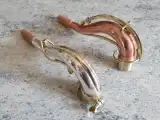
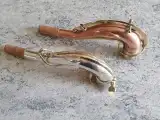
Hi guys, how are you all doing? Well, I am happy to say that after around 3 years on and off the back burner my own hand built 10M neck is finally finished. There were a few challenges to overcome whilst creating this one. In particular the octave key pivot posts are really small and fiddly to make and the lower brace was a absolute nightmare to get right due to not being able to source the correct grade of brass at the correct diameter. It would have been easier to have them cast but I elected to make everything in house. The tenon has a conical bore as per the original. Here is the 10M neck with one of my silver S20 necks for contrast.
 

Attachments

  • IMG_2356.webp
    IMG_2356.webp
    131.3 KB · : 159
  • IMG_2358.webp
    IMG_2358.webp
    205.8 KB · : 137

Social

New! Social Feeds

Look out for the navigation icon:

Follow CafeSaxophone

Latest Song of the Month

Trending

Forum statistics

Topics
32,064
Messages
578,475
Members
8,131
Latest member
Jef B
Back
Top Bottom