
 (bottom of page)




Vann Burchfield
Member
Photo Comparison: Rare McLean & Payne "Supersax Mark X" Prototype vs. 1970s Selmer Mark VI
Hi everyone,
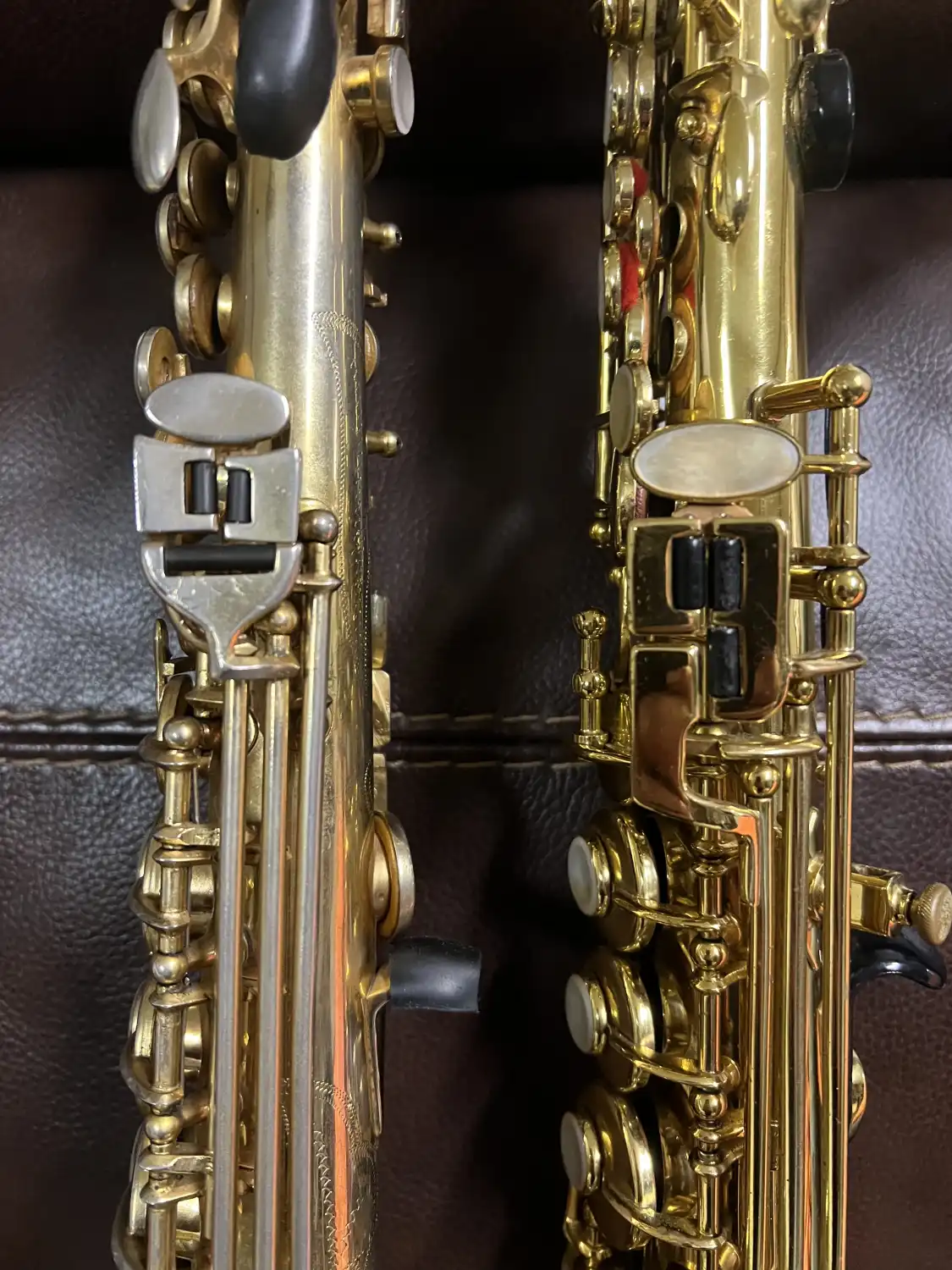
I recently acquired an incredibly unique horn and wanted to share a technical side-by-side comparison. This is a gold-plated McLean & Payne "Supersax Mark X" that bears no serial number, but has the number "0"stamped under several keys, heavily pointing to it being an early factory prototype from the short-lived 1980s venture by Jackie McLean and Don Payne.
To see exactly what the factory was doing, I lined it up against my pristine 1976 Selmer Mark VI (Serial #249894). The design choices on the prototype are genuinely bizarre considering McLean & Payne marketed their eventual production line as modern, Mark VI-inspired horns.
Key Technical Takeaways from the Photos:

Hi everyone,
I recently acquired an incredibly unique horn and wanted to share a technical side-by-side comparison. This is a gold-plated McLean & Payne "Supersax Mark X" that bears no serial number, but has the number "0"stamped under several keys, heavily pointing to it being an early factory prototype from the short-lived 1980s venture by Jackie McLean and Don Payne.
To see exactly what the factory was doing, I lined it up against my pristine 1976 Selmer Mark VI (Serial #249894). The design choices on the prototype are genuinely bizarre considering McLean & Payne marketed their eventual production line as modern, Mark VI-inspired horns.
Key Technical Takeaways from the Photos:
- Body Taper & Flare (Image 3): Side-by-side, you can see just how straight the prototype tube is. While the Mark VI has that iconic, aggressive acoustical bulge out at the bottom of the tube, the McLean & Payne remains narrow and completely straight until it hits the bell rim, perfectly mirroring a 1920s Buescher True Tone or Selmer Model 22 geometry.
- The Split Octave Mechanism (Images 1, 2 & 4): Instead of a modern automatic single octave mechanism like the Mark VI, the prototype relies on a throwback manual split/double octave key system with distinct nickel-silver key plating. The lower octave pad sits exactly where the modern body flare typically begins.
- The Global Bell Stamp (Image 5): The macro shot reveals the full country listing engraved at the bottom: "France, Germany, Italy, Japan, Taiwan, U.S.A." It seems they were heavily leaning into a global sourcing or marketing narrative right from the design phase.


