Saxophones Opinions on CONN 6M alto

I once had a Buescher True Tone alto. Silver with gold-wash bell. The most beautiful sax I have owned, and the best sounding alto I have owned. Excellent tuning and not fussy about mouthpieces. But the keys were in the wrong places for my big hands, even with huge amounts of Sugru for key risers.

I suspect that the True Tone would have been OK if it has been my only sax - I would probably have got used to the keywork. But I couldn't swap between it and my modern saxes. So I replaced it with a more modern instrument.
Popped into a shop that had one in (gold with silver keys though) and had a play.:sax:

I'm in love! Suprised how well it fitted me... probably more comfortable than my beginner horn.
 
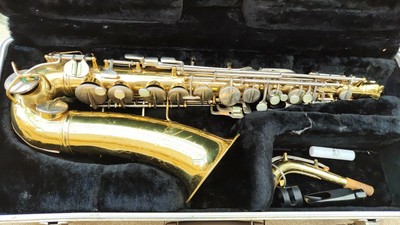
Not quite a 6M but here's a rather beautiful 245xxx Conn transitional model that I picked up at an auction a few weeks ago:

20220422_151922.jpg
 
Last edited:
That silver horn is very nice. Other than the left hand key layout it looks to be 100% the same thing as what we now call "6M".

In truth, the Conn model number for "saxophone, alto, low pitch" was 6M from sometime in the 1910s or before; it's just that when the New Wonder name was retired and the lady face engraving was introduced, they didn't create a catchy new name for the model. In the day, people typically called them "Pink Lady" (though nothing pink, but I assume by reference to the popular cocktail) or "Naked Lady" (though you rarely see anything but the head and shoulders with a bit of decolletage). It's recent collectors who have started calling that generation of Conn alto "6M" because the revised left hand key layout and the lady face engraving roughly coincided with when they started stamping "6M" by the serial number. Of course, Conn, being a factory dedicated to manufacturing things and selling them at a profit, did not keep in mind the potential concerns of collectors 80 years later; so they added and removed features, changed engraving patterns, altered the stamping patterns of serial numbers, etc., to suit the needs of their production line, leading now to confusion amongst collectors.
When we say 6,10 and 12 M we often mean the legendary "Artist" model. Some guys says Artist model ended in the late 50's and maybe earlier. 1947 is a watershed for many Conn fans.
 
As far as I know they made more silver plated models from that era than they did lacquered brass.
A bare brass model was the most popular sax. And they often got a layer of gold cellolusa laquer. A complete overhaul included laquer as well. This was before they knew a bare brass sax is more free-blowing!😉 My NW soprano 18 M (straight, low pitch) is probably a bare brass model that was laquered later. The reason that the silver or gold sax are so popular over the pond is that the freight is same if it bare brass, laquered, nickel plated, silver plated or gold plated. I earned more on real beauty in silver compared to a bare brass.
 
Buescher had silver plated and hand burnished silverplated. I have a Buescher TT soprano (LP-122 model) from 1928. No Snap-On pads and spurs. The last model of Buescher sopranos. But they made these saxes on special order as late as 1969 according to Vincent Bach International Company.
 
When we say 6,10 and 12 M we often mean the legendary "Artist" model. Some guys says Artist model ended in the late 50's and maybe earlier. 1947 is a watershed for many Conn fans.
Yep that what seems to have occurred, but @turf3 is correct to remind us all that 6M,10M and 12M were among the early designated factory inventory numbers for all of Conn's Altos ,Tenors and Baritones respectfully..
Other labels and badges came along later.

Hopefully someone will dig up the PDF of Conn Instrument designations.from these times. It's nice to protect history.
 
Last edited:
Yep that what seems to have occurred, but @turf3 is correct to remind us all that 6M,10M and 12M were the early designated factory inventory numbers for all of Conn's Altos ,Tenors and Baritones respectfully..
Other labels and badges came along later.

Hopefully someone will dig up the PDF of Conn Instrument designations.from these times. It's nice to protect history.
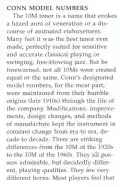
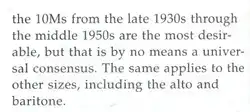
The number indicated the size, pitch and shape and the "M" indicate that it's a saxophone. Conn (UMI) used soeme of these model names as well but on diffent saxes. I think a 13M was a bari to low A and 14M to low Bb. This is was Dr Paul Cohen wrote (Saxophone Journal) about Conn model nubers back in the mid 90's.
connmnr.jpgconnnrII.jpg
 
Here's another document from Conn. There were a few more M numbers designated for horn models . It's an interesting subject. These 1920 new wonders were 6M if low pitch and 7M if high pitch.

 
Last edited:
I've had a couple of these. I wouldn't bother, even at £120. Mediocre.
My first sax was a used Conn Shooting Star from early 60's. I got it around Christmas in 1968. And I'm still honkin'. Many guys says these are among the worse saxes that's ever been made. I don't think so.
 
My first sax was a used Conn Shooting Star from early 60's. I got it around Christmas in 1968. And I'm still honkin'. Many guys says these are among the worse saxes that's ever been made. I don't think so.
They're certainly not the worst saxes made, or the worst I've owned, but in my opinion, they're just not very good.

I'd say the same about my first ever sax as well, a Buescher Aristocrat from around 1970. I still have it, sentimental old guy that I am, but I have known for a long time that it's not a great sax, comfortably outplayed by modern saxes.
 

Similar threads... or are they? Maybe not but they could be worth reading anyway 😀

Social

New! Social Feeds

Look out for the navigation icon:

Follow CafeSaxophone

Latest Song of the Month

Trending

Forum statistics

Topics
32,078
Messages
578,693
Members
8,136
Latest member
peterdehelegrote
Back
Top Bottom