Saxophones Low Bb vs low A baritones.

I weighed my SBA came in at 10.2 lb = 4.63 Kg with neck on no mouthpiece
My 2000 YBS62 weighs 5.79 KG! So 2.6 pounds more than my SBA!
😀
Helen, that Couf Bari looks so killer and minty.
OK...you compared a Selmer and a Yama.

I'd be very interested to know the weight of soneone's VI low A compared to your SBA low Bb.

Or even better, the two versions of VI weights....

To me, that would be more telling....
 
Bottom line, I do find that my low Bb and low A horn baris respond differently, and most definitely have different tonal complexities. I always assumed it had to do with the fact that they were different makes & models.

However, after viewing this video, I am coming to the conclusion that while yes, make & model obviously do make a difference, that extra 1/2 step does in fact change the horn's tonal complexity, and response.
Interesting because I did not hear that. Toggling back forth between the two Mauriats, I don't hear any notable change in the tonality , to me they sound like the same horn being played......the only difference noted in the vid, to mine ears, was the player's impression, verbally stated, that there was a diff....
 
OK...you compared a Selmer and a Yama.

I'd be very interested to know the weight of soneone's VI low A compared to your SBA low Bb.

Or even better, the two versions of VI weights....

To me, that would be more telling....
The MkVI low A comes in at 5.35kg (11.56lbs) - the Bb is 5kg, so half a pound lighter.
The low A mech is among the worst out there - and unless you're very lucky (or not that fussy and enjoy 'gorilla grip' playing).
 
What I think I remember about the Mark 6 low A was that it had an arm that arched over a bunch of other rods, making the whole thing extremely flexible.

Is it a realistic expectation that the thumb key should close all 3 bell keys accurately? I THINK that if I were to take up the low A baritone, I'd probably finger a low Bb and just add the thumb key. Is this a realistic fingering approach?
Yup, that's it - and then it has two more arms (one for the Bb, one for the B). Yanagisawa used the same setup on the 900 series baritones. You with get the have the key close all three pads reliably....but leaks when you finger a low Bb then hit the A key - or fails to close all three pads but doesn't leak when you go from Bb to A. Excepting Gorilla Grip, of course.

Yamaha cracked the mechanical issues with their two-armed 'under the action' mech, which is relatively easy to set up and adjust and which works just like an on/off switch.
But yup, again, if you're sporting an older bari it'll often be a safer bet to hit the low Bb in conjunction with the low A key.
Unless you have a low A Weltklang, which had the low A key positioned below the low B touchpiece. That worked pretty well.
 
Interesting because I did not hear that. Toggling back forth between the two Mauriats, I don't hear any notable change in the tonality , to me they sound like the same horn being played......the only difference noted in the vid, to mine ears, was the player's impression, verbally stated, that there was a diff....
Might hear it if in the room listening live.

Only repeating what I have read on - Brands and Horns | JazzBariSax.com

"Some swear by low A horns and some swear against them. The way I see it, everyone who uses a Low A essentially just wants that extra note. I have not come across too many players that play a Low A because of the way it sounds. I don’t think the Low Bb players dislike having an extra note, they are simply not willing to sacrifice anything for it. The Low A definitely weakens the power of the low end of the horn. From a business perspective one could argue that you need a low A for when Broadway shows, recording sessions (jingles) or big band charts . That being said, I do have a Low A baritone in the closet should I ever need it.

The Low A horn is not a bad idea in theory. However, they don’t seem well thought out. When designing a Low A horn the bell is generally just extended and another tone hole is drilled. If you look at any saxophone the opening at the neck is the smallest in diameter and the bell is the largest. Small to big. When they add a Low A they stop expanding the size of the tube so that the diameter at the Bb tone hole is the same as that at the Low A tone hole. Not that I blame them, to make a bell large enough to be in correct proportion it would have to be huge. But that doesn’t nullify the fact that the bell on Low A horns is just not big enough to account for all of the notes. To build a Low A horn you must design it from the neck down! Modern Low A baritones don’t resemble any of the other saxophones, just as straight soprano’s do not. the shape of the horn, bore dimensions, and bell size all vastly affect the sound of the entire instrument.

Low end aside, the extra hunk of metal on the end of the bell affects the resonance, timbre, and overall sound of the rest of the horn. Everyone claims you need a Low A baritone to play in a big band. This seems ironic to me, as it is much easier to punch the low end of the horn and support a section without the extra tubing!"

Now add the extra mass of the air column that needs to be moved because of the longer bell.

I must assume the intonation must be better on the newer Low A s?

 
"Kenny Berger made the following comment, which I found helpful in explaining the issue:"


“The sax, being a conical stopped pipe, has certain built-in acoustic properties. One is that the bell(lowest) note tends to be bright and full in quality and tune, if anything on the high side while the next note up (traditionally B natural), tends to be the darkest, most resistant note and tends to tune on the low side.
Needless to say, these aspects also effect the notes that fall within the overtones of these notes.
Add the low A and all these basic acoustic properties are thrown totally out of whack( is there any worse feeling than trying to get a good sound on low Bb on a low A horn). Plus I have run across some low A horns where the low A is flat!
 
...When they add a Low A they stop expanding the size of the tube so that the diameter at the Bb tone hole is the same as that at the Low A tone hole. ...
I don't believe this statement. Got any measurements?

Certainly the terminal bell flare (below the last tone hole) is larger on low Bb instruments, but every photo of a low A (except Conns and Bueschers with the inserted piece at the bell to bow joint) I can find, clearly shows the conical shape of the bell continues from the bow joint right on up till the terminal bell flare begins, past the last tone hole.
 
And here's another statement with some serious dubiousity to it:

"...One is that the bell(lowest) note tends to be bright and full in quality and tune, if anything on the high side while the next note up (traditionally B natural), tends to be the darkest, most resistant note and tends to tune on the low side.
Needless to say, these aspects also effect the notes that fall within the overtones of these notes..."


And which notes are these that "fall within the overtones of these notes"? For that matter, what does that phrase even mean? I'm not aware of any standard fingerings for any notes that use the low Bb or low A fingering, except for low Bb and low A.

I'm more than willing to believe that there are tonal and response differences in the lowest notes of the low Bb and low A baritones; but at least in trying to understand why this might be so, let's not make statements that can be shown to be factually incorrect with a measuring tape, or a fingering chart!
 
Do you mind if I ask your sources on these ? Do you have serial charts for the French makes ? And either catalog or confirmed serials on the Magna ?
They came from a series of books called "Music Instruments" published by The Instrumentalist magazine, which listed models, features, and prices (usually) of most band instruments on the market. They issued six of them between 1958 and 1970. I got them through Inter-Library Loan, if you're interested in having a look yourself. (And in the case of Martin, there are RMC-era catalogs both with and without the Magna baritone, which had that narrowed down to begin with.)
 
I'm a tenor player primarily who has always loved playing bari. But my local scene is saturated with good bari players. In spite of that I finally bought a used Kessler about 6 years ago. Since then I've worked my way in to 3 bands, on and off. While it took years of gig money to pay off that horn, I just love playing it. So it was totally justified in my mind. There's nothing like playing a great bari part in a big band.
So true! I used to play and still play a lot in Bigbands, from first alto to baritone. But playing the baritone for me is the most rewarding! Especially since I switched from low A to low Bb, from Yanagisawa to conn/grassi. Less weight and so much more sound!!! And I don't miss the low A at all.
 
I don't believe this statement. Got any measurements?

Certainly the terminal bell flare (below the last tone hole) is larger on low Bb instruments, but every photo of a low A (except Conns and Bueschers with the inserted piece at the bell to bow joint) I can find, clearly shows the conical shape of the bell continues from the bow joint right on up till the terminal bell flare begins, past the last tone hole.
I stated these were not my words but those posted on - Brands and Horns | JazzBariSax.com
I guess you could reach out and ask him?

From what I have been reading on line they made the Low A bell as it is because of ergonomic restraints. The bell would be huge if correct. So it does expand as it goes up but not to the degree it should. It is a mathematical equation that could not be physically met.
 
Bass & Bari observations from here as a mechanic, Redneck engineer, and terrible player.
1) There’s limits to mechanical machines and the metals used. Here, usually brass or (?) nickel alloys for keywork.
Materials have limits to mass size. IE flex as an example.
2) A bass is freeking huge !
3) The market. What, one a year ? Two ?? Even at top premium prices will any company spend R & D dollars for a loss on investment ?l
4) Makers aren’t uninformed idiots. They follow / track trends in music. All genres. All economies and market accordingly….for profit.
5) Anything can be made to order. Especially when a non refundable deposit is made in advance.
 
Yup, that's it - and then it has two more arms (one for the Bb, one for the B). Yanagisawa used the same setup on the 900 series baritones. You with get the have the key close all three pads reliably....but leaks when you finger a low Bb then hit the A key - or fails to close all three pads but doesn't leak when you go from Bb to A. Excepting Gorilla Grip, of course.
My B900 (and the one I had before it) is fine. Never any problems with low A.

Also, it is not any quieter than my Conn 12M. Considerably different sound, of course, but no less ballsy.
 
They came from a series of books called "Music Instruments" published by The Instrumentalist magazine, which listed models, features, and prices (usually) of most band instruments on the market. They issued six of them between 1958 and 1970. I got them through Inter-Library Loan, if you're interested in having a look yourself. (And in the case of Martin, there are RMC-era catalogs both with and without the Magna baritone, which had that narrowed down to begin with.)
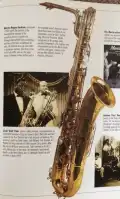
"The Martin Magna Baritone" was/is to low Bb as well? Here is a picture from "The Sax&Brass Book" ( Priestley, Gelly, Trynka, Bacon). Here we got some info about Martin Magna Baritone (1948???) and also a picture of Red Tyler on a low Bb bari and the unknown tenor player is Jesse Powell. Both A&R men and were doing well. To be an A&R was more lucrative compared to be a touring or recording muscian paid by hour.

1794131921509.webp
 
Ok. With regard to punch and all that, if people can tell between the two, then people should be able to pick the difference every time. Different players and setups included - because that’s real world and what is essentially being argued: the horns are different and sound different.

I can’t hear it. I hear players that I like and players that I don’t.

I can hear the difference between a Bb clarinet and an A though - but this isn’t the same as hearing the difference between a Boehm clarinet (to low E) and a full Boehm to low Eb.
 
When an extra tone is added to a sax they use to say that the overtones changes? A player studied classic saxophone at Berklee and bought a low A alto. The first comment his teacher gave him. "-You got different overtones in that alto". Is it the same with a bari to low A? I don't know I just play low Bb bari as loud as I can 😉.
 
My B900 (and the one I had before it) is fine. Never any problems with low A.
It's a stiffer mech than that found on the MkVI - so yes, it can be made to work reasonably well...but it ranks 3rd best after Selmer's modern 'round the back' mech and Yamaha's. If I include the likes of Mauriat etc. - which use a similar 'round the back' mech to Selmer then it pushes the Yani into fourth place.
I really don't understand why they don't do something about it (it's used on the WO series)...even if they just stiffened that floppy arm that sits over the stack action, it would help.
 
"The Martin Magna Baritone" was/is to low Bb as well? Here is a picture from "The Sax&Brass Book" ( Priestley, Gelly, Trynka, Bacon). Here we got some info about Martin Magna Baritone (1948???) and also a picture of Red Tyler on a low Bb bari and the unknown tenor player is Jesse Powell.
I have never seen any Martin documentation advertising a low Bb Magna, but there's a purported '59 pictured on The Martin Story as well.

I won't speculate.
 
They came from a series of books called "Music Instruments" published by The Instrumentalist magazine, which listed models, features, and prices (usually) of most band instruments on the market. They issued six of them between 1958 and 1970. I got them through Inter-Library Loan, if you're interested in having a look yourself. (And in the case of Martin, there are RMC-era catalogs both with and without the Magna baritone, which had that narrowed down to begin with.)
Cool so literally paper hardcopy issues ? anybody ever put images on the www ?
 

Similar threads... or are they? Maybe not but they could be worth reading anyway 😀

Social

New! Social Feeds

Look out for the navigation icon:

Follow CafeSaxophone

Latest Song of the Month

Trending

Forum statistics

Topics
32,035
Messages
577,555
Members
8,113
Latest member
cheeseplz
Back
Top Bottom