

Sheet Music Help with transition between slurs

Messages
154
Location
Greater Toronto Area (Canada)
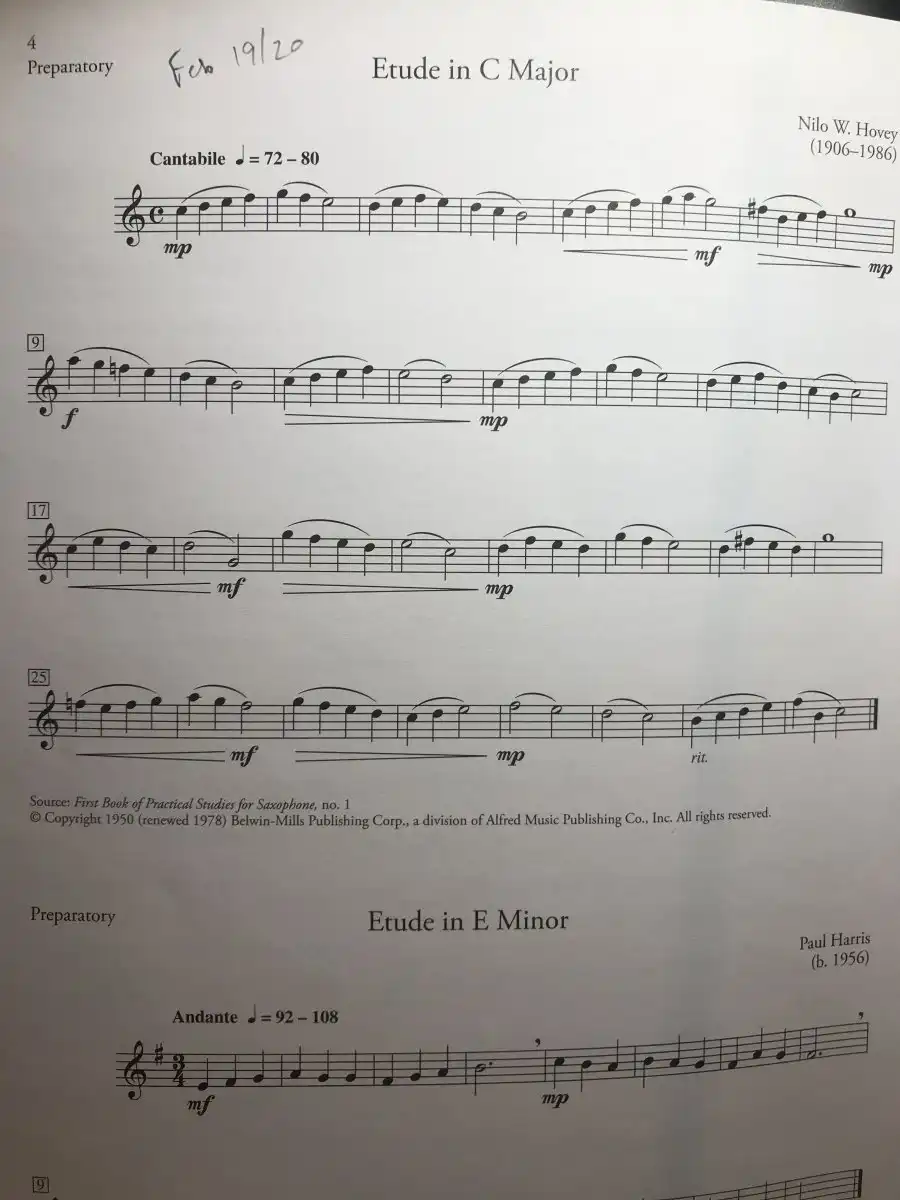
I’m playing an easy piece but want to get the technique right. What do I do with the transition between slurs, for example, between bar 1 and 2? Do I tongue the last note of the first bar to get a definite separation between bars? And do I breathe between bar 1 and 2? I know the first bar is all slurred and should form a phrase and the second bar is the same. I just don’t know how to transition between the slurs. Thanks for your help!
9D9FC567-4525-443D-9E7D-8C8B42B8F528.webp
e
 
The slur marks are not phrase marks. A phrase - musical sentence - will often be 2, 4, 8 or 16 bars in length, mainly depending upon the tempo of the piece. Try and breathe at the end of a phrase, or where you think that a breath will interrupt the flow of the music as little as possible.

As the others say, the first note of a slur is tongued, and then all the other notes under the slur are simply a lift of the appropriate finger(s) in order to transition smoothly. It's like playing a long note but then moving your fingers.

The only caveat is when there is a repeat of the same pitch. This will need to be lightly tongued or it will not sound as a separate note.

With this particular exercise, try to breathe every four bars, and maybe start off with a slur over those four bars too so you can really concentrate on the smooth delivery. When you become more confident, add the extra tonguing whilst trying to keep it as smooth as the slurring.
 
It might help to use how I see this as a cellist. If a group of notes are slurred together, the expectation is that they are all played in the same bow and that the bow does not change direction until the start of the next note/s after the end of the slur.
Sax is no different. All the notes that are part of the slur are played without tonguing, only the first note of the group is tongued.
So, in bar 1 the only note you tongue is the first note, the C. The next note that you tongue is the G at the start of bar 2, the next note that is tongued is the D at the start of bar 3 and so on.
 
A couple of thoughts perhaps repeating what others have said.

The marking "cantabile" (in a singing style) along with the tempo suggests a legato style of tonguing using a very light "du" or "doo" syllable. It can be a bit confusing since slurs and phrase marks look identical. For this melody at this tempo I would play 4 bar phrases. Sometimes there is actually a phrase mark 4 measures long above the slurs to reinforce the "phrasing".

One thing I feel is important in this style is to play as connected as possible when tonguing notes. That means to articulate du without interrupting the sound similar to the illustration below. The exception is at the end of each 4 bar phrase where there is a breath. Another thing I would stress when playing in a legato, cantabile style is to not "hear" the bar lines. This means you "blow through" the half notes in bar 2, 6, etc.

1591022370751.webp
 

Similar threads... or are they? Maybe not but they could be worth reading anyway 😀

Social

New! Social Feeds

Look out for the navigation icon:

Follow CafeSaxophone

Latest Song of the Month

Trending

Forum statistics

Topics
32,084
Messages
578,944
Members
8,141
Latest member
Alisanna
Back
Top Bottom