Introduction Hello from Sunny Florida

I agree with Jeanette - to start playing the saxophone all you need is the ability to blow and to wiggle your fingers. Lots of people on this forum have had a yearning to play and then decided one day to actually do it. For example, I bought a saxophone as a 65th birthday present to myself. So why not give it a go?
 
Hi Alice.
My mother said he played in some local bands but when he got married my grandmother told him he had to get a "real job". I'm not sure if these are what he played in his 20's or had some later in life. That is why I am so interested in finding out the age etc of these saxophones.
I can understand Grandmother's reasons because those were tough times but I still think, what a shame.. I'm glad he kept them though and I agree that it would be fabulous if you learned to play them and had them restored... If it's possible/affordable to do so.
 
I'm not an expert, but I think the silver sax was manufactured by Buescher. - it looks like a series 2 True Tone. (e.g. Pearl G# Key)
If the serial number (92465) is a Buescher serial number then it would be from 1921.

It looks like it might be a C-melody sax to me. They were used in dance bands or for home entertainment, because they could be played alongside a piano without having the transpose the tune. Most modern players have a Bb Tenor instead.

Here are some pictures of a similar, rather beautifully restored, one
Photo Gallery :: SaxPics.com

If I'm right, then it's a fine old sax, but the cost of a professional restoration would be higher than its value once it was restored. That's because a lot of these horns were manufactured in the 1920's, and not many people play them nowadays. So restoring it would be a labour of love, rather than a money-making enterprise. But you would have a lovely instrument at the end of it. I have an alto True Tone and it's gorgeous, both in appearance and in tone.

Question for the experts - would the serial number on a Buescher-made stencil horn be a Buescher serial number?

Based on the patent date (December 1914) I would guess that the other sax is also manufactured by Buescher.
If the serial number (122382) is a Buescher serial number, then it was made in 1922. If you could post more pictures, we can see whether it's a tenor, an alto or a C-melody. It would help to know if they are both exactly the same size.


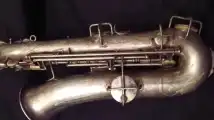
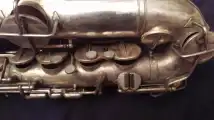
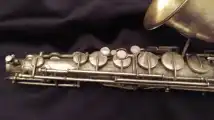
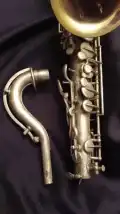
Thank you nigeld. WOW. The restored sax is beautiful. As you requested I will post more pictures to see if my sax can be identified.I'm not sure exactly what you need/want pictures of.

As for your questions: Both sax are the same length - 24 1/2 inches. The necks are the same - 8 inches. The same 8 keys are pearl. Therefore it appears they were made by the same manufacturer ????
 

Attachments

  • IMAG0930.webp
    IMAG0930.webp
    15.4 KB · : 64
  • IMAG0931_BURST002.webp
    IMAG0931_BURST002.webp
    11.3 KB · : 69
  • IMAG0932.webp
    IMAG0932.webp
    17.2 KB · : 72
  • IMAG0933.webp
    IMAG0933.webp
    14 KB · : 67
  • IMAG0934.webp
    IMAG0934.webp
    15.3 KB · : 64
What you have here are two 'stencil' saxes - made by one maker with someone else's name on it. Guessing Oliver Ditson was a music shop. Wurlitzer was a big brand, not just limited to saxes.

To identify maker, we'd need to see full picture of each side of each horn. Close ups of the tone holes, lh table, rh table, octave key and necks.

Low pitch is good, means they will play in tune with modern instruments.

Not sure, but one may be a C melody. So length of the body would help.

Guessing, these horns are from between WWI and WWII. Look as if they'll both need a lot of work doing to make them playable, but would play well once this is done. But vintage is vintage and more modern horns can play a lot better. I'm a fan of older horns, but not everyone is.

@jbtsax sax would be better placed for value/restoration costs, but unless I missed something, they're not worth much as they are.

JBTsax- I just noticed your earlier message that said "sax would be better placed..." do you mean I should have put this in a different forum? If so I apologize since I am new and do not understand the site yet.
 
JBTsax- I just noticed your earlier message that said "sax would be better placed..." do you mean I should have put this in a different forum? If so I apologize since I am new and do not understand the site yet.
That was written by Kevgermany, paying me a complement saying I would be a better place to go to for the value and restoration costs. Sorry for the misunderstanding.
 
So as @kevgermany said, your silver sax is a so-called "stencil" - probably manufactured by Buescher for Wurlitzer, and sold under the Wurlitzer brand. It looks like a Buescher True Tone Series 2 - manufactured before 1926, quite likely in 1921, based on the serial number. Buescher was one of the big American manufacturers of saxophones in the first half of the last century and this was a professional-quality saxophone. Their factory was in Elkhart, Indiana.

The body might be nickel plated or silver plated. If it is silver it will have a matt finish. In either case, the keys are probably nickel plated. Looks like the bell has a "gold wash" finish inside. You need to be careful that you don't spoil the silver plate by over-enthusiastic cleaning. I use non-abrasive silver polish on mine. I think Kev uses a silver cloth.

If you just want to put it on the wall, then you can polish it up yourself, but if you want to get it back to playable condition, then I think you will need to get it professionally restored. The leather pads look pretty poor, so they will probably need to be re-padded. Buescher had proprietary "snap-on" pads, so you should take it to a repair person who knows how to re-pad them (though it's possible that they have been replaced with normal pads during the life of the sax).

You might find this thread useful:
Technical - Cleaning a Buescher True Tone alto

@kevgermany and @jbtsax can tell you whether it is a Bb tenor or a C-melody. Have a look at @jbtsax posting here:
Saxophones - Is this a Tenor or a C-Melody?

If you want to learn to play saxophone, then you could use the silver sax if you have it restored to playing condition. The first sax I played was a vintage c-melody that my teacher lent me. But it's not an ideal starter instrument because vintage saxes can be a bit harder to play than modern ones. Later on, if you want to play with other people, you will probably need a Bb tenor (or an alto).

It sounds quite likely that the brass-coloured sax is a similar Buescher stencil. You could try comparing what the key guards look like and how they are attached to the body. (The key guards are the metal frames). If it is exactly the same size as the silver one, then they are both the same type (c-melody or tenor). If you post pictures, we can see.

Edit: When you take photos of the brass-coloured sax, it would be good to have a picture of the "pinky key cluster". This is the group of 4 keys operated by the little finger of the left hand. If you hold the sax as if you are going to play it, they are about 1/3 way down on the left. Also the octave key, which is on the back of the sax near the top, and the mechanism going up from it to the top of the body.

 
Last edited:
So as @kevgermany said, your silver sax is a so-called "stencil" - probably manufactured by Buescher for Wurlitzer, and sold under the Wurlitzer brand. It looks like a Buescher True Tone Series 2 - manufactured before 1926, quite likely in 1921, based on the serial number. Buescher was one of the big American manufacturers of saxophones in the first half of the last century and this was a professional-quality saxophone. Their factory was in Elkhart, Indiana.

The body might be nickel plated or silver plated. If it is silver it will have a matt finish. In either case, the keys are probably nickel plated. Looks like the bell has a "gold wash" finish inside. You need to be careful that you don't spoil the silver plate by over-enthusiastic cleaning. I use non-abrasive silver polish on mine. I think Kev uses a silver cloth.

If you just want to put it on the wall, then you can polish it up yourself, but if you want to get it back to playable condition, then I think you will need to get it professionally restored. The leather pads look pretty poor, so they will probably need to be re-padded. Buescher had proprietary "snap-on" pads, so you should take it to a repair person who knows how to re-pad them (though it's possible that they have been replaced with normal pads during the life of the sax).

You might find this thread useful:
Technical - Cleaning a Buescher True Tone alto

@kevgermany and @jbtsax can tell you whether it is a Bb tenor or a C-melody. Have a look at @jbtsax posting here:
Saxophones - Is this a Tenor or a C-Melody?

If you want to learn to play saxophone, then you could use the silver sax if you have it restored to playing condition. The first sax I played was a vintage c-melody that my teacher lent me. But it's not an ideal starter instrument because vintage saxes can be a bit harder to play than modern ones. Later on, if you want to play with other people, you will probably need a Bb tenor (or an alto).

It sounds quite likely that the brass-coloured sax is a similar Buescher stencil. You could try comparing what the key guards look like and how they are attached to the body. (The key guards are the metal frames). If it is exactly the same size as the silver one, then they are both the same type (c-melody or tenor). If you post pictures, we can see.

Edit: When you take photos of the brass-coloured sax, it would be good to have a picture of the "pinky key cluster". This is the group of 4 keys operated by the little finger of the left hand. If you hold the sax as if you are going to play it, they are about 1/3 way down on the left. Also the octave key, which is on the back of the sax near the top, and the mechanism going up from it to the top of the body.

 
Thank you for your comments and the links. I am learning so much from all of you. But unfortunately the more I learn the more confused I get. For instance several of you have suggested that this is a true tone. But the links you gave me show the words true tone engraved on the back below the serial number. Neither of mine have this. Could it be that they did not engrave it on stencils?

I looked at the pictures from jbtsax about tenor vs c-melody. The bell brace on both my sax are less than 3 inches from the top. But then I read the post below jbt's pictures saying that wasn't always true.

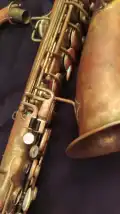
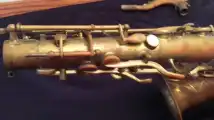
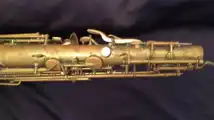
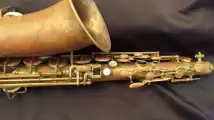
I think these are the pictures you requested to help identify the sax.
 

Attachments

  • IMAG0939.webp
    IMAG0939.webp
    17.9 KB · : 75
  • IMAG0938_BURST002.webp
    IMAG0938_BURST002.webp
    13.7 KB · : 74
  • IMAG0937.webp
    IMAG0937.webp
    13.1 KB · : 69
  • IMAG0936.webp
    IMAG0936.webp
    12.1 KB · : 75
  • IMAG0935.webp
    IMAG0935.webp
    17.1 KB · : 78
For instance several of you have suggested that this is a true tone. But the links you gave me show the words true tone engraved on the back below the serial number. Neither of mine have this. Could it be that they did not engrave it on stencils?

I believe "True Tone" was a Buescher trade mark. So they would not have put it on a stencil horn which was sold under a different brand name.

People also use the term "True Tone" to refer to the series of Buescher saxophones produced before 1930, when they introduced the "Aristocrat" range.
 
I believe "True Tone" was a Buescher trade mark. So they would not have put it on a stencil horn which was sold under a different brand name.

People also use the term "True Tone" to refer to the series of Buescher saxophones produced before 1930, when they introduced the "Aristocrat" range.
Thank you.That sounds like a good explnation.
Today I have been looking around on saxpixs.com and they list Martin as the manufacturer of Oliver Ditson stencils. What do you think? Could it be a Martin?
 
Thank you.That sounds like a good explnation.
Today I have been looking around on saxpixs.com and they list Martin as the manufacturer of Oliver Ditson stencils. What do you think? Could it be a Martin?
Oops. I was wrong. Oliver Ditson could have been Martin or Buescher
This link may help: Alto or Tenor?

Thank you jbt. If I am understanding this right they are both c-melody since they measure 24 1/2 inches?
 

Social

New! Social Feeds

Look out for the navigation icon:

Follow CafeSaxophone

Latest Song of the Month

Trending

Forum statistics

Topics
32,085
Messages
579,003
Members
8,141
Latest member
RoyalCrown
Back
Top Bottom