Tech/maintenance Chinese Pads on EBAY?

I don't understand this. Every saxophone manufacturer uses different pad sizes (both diameter and thickness); saxophone manufacturers change pad sizes from time to time, and if you order a pad set, you're 100% depending on some measurements some guy took, maybe years ago, on a horn that may not even be the same model you have.

The standard for buying pads is:

1) Take 'em all out.
2) Measure each and every pad cup.
3) Based on available pad sizes from the seller, select a pad size for each pad cup.
4) Order THOSE pads, not some other pads.

If you buy cheap crappy pads from who knows where on Ebay, and it magically happens that they are all the right sizes, and you do a bang-up job of installing them (assuming here it's your first repadding job, as the OP indicated, though the discussion's moved on) - then you've got a horn with beautifully installed crap pads. So do you rip 'em all out and redo the whole freaking job again with good materials, or do you leave 'em in and see how long their fake-leather-scraps-pasted-together-with-glue and mystery-felt-like-stuffing last?

Even if the pads are of decent quality (see Stephen Howard's remarks on one company), ordering pre-assembled pad sets is a real good recipe for wrong-sized pads.

Why not just order quality pads from someone like Ferree's or Music Medic (the latter allow you to custom specify pad sets to YOUR pad cup sizes), that when you install them, if you haven't botched the job., you can just leave them in and play the horn?
 
Where are you and you just need pads ?
Not all ship internationally ! I see you’re in the US.
Any other sources like Zhenghao that make the pads and you can order direct?
Music Medic
Instrument Clinic
Ferree’s tool
Prestini USA
JL Smith.

As mentioned above I would avoid “pad sets”. Mark the pad position on each pad face. Remove the pad. Flatten and round the cups. Measure each cup two directions in MM not inches and check the required thickness. Too thin and you’ll be shimming. Too thick and you’ll never get them to seal properly. Keep in mind that 99% of all repads require new cork work for regulation needs.
 
...Keep in mind that 99% of all repads require new cork work for regulation needs.
My practice is before I get into pads (if it's more than a couple in the stacks) I scrape off all the corks. Then you can seat each pad and make sure it's sealing BEFORE you start trying to regulate its interactions with other pads. If you don't do this, every time you see that little sliver of light, you gotta figure out, is this because THIS pad is not sealing properly, or is it because THAT pad's holding it open? Do I need to refloat the pad, or just sand down/add more cork at the back bar? Doing the pad installation and seating with no corks in, and/or all adjustment screws backed out (if you're so lucky) allows you to separate the jobs of seating pads, and regulating the action.
 
My practice is before I get into pads (if it's more than a couple in the stacks) I scrape off all the corks. Then you can seat each pad and make sure it's sealing BEFORE you start trying to regulate its interactions with other pads. If you don't do this, every time you see that little sliver of light, you gotta figure out, is this because THIS pad is not sealing properly, or is it because THAT pad's holding it open? Do I need to refloat the pad, or just sand down/add more cork at the back bar? Doing the pad installation and seating with no corks in, and/or all adjustment screws backed out (if you're so lucky) allows you to separate the jobs of seating pads, and regulating the action.
Exactly spot on !
The individual key(s) need to be installed “as played” (all parts of “system”installed ) and with the spring(s) loaded, cork(s) off. Otherwise you’re going to be deceived. A astute mechanic will get beat to a pulp by what appears to be a stupid easy mechanism.
Wear, flex and the use of natural materials is a craft to be respected. If anyone thinks they can just toss pads in. Squeeze down like a car gasket to make fit. Well, they’re dreaming.
A saxophone is a very different machine. Fair warning !
Saxophone pads are made for saxophones but not specifically for the one you are working on. The design of the saxophone has a lot of narrow tolerances around the pad. If the dry fit as described by PigSquealer results in a fit where tone hole and key cup are parallel, the material of the pad only needs to deform slightly to close all leaks. This small deformation makes a long lifetime of the pad possible.
This ideal fit makes it necessary that diameter and thickness of the pad are in a certain range determined by the saxophone. Something you can't expect from a set. So I make my own pads.
For saxophones where some tone holes and key cups can't form this ideal situation you need an experienced tech.

Also when pad diameter > 35mm, do the dry fit in the playing position of the saxophone as gravity effects start to become significant at this point.
I completely agree. This is a craft / skill that takes (needs) some understanding of the task at hand. It’s not for the DIY/ mechanic or technician that’s a “parts replacer”. One does not fit all…. A DIY will be beat to a bloody pulp if they think they can just stick a pad in and squeeze to make seal. Still a DIY can have success in doing a repad with good working knowledge / understanding. It’s not rocket science, but a good amount of respect to the basic overall mechanical engineering is needed. An understanding of the task at hand. It’s all small stuff that will make or ruin your day. A choice.
@Woodpad @PigSquealer and others are here to help answer concerns, questions and help freely. Don’t be shy. Anyone reading included. Send us a private message if that’s more comfortable.
@Woodpad thanks for your support in helping others 😇
 
Any other sources like Zhenghao that make the pads and you can order direct?
Well what did you choose or discover ? Your feedback is greatly appreciated.
Not all ship internationally ! I see you’re in the US.

Music Medic
Instrument Clinic
Ferree’s tool
Prestini USA
JL Smith.

As mentioned above I would avoid “pad sets”. Mark the pad position on each pad face. Remove the pad. Flatten and round the cups. Measure each cup two directions in MM not inches and check the required thickness. Too thin and you’ll be shimming. Too thick and you’ll never get them to seal properly. Keep in mind that 99% of all repads require new cork work for regulation needs.
 
Most pads are made in China and Italy. If you want to eat Chinese or Italian you can Door-dash. Doesn't work for pads yet. Commercially it could be possible to have pad ateliers who can supply sized ordered pads within 24 hours in a 160 km radius.
 
Please note that there are a couple people who make pads for sale besides the usual suspects.

Matt Stohrer makes his own pads and uses them in his overhauls. He occasionally sells some. He learned to make them from Phil Noy in Australia, who sells pads and also the tools and templates to make your own if you are so inclined. Neither of these is cheap, but it's an attractive option if you have time and are skilled with your hands. Both of these guys use kangaroo hide for their pads.
 
I bought pads from USA.

My mission was to buy American student saxes and make them playable, so aspiring rocksax players could get a sax witout paying too much. I also wanted learn how to work on my own saxes. This was in the early 90's.

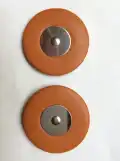
Here are two 52/32 standard pads. One is .160" (c 4 mm) thick and the other is .185" (c 4,7 mm). That's important.

My keywords back then was: - Amrstrong, Bundy, Conn Shooting Star, Indiana, Band Instrument Repair Manual, Rock & Roll Saxophone, Rock & Roll Saxophone Workshop .... . They are still keywords for me. But I don't hear or see so many saxplayers today.

IMG_5117.webp
 

Social

New! Social Feeds

Look out for the navigation icon:

Follow CafeSaxophone

Latest Song of the Month

Trending

Forum statistics

Topics
32,037
Messages
577,706
Members
8,116
Latest member
jaspire
Back
Top Bottom