Tech/maintenance Bought some spring bending pliers...

DavidUK

Well-Known Member
Messages
8,133
Location
Near Evesham, Worcestershire
I looked at Music Medics' but pricey shipped...


...so I found these at £7.50 shipped...
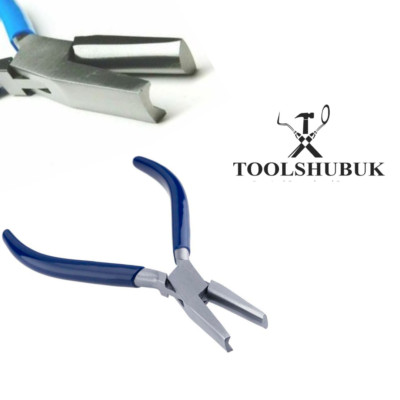

Used them past couple of days. They seem good quality and well built and were just the job for bending a newly inserted needle spring.
 
That sounds like a good deal. Several of my repair pliers are from Otto Frei. When the key is still on the saxophone, I like to use this Music Medic tool to bend springs. I have the medium and small sizes.

tool-sh200.jpg
 
The sax came to me in bits and on reassembly (mostly to check all the bits were there - they weren't) one of the upper stack key springs had obviously been inserted prior to a previous build (or attempt) but not trimmed to length.
I trimmed it in situ, bent it to suit, but the pillar end hadn't been flattened so it spun in the pillar.
I removed it, but bashed it too agressively and it split. Fortunately I had some same size new springs so this time flattened the end first (in case I bodged it I could cut the bodge off and try again).
This time I used a flat metal punch accurately positioned to flatten the end of the spring and hammered that rather than the spring direct, using an anvil under. Worked a treat this time. Inserted spring, pushed into pillar, bent with pliers, job's a good'un.

What is the preferred way of end flattening? Hammer, or is there some 'special tool'?

I could also do with a proper 'needle spring pushing in tool', you know, the one with a slot in one jaw, but they too seem pricey for occasional use.

And... whilst on the subject... if you have an existing spring which doesn't want to come out, not one broken off at the pillar just a rusty or snapped off half way one, how do you get that out? I know not to grip it with pliers and hammer the pliers as the pillar is likely to move and put a dent in the body. Or do you snap it off at the pillar and use one of those tools with a point which pushes it out? That sounds like it may be the way?

But what about a good spring you wish to re-use? How do you get that out?
 
Spring removal. Grab the spring with needle nose pliers on one side. With another pair of pliers squeeze the gripping pliers and the post you’ll just need to get it beyond the wedge.
I like to heat in my Springs some before forming the dovetail end. Be careful what you do they can become brittle or soft. Hammer & anvil.
1671484272840.webp

make them long and trim to fit
1671484362191.webp

It’s not difficult to make a nice taper. I’m guessing the tech on the right had one too many pints the day he made that spring.
1671484504026.webp
 
I could also do with a proper 'needle spring pushing in tool', you know, the one with a slot in one jaw, but they too seem pricey for occasional use.

And... whilst on the subject... if you have an existing spring which doesn't want to come out, not one broken off at the pillar just a rusty or snapped off half way one, how do you get that out? I know not to grip it with pliers and hammer the pliers as the pillar is likely to move and put a dent in the body. Or do you snap it off at the pillar and use one of those tools with a point which pushes it out?
I've never used spring inserting pliers, a pair of long nose pliers with smooth jaws does the job, I preferred investing in the "spring removing" pliers, which are not used often but when I need them I thank I have them!
Half snapped springs: I trim them to about 1-2 mm from the pillar, the "snap" from the cutter usually starts moving the spring in the pillar, I then use the flat long nose pliers to push the spring against the pillar (so from the snapped bit out). On the odd occasion, on poor quality or very rusted springs, the spring just crumbles, that's when the spring removing pliers come in.
I also made some spring punches (using blunt springs) for those stubborn ones that don't want to come out.
 
It shouldn't be too difficult to adapt a set of flat nose to suit.
 
It shouldn't be too difficult to adapt a set of flat nose to suit.
Yes, you would just need to cut a .5 mm slot in one of the jaws, the tricky bit is softening the plier first!
 
The bending pliers require you to have access from directly above the spring, which isn't always the case without a lot of disassembly. The levers shown by jbtsax allow you to come in from the side, which MAY be easier depending on the spring.

I have another tool, a small screwdriver into whose blade I filed a deep notch. If I have access from above I can hook the notch over the spring and twist to bend the spring.

It's quite easy to make a notch in plier jaws, they are only minimally hardened. Personally I'd use a Dremel with the cutoff wheel (or maybe two or three of them, stacked). Or, a hacksaw with two blades stacked in the frame. You don't need such a narrow slot as 0.5 mm. In fact most springs approach or exceed that dimension. A slot more like 2 mm would work better.

It's dead easy to flatten the end of a spring. If you have a small anvil (which could just be a piece of 2" square steel bar stock) you just use a ball pein hammer and LIGHTLY tap till you get the desired amount of spread. You can also use the face of a second hammer as an anvil if you can figure out how to hold it. If I'm near enough a vise that I can clamp the second hammer, I can use the little anvil formed into the vise body.
 
It shouldn't be too difficult to adapt a set of flat nose to suit.
I see Hobby craft have some...


Might try my 1mm metal cutting disc in my angle grinder to see if I can cut a neat notch one side... without cutting the other side! Then tidy with diamond files.
They have curved ones too. Might be useful one day?: Buy Bent Nose Pliers for GBP 4.50 | Hobbycraft UK
 
The first photo shows the pliers I use to remove springs. The spring plier attaches to the spring just past the post and the adjustable jaw pliers are used to squeeze the spring toward the post to pop it free. On places there is not enough room for the fat spring pliers, the small Knipex work quite well. The second photo shows the tools I use to "dovetail" springs. The spring is held in a spring vise and laid toward the end of a jeweler's block on its side with a curved corner.

IMG_1202[1].webp
IMG_1217[1].webp


The slight curve in the jeweler's block also known as a bench anvil was made using a sanding disk in a bench motor. The last photo shows the Music Medic pliers I use to insert springs in the post. They are worth the price because they allow springs to be set in the posts without making marks on an instrument that looks new.

IMG_1213[1].webp
IMG_1203[1].webp
 

Similar threads... or are they? Maybe not but they could be worth reading anyway 😀

Social

New! Social Feeds

Look out for the navigation icon:

Follow CafeSaxophone

Latest Song of the Month

Trending

Forum statistics

Topics
32,075
Messages
578,673
Members
8,134
Latest member
banjo
Back
Top Bottom