

Alternative uses of tools

Messages
3,089
I've found a good number of my modelling tools to be helpful at one time or another with woodwind repair.
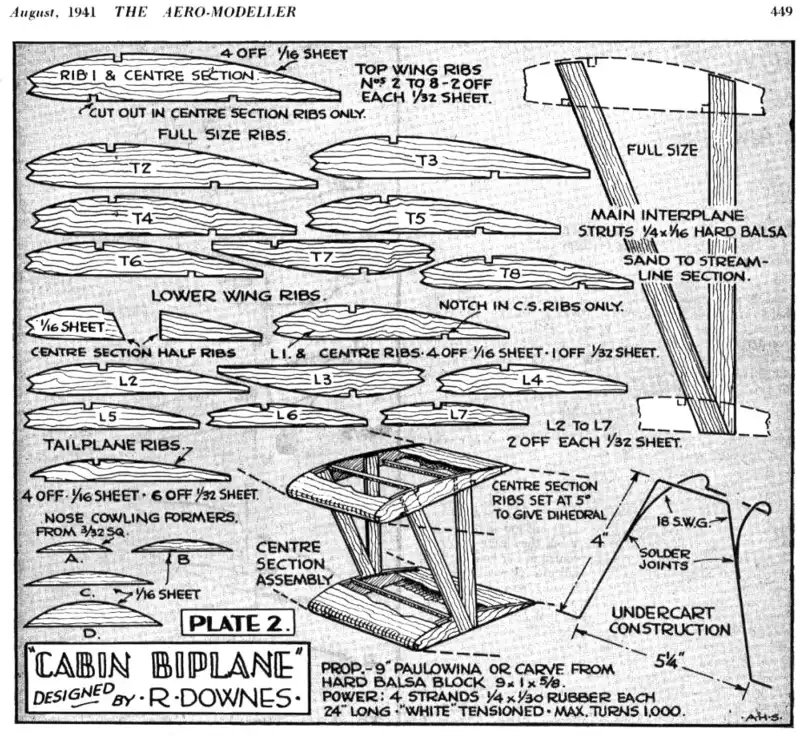
1941-08 Aeromodeller.jpg-21c.webp

Drawing obtained from the August 1941 Aero-Modeller Magazine through a UK resource: RCLibrary : Aeromodelling library. Out of print books, magazines and catalogues. Free downloads. .

That drawing is of a rubber powered model aircraft, where one purchased balsa and plywood sheets, cut and sand the wood from patterns, glue and assemble the model. Seal wood with a special lightweight lacquer called "dope", sand to remove fuzz, then cover with a special lightweight paper tissue.

Knives, screwdrivers, rules, special pliers, etc. came in handy.
 
I've found a good number of my modelling tools to be helpful at one time or another with woodwind repair.

View attachment 30588
Drawing obtained from the August 1941 Aero-Modeller Magazine through a UK resource: RCLibrary : Aeromodelling library. Out of print books, magazines and catalogues. Free downloads. .

That drawing is of a rubber powered model aircraft, where one purchased balsa and plywood sheets, cut and sand the wood from patterns, glue and assemble the model. Seal wood with a special lightweight lacquer called "dope", sand to remove fuzz, then cover with a special lightweight paper tissue.

Knives, screwdrivers, rules, special pliers, etc. came in handy.
I remember the 'dope' was used on the paper tissue.
 
When I was a nipper, my step dad, who was ex RAF, designed an aircraft from scratch of similar ilk to the plans above, we then built it together, this was brilliant as in the process involved learning about the whole aerofoil section malarkey and much more.
With it's massive 'rubber band' It actually flew very well too 🙂
 
We used to build model rockets back in the day. You know, the Estes stuff. Rebooted it when my son was young... and I was finally able to build from the level 4/5 kits. Still have a couple of them hanging over my workbench. They only launched twice at most and then were retired given what I put into them. The casualty rate was incredibly high with such things.
 
Lots of skills learned from model building. Following instructions to how not to burn the house down included. I mostly built 6’ to 8’ towline gliders. This one below was my last. 42” wing all hand-cut from balsa. Gas powered RC and never finished. It’s been well enjoyed as a barn ornament since 1975.
Oh, that yellow film covering was Monokote. New tech of the day. Tack on with hot iron then iron to srink tight / smooth. I got distracted during the process and left mom’s iron face down on ironing board. Lesson learned !
Don’t use mom’s good stuff !
1758858779643.webp
 
I used to be into RC cars. I had a buggy to race in the summer and a carpet racer for the winter months.

The carpet racer was really neat. It had a carbon fiber chassis a huge battery and foam slick tires. That thing would really go.

I sometimes think about getting into RC planes. However, I don't really have anywhere to fly it.
 
One of the best things i learned from model car (slot car) building (apart from how to solder badly) was appropriate heat sinking.

Solder on bit on and another bit falls off. Solder that bit back on and the first one falls off. I didn't know about solver solder back then. But I found it very neat when I did find out what an elegant solution to have one type of solder that melts at a much higher temperature. But I did sort of solve my issue with a kind of home made Heath Robinson heat sink made from various clips and bits of thick wire. It sort of worked but most of the heat sinked onto various parts of my hands and arms.
Yes, I've had those hot parts sink into my hands and fingers and forearms, and I can still see the scars to this day.

Memo to self: when doing overhead welding on a scissor lift 15 feet in the air, wear elbow length leather gloves, to prevent the little red hot piece of steel from dropping in between your wristwatch and your skin and staying there, with a faint sizzling sound, till cool. (You can't get the watch off either, because you've got a live welding stick in the other hand....)

Second memo to self: when doing overhead welding on a scissor lift 15 feet in the air, check the deck for any old oily rags, and REMOVE them, FIRST, before you strike an arc - I think you can guess how I learned this lesson...
Another interesting one is when you get a bit of weld spatter go in your ear and you listen to it sizzling the lil' hairs in your lug holes...
Or try a day arc welding on railway wagons out in the rain, every time you change a rod you get a bloomin' shock 😱
 
Yeah, welding's a young man's game I think.

My stepfather worked for a while in the shipyards in Chicago; he was NOT a welder - but he told about the guys who would weld the bottoms of the barges in drydock - they would lie in the gap a couple feet tall between the bottom of the barge and the bottom of the drydock and run beads overhead all day long. Is it overhead welding if you're lying down?
Well I was still on it well into 50s +..I still do a bit but just occasional 'project' stuff for me, and definitely decline messing with other peoples bleedin' cars !
A nasty one we did once was welding and fixing sections of pipe crawling down these tiny tunnel things beneath what was an ex MOD site. I can't imagine doing that now.
 
I did a lot of welding in the day. Specifically at MTU, the largest part we (it took about 10 welders simultaneously because of the heat distribution / avoiding of warping was a 30 ft long crankshaft from one of their gigantic ship Diesel engines. It took about 2-3 days of prepping and choreographing everybody's contribution in the hope we could maintain the tolerance in axial deviation and nobody knew whether it would work until the part had finally cooled off again.

But we did it and the management bought a huge buffet including several cases of beer for everybody who participated.

And yes, I had some of these little surface mount resistors / capacitors burned into my fingers but that was just my own stupidity / getting distracted by somebody ...
 

Social

New! Social Feeds

Look out for the navigation icon:

Follow CafeSaxophone

Latest Song of the Month

Trending

Forum statistics

Topics
32,037
Messages
577,700
Members
8,116
Latest member
jaspire
Back
Top Bottom