

 (bottom of page)


I started to play the sax by playing along recordings. This was my way to "learn" to play, I just played along. Some improvasion, catching some singing lines, copy solos, riffs, fillings ...... I just played along and got familiar with a song-style-genre ... this way. I played a song 500 times, maybe more! "Look At Little Sister" (Hank Ballard) is one of these songs. I began to listen to Stevie Ray Vaughan back in the early/mid 80's. Sax friendly music. SVR had saxes on some recordings. Joe Sublett (tenor and baritone sax) and Stevie Ray played together in Texas. Joe Sublett played baritone and tenor on "Look At Little Sister". My learning process was slow and very basic. I just played what I heard and added my sax here and there.
View: https://youtu.be/OFdocqyMB54?si=x3_J01Wy6FIE5SKP
In the mid 90's I came in touch with the Boston saxplayer, Andrew Clark. He wrote in Saxophone Journal about Rock & Roll Saxophone. In a column he wrote about three ways to play the blues. I tried and and since then it's the method I trust. I didn't copy Andrew Clarks method. Mine is more ad lib. Through the years I learned some theory by buying sheet music. More to see the chords, form ...... than reading dots.
1. I just play the chord tones over the recording. 12 bars in I, VI and V progression. The song is in concert Eb. F on tenor, C on baritone. Just played the chord tones over and over to SVR's recording.
2. Play the F blues scale and C blues over the song. F blues; F, Ab/G#, Bb/A#, Cb/H/B, C and Eb/D#. C blues: C, Eb/D#, F, ,Gb/F#, G and Bb/A#. I'm a sharp guy so I think in "#'s" rather than in "b's" I try to stay out of reading as well. Play other scales over the song as well so you can compare. Maybe some parts of a another scale sounds better!?!?! I borrowed from the other scales. Just tried to play with a nice flow.
3. After some time I wanted to add some RockSax tricks. And my tone/sound developed as well over the years.
I like Rock & Roll Saxophone and I always come back to the blues after breaks. It were it's started for me. IMO it's not possible to play Rock & Roll without to have learned to play and love the tradition of blues. The easy blues is great.
Today I don't have to play along with recordings. In the late 80's I bought my first backing CD-R's. Nowadays I buy custom backing tracks on internet.
I even read easy hornparts. You can learn an old dog new tricks !!!!!
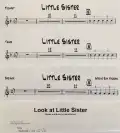
3- Horn parts in F/C. Lead sheet in E with a note to tuned down a ½ step. The guitarrists here around didn't tuned down.. So the hornparts were transposed a ½ step up tp F# and C#. Me like. The sax players s didn't read, but the trumpet player did!!!
In the mid 90's I came in touch with the Boston saxplayer, Andrew Clark. He wrote in Saxophone Journal about Rock & Roll Saxophone. In a column he wrote about three ways to play the blues. I tried and and since then it's the method I trust. I didn't copy Andrew Clarks method. Mine is more ad lib. Through the years I learned some theory by buying sheet music. More to see the chords, form ...... than reading dots.
1. I just play the chord tones over the recording. 12 bars in I, VI and V progression. The song is in concert Eb. F on tenor, C on baritone. Just played the chord tones over and over to SVR's recording.
2. Play the F blues scale and C blues over the song. F blues; F, Ab/G#, Bb/A#, Cb/H/B, C and Eb/D#. C blues: C, Eb/D#, F, ,Gb/F#, G and Bb/A#. I'm a sharp guy so I think in "#'s" rather than in "b's" I try to stay out of reading as well. Play other scales over the song as well so you can compare. Maybe some parts of a another scale sounds better!?!?! I borrowed from the other scales. Just tried to play with a nice flow.
3. After some time I wanted to add some RockSax tricks. And my tone/sound developed as well over the years.
I like Rock & Roll Saxophone and I always come back to the blues after breaks. It were it's started for me. IMO it's not possible to play Rock & Roll without to have learned to play and love the tradition of blues. The easy blues is great.
Today I don't have to play along with recordings. In the late 80's I bought my first backing CD-R's. Nowadays I buy custom backing tracks on internet.
I even read easy hornparts. You can learn an old dog new tricks !!!!!
3- Horn parts in F/C. Lead sheet in E with a note to tuned down a ½ step. The guitarrists here around didn't tuned down.. So the hornparts were transposed a ½ step up tp F# and C#. Me like. The sax players s didn't read, but the trumpet player did!!!


