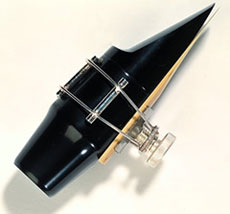
Ligatures Ligature do I really need a fancy one ?

But seriously, folks... having had my little joke...

Some believe that ligatures make no difference to tone as long as they hold the reed securely, others that ligs can make a difference.

If they do affect tone, how do they do it?

Anyone who believes that they make a difference has probably tried to figure out why, so I am genuinely interested to have your views. Also - is there any concensus on which ligs alter the tone in a particular direction?

I would call for a 'BLIND TEST' then we would have fun!
 
My general observation is that material ligs seem to dampen the sound somewhat, that metal ligs seem to produce a brighter sound overall, and that metal ligs with parts seem to be rated slightly better - such as Francois Louis/Vandoren Ultimate. I use a Marca Jean lig - the only part that touches the reed is made of wood and I often describe the sound as more three dimensional. Given this I would speculate that resonance of some sort and the effect of various materials on this is what affects the tone.
 
My general observation is that material ligs seem to dampen the sound somewhat, that metal ligs seem to produce a brighter sound overall, and that metal ligs with parts seem to be rated slightly better - such as Francois Louis/Vandoren Ultimate. I use a Marca Jean lig - the only part that touches the reed is made of wood and I often describe the sound as more three dimensional. Given this I would speculate that resonance of some sort and the effect of various materials on this is what affects the tone.

Similar feel here.
A strange thing is the difference between an original Link ligature or a Selmer on a metal Link changes things. I suspect that the way the reed seals makes a bigger difference than any possible resonance.
 
To think you can get all the sounds mentioned below, just from the plating? I fancy the 'more elegance'
>:)

The Ultimate Ligature comes in three finishes:

20.jpg

The Brass is more resonant and vibrating.
The Silver is more resistant and darker.
The Gold has more “elegance” and a slicker tone quality (polished).

That confirms what I said about traces of diesel fuel and old engine oil on my jubilee clip lig giving the dark and smokey sound I was after...
 
Last edited by a moderator:
But seriously, folks... having had my little joke...

Some believe that ligatures make no difference to tone as long as they hold the reed securely, others that ligs can make a difference.

If they do affect tone, how do they do it?

Anyone who believes that they make a difference has probably tried to figure out why, so I am genuinely interested to have your views. Also - is there any concensus on which ligs alter the tone in a particular direction?

I looked into it a lot for my own playing sound and set up and the ligature effects the reed by the amount of pressure applied to the surface area and at what points of the reed it touches, which varies the way it vibrates so if a ligature that holds a reed like a rovner, covering a lot of reed, then it tends to dampen the vibrations leading to a less open sound or more focused, maybe that's why a lot of classical players tend to use them or people who prefer a darker sound, so if you use a ligature that has pressure points/plates it only touches the reed at certain points allowing it to vibrate more freely thus producing a more open sound usually brighter too and that is why i spent over 3 hours with a sax tech in Berlin choosing my ligature with care and 1 particular focus for my sound..
 
To think you can get all the sounds mentioned below, just from the plating? I fancy the 'more elegance'
>:)

The Ultimate Ligature comes in three finishes:

20.jpg

The Brass is more resonant and vibrating.
The Silver is more resistant and darker.
The Gold has more “elegance” and a slicker tone quality (polished).
looks like my Berg Larsen,(in the yard sale here) i use a F.Louis clarinet silver lig on it, fits great and a great sound too.View attachment 2734View attachment 2735
 
Last edited by a moderator:
Just been having a break playing my tenor - Saxscape Uptown Live mpc, Alexander NY reeds and 4 different ligatures to hand - Marc Jean, FL Basic, Selmer 2 screw and Rico Basic - from £46 down to £20. The Marc Jean was the most resonant and did not have the metallic edge I normally notice on metal ligs. More pronounced difference in the lower register but quite a full upper register. The FL Basic had a fairly solid range - some resonance but clearly only to a certain point. The upper range was thinner and the edge was slightly metallic. The Selmer had the more solid lower register, closer to the Marc Jean but not as resonant. The upper register had some body, too. The Rico Basic Lig was slightly less solid in its range. The sound was pretty good but had the most metallic edge as it went up the scale. Less resonant than the others, not unpleasantly so. The Marc Jean was better than the others in the upper register, all of which had various degrees of thinness, or thinnerness as the extent of this was not high.

In terms of rating I would put it:

1.Marc Jean
2. Selmer
3. FL
4. Rico

The more solid metal of the Selmer seemed to make a difference as may have been that the reed was on the same side of the lig as the screws. I could not find my Rovner Evo-5 ligature to try out a material ligature, unfortunately.
 
I believe that the differences in sound and feel are due to the fit. Fit is everything in my opinion.

I use a textile ligature for the tenor rubber mouthpiece. It's handmade by me using the generic parts of a cheap lig and adapted to fit this one specific mouthpiece. I like it with the bars on the reed which gives a small ish contact area on the reed and holds it firmly and snuggly on the table of the mouthpiece.


I have a selmer metal lig for the metal alto mp. The plating wore off decades ago so it's apparent that it's made of brass. With a soft metal like brass the lig moulds itself to the mouthpiece under the tension of the screws and over time it becomes one with the mouthpiece. I like this one screws on the reed.

From an engineering point of view, I can't see how most ligatures can be swapped from mouthpiece to mouthpiece and fit them all snuggly and precisely without some sort of problems or damage, especially the metal ones like a rico.

The rico ligs I've handled that came with various mouthpieces fit quite well on the piece they come with but appear to have little give or flexibility in the metal and I can't see them being much use on anything else.

The FL ligs pictured have a very open, almost skeletal design and should adapt themselves quite well to a range of differently shaped mouthpieces and with the plates being almost independant or the ring should give a good even pressure on the reed almost like a slide on lig.

The thing that bothers me with them is the price. I think they are taking liberties. Maybe I should offer a hand made textile lig service and clean up.

So, to sum up, a fancy, expensive, cutting edge, fashionable, cool looking, talking point will play fine, if it fits, But no better than a battered old friend or a brand new cheapy. IMO of course.
 
We'll just have to agree to differ......................................................................

I just do not accept that the world is full of people trying to make a fast buck by trying to fool most of the people most of the time. Marc Jean is a very humble Canadian, and Francois Louis is similarly a well researched, very sincere guy, having had much chat with them over the years. They both produce superb ligatures.
 
Last edited by a moderator:
Okay, I thought I'd try two different ligs tonight t see if I could tell the difference. I usually use a Rovner Versa on alto. It only fits one way with the cradle on the reed and has limited contact on the sides, unlike other material ligs. the only metal lig I have is the standard two screw Yanagisawa that came with the sax.

Given the limited contact on the Rovner (vs a dark, for example) and the basic nature of the Yani I didn't expect a difference.

I was very surprised. There was a marked difference, with the metal allowing some of the overtones to come through and it was much more vibrant without being overly bright. I was able to play overtones more easily.

I always was of the opinion that ligs wouldn't make much difference. I guess it depends, as always, on the combination of mpc and reed with the lig but I'm going to experiment with FL and Vandoren Optimum.

on tenor I play both metal mpc with metal lig and HR with Rovner dark. I thought the difference between the two was purely down to mpc material. I will now rethink that too......
 
(inserting sarcastic humour here, before you decide to attack ;})
I think at this point i say "told you so" to all the doubters thinking ligatures do not matter. Many players including myself at great lengths have test run the theory on this subject and found they do make a difference but if some people still prefer to be happy thinking otherwise then that is up to them, or maybe some are simply happy with a generic tone while they ponder about the world being flat 🙂))
 
Last edited by a moderator:
My scepticism on this subject comes down to a question of mechanism. Just how is the ligature supposed to affect the sound? Surely the part of the reed which is in contact with the ligature is not supposed to be vibrating.

I can see that an ill-fitting or poorly made lig might permit unwanted vibration or even damage the base of the reed. but if it's doing its job of holding a certain part of the reed still, how can it affect the sound?

Seems to me if it floats your boat sound wise or frees up the reed, there is no need to know the mechanical or scientific reason. Lots of people drive cars, and don't have a clue how they work.
 

Social

New! Social Feeds

Look out for the navigation icon:

Follow CafeSaxophone

Latest Song of the Month

Trending

Forum statistics

Topics
32,082
Messages
578,839
Members
8,140
Latest member
AnnaR
Back
Top Bottom