Saxophone beginners Why am I squeaking going from high C to G?

Messages
154
Location
Greater Toronto Area (Canada)
Hi there,

Does anyone have any idea on why I consistently squeak when descending from the high C to the G in this C major two-octave arpeggio? It also happens sometimes when I land on the G coming from a higher note but not always.
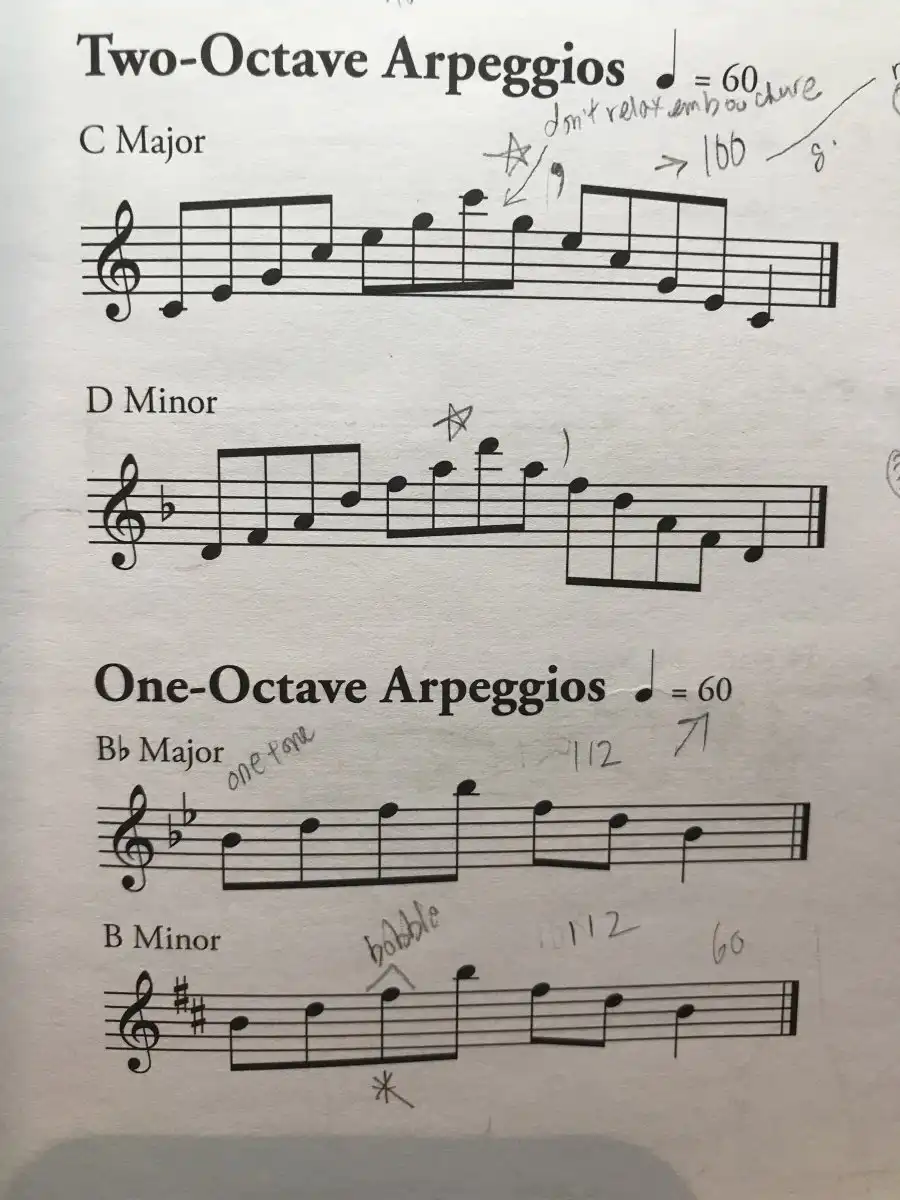
9BD9031C-F932-4BFB-B0FF-1929678B6FAF.jpeg


I just bought a new sax (YAS62) and it happens on my old sax (YAS26) as well. Unless coincidentally both saxes have the same problem (which is possible), I think it’s my technique.

Any thoughts?
 
Last edited:
If there isn't a problem with both saxes, the most likely cause is fudging the fingering.
C to G with the octave key has the octave mechanism switching from neck pip to body pip. You need to be accurate and firm. Take your time till your fingers get synched automatically. You may be fudging palm keys or front f. Keep your fingers close to the pearls. The smallest movement results in best accuracy.
It could be the horns. Maybe bis needs regulating. It is common for it to go out of synch and leak a little with just left hand. Closing a right hand key may still be closing it so it goes un noticed.
To check hold G and with the left hand press Bis with the right. Any movement can be felt and needs regulating away.
Having said all that it may just be a voicing problem. Think G2 and hear it before you play it. Relax your embouchure into it from C3.
 
Vote:
Upvote 0
If there isn't a problem with both saxes, the most likely cause is fudging the fingering.
C to G with the octave key has the octave mechanism switching from neck pip to body pip. You need to be accurate and firm. Take your time till your fingers get synched automatically. You may be fudging palm keys or front f. Keep your fingers close to the pearls. The smallest movement results in best accuracy.
It could be the horns. Maybe bis needs regulating. It is common for it to go out of synch and leak a little with just left hand. Closing a right hand key may still be closing it so it goes un noticed.
To check hold G and with the left hand press Bis with the right. Any movement can be felt and needs regulating away.
Having said all that it may just be a voicing problem. Think G2 and hear it before you play it. Relax your embouchure into it from C3.
Thank you. I will try all of your suggestions and see what happens.
 
Vote:
Upvote 0
Practice fingering isolations:

Place all fingers including pinkies on the pearls. Finger and play octave A then G then A (engaging the octave switch). Start slowly and repeat over and over. The G key is a little stiffer to press because it is linked to the octave mechanism.

Then practice B then G then B over and over. Then C then G then C. (On through the palm key fingerings, too).

Starting easily (in both tempo and note interval) and speeding up gradually helps bring both your fingering and your voicing to mastery.
 
Vote:
Upvote 0
What @CliveMA wrote was right on target. Sometimes the 3rd finger on the left hand is a bit late closing the G key which allows the neck octave to stay open a bit too long, or you could say close a bit too late. When both octave vents are open at the same time things go haywire like when the neck ring is out of adjustment and the neck octave vent stays open. One suggestion is to try "leading" slightly with the 3rd finger when making those finger changes.

@Colin the Bear also mentioned "voicing". Specifically when the back of the tongue is too high, it encourages the G to go to the 2nd overtone of low G which is high D which can sound like a squeak. Singing or saying "AHH" like you do when the doctor wants to see your throat is the way to solve that problem if it applies in this case.
 
Vote:
Upvote 0
Hi there,

Does anyone have any idea on why I consistently squeak when descending from the high C to the G in this C major two-octave arpeggio? It also happens sometimes when I land on the G coming from a higher note but not always.

View attachment 16732

I just bought a new sax (YAS62) and it happens on my old sax (YAS26) as well. Unless coincidentally both saxes have the same problem (which is possible), I think it’s my technique.

Any thoughts?
I have a keilwerth tenor finding a lot of squeaking on middle b
 
Vote:
Upvote 0
Pinchy bitey embouchure and inadequate airstream support. Put a big solid airstream through the thing, blow from the ankles up, hold the mouthpiece like a Labrador Retriever bringing a duck - firm yet soft - use the muscles of the embouchure to provide light steering forces and fine adjustments while the work is done by the large powerful muscles of the torso and abdomen.
 
Vote:
Upvote 0

Similar threads... or are they? Maybe not but they could be worth reading anyway 😀

Social

New! Social Feeds

Look out for the navigation icon:

Follow CafeSaxophone

Latest Song of the Month

Trending

Forum statistics

Topics
32,034
Messages
577,653
Members
8,115
Latest member
kamosax ug
Back
Top Bottom