Playing the saxophone How to play middle D louder?

Aindan

New Member
Messages
2
Location
Norwalk
Hey, I am currently in marching band and most of my music hits high points on a D, I have had problems playing a D louder but it feels like I’m hitting a wall which the amount of sound I am able to produce. I was wondering if anyone knows if or how I can play any louder. I am playing a YTS 21 on a beginner Yamaha mouthpiece right now but have better mouthpieces for concert and jazz.
 
Do you mean middle D - written within the stave, or "palm" D sat on two ledger lines above the stave?

If you mean middle D, then yes, you can open the palm key D at the same time as fingering the D the normal way - just add it. Very useful as lead alto in a Big Band too.

If you mean high D, then I would imagine that your general volume throughout the instrument is below where you would like it to be. You can try a harder reed, but that might mean that control is compromised, or change to a mouthpiece with a larger tip opening, which will literally allow more volume of air.
 
Vote:
Upvote 0
  • Try to adjust the ligature. You can move the ligature forward or backward. We are not talking about one centimeter!!
  • Loosen the ligature screws.
  • A new reed or do some work on the reed.
  • D2 can be tricky to play. Try to play D3 (palm key) without the octave key and no other fingers. The ordinary fingerings for D2 and add D palm key.
 
Last edited:
Vote:
Upvote 0
Stand facing a wall or window and practice going from C to D while trying to maintain the same timbre and dynamic. I think part of what you're experiencing is above and below middle D, the sound emanates from higher up on the horn and closer to your ears. D comes out the bell, farther away from your ears. Hearing the reflection from the wall will give you a truer picture of what's really happening. I suspect your D is actually louder than you think.

Of course on the field, it will feel as if you're playing into a black hole. Not much to be done about that. Rather than you giving yourself a hernia, your section mates should step up the volume as well. One lone saxophone isn't going to make any difference. It's the brass that people actually hear in the stands.

Another thing that's worth a try is unscrew the low C felt stopper a little more to make D less stuffy, but not too much or the D will go a little sharp.

The palm key D trick is a good one, especially on bass sax. I've never had to resort to that on other horns.
 
Vote:
Upvote 0
Every instrument has notes that vary in timbre and responsiveness. Your job, if you want to be a musician, is to learn how to play the notes with consistent tone and pitch. You do this by practicing.
 
Vote:
Upvote 0
  • Try to adjust the ligature. You can move the ligature forward or backward. We are not talking about one centimeter!!
  • Loosen the ligature screws.
  • A new reed or do some work on the reed.
  • D2 can be tricky to play. Try to play D3 (palm key) without the octave key and no other fingers. The ordinary fingerings for D2 and add D palm key.
A variation of this that I learned is to play D2 using palm D in place of the octave key. The acoustical explanation of why the D is more resistant/stuffy is because it is the first note of the upper register to use the octave key and it uses a longer "tube". On the conical saxophone, when you add fingers to go lower, you are also playing on a wider tube. A saying I used to use with my students was "the lower you go, the harder you blow".
 
Vote:
Upvote 0
A "beginner mouthpiece"? Yam 4c?
Why use this if you have others? It's not exactly a piece known for its projection.

Any leaks in the lower stack or G# regulation will sap your volume, so have it checked.

A wider tipped mouthpiece may facilitate more volume especially if used in conjunction with a step up in reed hardness.

Playing outside is very different to playing inside. Nothing is reflected back to you. You may already be louder than you realise.
 
Vote:
Upvote 0
A variation of this that I learned is to play D2 using palm D in place of the octave key. The acoustical explanation of why the D is more resistant/stuffy is because it is the first note of the upper register to use the octave key and it uses a longer "tube". On the conical saxophone, when you add fingers to go lower, you are also playing on a wider tube. A saying I used to use with my students was "the lower you go, the harder you blow".
First time I heard of using just the palm D key was when I saw Steve Douglas VHS "Rock & Roll Saxophone"in the early 90's. Douglas used to play D2 and E2 with playing D3 and E3 (palm keys) due to his Super 20. A player told me to play/practice the C2 to D2, C#2 to D2 ..... without using the octave key. Think (visualize) how good, clear, strong ..... your D2, E3 ... comes out.
 
Vote:
Upvote 0
I use the palm D key INSTEAD of the octave key for D2, especially for notes that have to be strong or are held a long time. I have not tried this with E2, or Eb2, these notes speak well for me on my horns. But D2 is somewhat stuffy on every horn I’ve ever played.
 
Vote:
Upvote 0
A sax tech in USA used to make an extra tone hole (opened when D2 was played, I don't know if it was opened when Eb2 and E3?). Didn't Holton make saxes with a "speaker key"?

The D2, Eb2 and E2 are "double tricky". The player and the saxophone. To hear/have the tone in your head you are going to hit helps up.
 
Vote:
Upvote 0
I use the palm D key INSTEAD of the octave key for D2, especially for notes that have to be strong or are held a long time. I have not tried this with E2, or Eb2, these notes speak well for me on my horns. But D2 is somewhat stuffy on every horn I’ve ever played.
Yes it works really nicely on tenor - Getz used it a lot - but it’s a fairly different sound on alto and you have to pick where you use it and the reason for it.
 
Vote:
Upvote 0
Alternate D2 (palm D instead of octave key) works on alto for me. I agree it has a different tone color, which is why I use it.

Another useful D2 fingering that only works on alto (for me) is to finger C2 (LH middle finger) plus the palm Eb key. On tenor, just plain palm D works in situations where this fingering is useful.
 
Vote:
Upvote 0
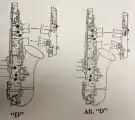
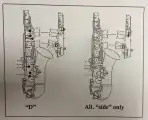
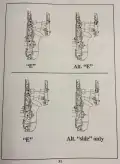
Here is some pictures with "alternative fingerings" for D2 and E2. The technique is also called double tone or "Doo Wop" in John Laughter's book "Rock & Roll saxophone" and I borrowed the pict from his book as well. Great book and easy to use as well. Pete Thomas calls it false or fake fingerings or double densites False or Fake Fingerings aka Double Densities . It's not only the saxophone sound that can be described with variuos words/terms?

When you have come to the point when you after practicing, tweaking with embrouchure, reeds, ligatures and mouthpice and you can't play ordinary D2 or E2 with ordinary fingerings you can try alternative fingerings. If the alternative fingerings sound better and is in tune compared to ordinary fingeings, then it should be your ordinary fingering?

Alternative fingerings are used to create some interest in songs/solo. But can also be used to cover bad saxes/constructions😉 It's your choise.

D2 and E2 should be played with ordinary fingerings. @Aindan the tips/info useful for you?
alt D2.JPGaltd2.JPGalt E2.JPG
 
Vote:
Upvote 0
Folks, let's keep this in context. OP is a school kid in marching band. Introducing alternative fingerings that hardly anyone uses, at this stage of learning, is more likely to cause issues than to solve them. OP just needs to learn how to blow through the horn with standard fingerings first.
Yes, that's right. But to be frank we just know that he is playing in a marching band ....."playing a YTS 21 on a beginner Yamaha mouthpiece right now but have better mouthpieces for concert and jazz......." Maybe a beginner or a player that been playing for some years?. But I also think to learn to play D2, E2 correct is the best way. It would be easier if he gave us a sign.
 
Vote:
Upvote 0

Similar threads... or are they? Maybe not but they could be worth reading anyway 😀

Social

New! Social Feeds

Look out for the navigation icon:

Follow CafeSaxophone

Latest Song of the Month

Trending

Forum statistics

Topics
32,072
Messages
578,571
Members
8,133
Latest member
walthang
Back
Top Bottom