Playing the saxophone Help - I'm sharp over the break and more so in the altissimo range

I think you're missing the point going on about chamber size. It's perfectly possible to play in tune with a small chamber mouthpiece. We don't actually know that Tobes' custom job is a small chamber mpc - and he had the same problem on a Link. Something else is the matter.
 
Last edited by a moderator:
I've ordered the Rico Royal Graftonite A / 7 for 14 quid with free delivery so will quickly know how chamber volume with affect tuning - I heard they were quite good anyway and can always use as spare or sell on.

Incidentally I just managed to play all of 'Here comes the bride' (round of applause - don't ask!) on my custom alto mp - I can't do this on tenor mp so it could be tenor mp, or more likely, that my embouchure is currently more suited to alto...
 
I've ordered the Rico Royal Graftonite A / 7 for 14 quid with free delivery so will quickly know how chamber volume with affect tuning - I heard they were quite good anyway and can always use as spare or sell on.

That's a good strategy. The Graftonite will make a decent, flat baffle (Berg/Dukoff) mouthpiece giving you the edge and focus that you want. You can then ream out the rear chamber/throat to get the volume/pitch right. If you always start your playing test from the D1/D2, perfect octave, then the volume will always be optimal. You then monitor the alignment of the C#3 to C#2. The fatter you make the chamber, the more you raise the C#3/upper register pitch. When they are effortlessly perfect, you are done, and the horn will be centered at A=440, the scale will be as even as acoustically possible, and play better than it ever did before.

The reason many saxophones have a bad high, C/C# is because of the mouthpiece being poorly aligned. Fix the mouthpiece and you fix the horn.

The polycarbonate is extremely tough to cut though. It will quickly dull any cutting tool.
 
Last edited by a moderator:
Rico Graftonite arrived

The Rico Graftonite arrived. Very impressive mp for the price - nice full sound and even toned throughout whole range of instrument - very similar to my Otto link 7* Tone Master I used to have!

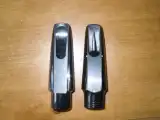
The volume of the Rico chamber is definitely a lot larger than my custom one. I have attached 2 photos comparing the two - my custom one is the one on the left of both photos. However, I still same tuning problem, as naturally 20 cents sharp on notes over the break! Interestingly though, it is easier to flatten the notes on the Rico - I can also control the pitch better on the Rico when playing just the mouthpiece - I am wondering why this is?

I do prefer the overall volume, and big sound I get with the custom mp though, although harder to control, I am still going to persevere with it as my mp of choice. You'll see that my custom mouthpiece has much thinner rails and a shorter, wider opening from the face view. Both are around a 7 tip.

My conclusion on the whole playing sharp over the break, is that my ears have been de-tuned slightly as a result of playing like this (with bad embouchure) on the tenor for some while now, to the extent that the second high note of a perfect octave can sound ever so slightly flat to my ears (haven't got a clue why this doesn't affect alto tuning but there we go!)

My solution, as before, is to practice with just mp, learning to control pitch better and playing with the tuning track I laid down, everyday covering the entire range of the instrument. Also I am going to start playing piano more again, which obviously is perfectly in tune so hopefully won't be long before my heads got straightened out tuning wise 🙂
 

Attachments

  • SDC11175.webp
    SDC11175.webp
    7.9 KB · : 158
  • SDC11174.webp
    SDC11174.webp
    16.1 KB · : 154
Regardless of brand, the saxophone can not play any better than the degree to which the mouthpiece completes the horn's acoustic design correctly. There is no getting around it. You can spend years, randomly trying every possible stock mouthpiece, hoping to find something that works well, or you can spend 5 minutes and systematically determine exactly what you need, at which point, obtaining it (adjusting your mouthpiece yourself or having someone else do it) is a simple task.

Please give us a few pointers - at idiot level that I can understand.
 
Had a top sax player come round (Ian Ellis) and tried my setup. To be fair his exact tuning was not that much different to mine. He's obviously better at sharpening or flattening the notes depending on the horn tuning quirks, for which there are quite a few. However, since practicing just Mouthpiece playing, (I can play an even (ish) scale for one octave on the tenor mp now, better than a couple of weeks ago) I can manipulate the pitch much better 🙂. We concluded that at present, my tuning was not a MAJOR hang-up and that the best next steps are to sort the horn tuning quirks out - different mouthpieces made very little difference.

Ian noticed that there was quite a large variation in how much travel there is on some of the keys, for instance, the lower Eb key is not opening that much, making the note naturally flat, whereas most of the auxiliary keys are opening too far probably making the pitches too sharp. So I need to make some adjustments. Any ideas on the easiest way to build the corks up (raise height / create more cork) where there is too much travel on the keys?
 
Any ideas on the easiest way to build the corks up (raise height / create more cork) where there is too much travel on the keys?

If the cork is too thin, it may be better to replace it with one piece of thicker cork. I find that in the old days, when Evostick actually worked properly, then building up in layers could be OK, but today's glue is crap.

What you will find is that many of the keys are dependant on each other, if you get one sorted, another will go out of whack. Great fun.

It's worth spending a few quid on Stephen Howard's Haynes Saxophone manual.
 
I can only second what Pete said. I did some tweaks to my tenor the other day, trying to cure a problem. I sanded the wrong cork by mistake.... 1 New cork later it's OK again. However low Eb is independant of other keys, so you can mess with that without fear of upsetting others.

Stephen's manual is super, there's also quite a lot of info at cybersax.com on regulation, but it's split across quite a few threads.

You might find it worth taking a look at the Balanced venting page at music medic, if only for a little insight:

http://www.musicmedic.com/info/articles/num_25.html
 
Well the gigs are over now and I asked the sound guy the other day if he'd noticed any difference in my tuning over the summer - he's immediate reply was that my playing, tuning in particular, has come on leaps and bounds since the start of the summer - I HAVE been asked back to play with the show in October when it restarts, so can't be a bad thing!?

I think the main thing I have come away with it knowing how to, and how much you can, alter the pitch, even just using mouthpiece etc, and to keep a keen ear always open to tuning so I can flatten or sharpen as necessary - being also weary of problem notes, like tendency of E2 to be sharp etc. This is something I still need to continually develop and hopefully will continue to improve.

Incidentally my wife has just started learning the violin and can't read or understand music, basic theory etc. so I am learning the violin with her. Really enjoying it! This, I think, is the ultimate test of developing sense of pitch and accurate intonation - I recommend learning basic violin to any sax player need to develop tuning / intonation. Believe it, or not, it don't sound half as bad as someone just starting to learn sax - especially if you already have a good sense of pitch etc. Thanks again for all your input 🙂
 

Similar threads... or are they? Maybe not but they could be worth reading anyway 😀

Social

New! Social Feeds

Look out for the navigation icon:

Follow CafeSaxophone

Latest Song of the Month

Trending

Forum statistics

Topics
32,073
Messages
578,611
Members
8,133
Latest member
walthang
Back
Top Bottom