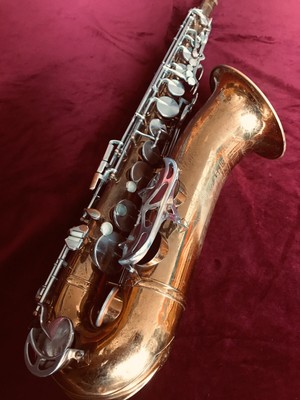
Saxophones Did King ever make a transitional zephyr

That's good to know.... I have a tenor #283xxx!
Except as I noted in reply #11....that's not right. (Well it IS right that you DO have a sweet-spot one.

But I dunno who the heck came up with the ludicrous notion that the 'best' Zephs only were within a 5000 digit serial range. 😳 It even sounds silly, when one thinks about it, doesn't it ?

That is what is known as...malarkey.
 
Just curious. Silver soldered toneholes on your freinds S20? How was the neck joint?
I will have a look at my friend's next practice, I believe it (700,000) has soldered toneholes. I am told that the 2414/2416, which is what the S20 was renamed in late 70's, may not have; some say only the bell and bow holes were soldered, the tube was drawn.....although I have only done 2 of them and I did them before the question appeared on my radar. I'd like to confirm or refute that, next time one of those late ones crosses my bench,

I have only glowing things to say about S20's made in Eastlake for '67 to at least mid 70's. And actually, I LIKE the 2414 and 2416 models, too. They are a damn steal, because folks don't realize they are actually S20s.

My buddy's horn is solid as can be, no neck joint issues, no soft keywork, no typical indicators of slipping quality. It was set up by a very good shop and it feels quite fine. The underslung neck key is gone, of course...and so is the bling, but it is at its core an S20.
 
Dunno...I have refurbed military ones, too but never did any sorta side-by-side.
I hadn't come across the "US" marked ones before. Have the military ones you've refurbed been fairly plain, no engraving, or were they heavily engraved with "US" added? I've just seen examples of both online but wondered if there were a set number of military designs, like an evolving wartime model over the period of WWII.
 
Here's an INTERESTING horn, actually.....if you wanna talk about "transitional', here is one which seems to be 'transitioning' on the OTHER end of the eras - mid-late 60's, out of the 'sweet-spot' to the 'clunky' spot.

400k serial number.

The problem with the '66 and later Zephs was that King 'revised' the keywork....not sure why they would do that, and they did it on the Cleveland models too....because it was a significant dis-improvement. The bodies of these Zephs are still the same, but the new keywork is just....well...not very good.
It is actually significantly clunkier-feeling than, say, a 380K serial one.

THIS one, interestingly, seems to have retained the 'sweet-spot' pinky table (aka cloverleaf), although the spat keys now show the angled corners of the later versions. I thought that cloverleaf vanished at 385k, that is the latest horn I had ever seen it still appearing on.

This is a curious one, I have never seen this combo on a Zeph before. By US standards, maybe a tad overpriced....but perhaps by European standards, not. It says it's been overhauled. This might NOT be a bad take at all...

 
Last edited:
FWIW here is the pinky table on the post '66-67 models which is the telltale sign of the 'redesigned' keywork...these tend to go cheap and again, you get the SOUND because they didn't mess with the body, but the keywork is just not as responsive....

Screen Shot 2020-05-07 at 9.04.00 AM.webp
 
I will have a look at my friend's next practice, I believe it (700,000) has soldered toneholes. I am told that the 2414/2416, which is what the S20 was renamed in late 70's, may not have; some say only the bell and bow holes were soldered, the tube was drawn.....although I have only done 2 of them and I did them before the question appeared on my radar. I'd like to confirm or refute that, next time one of those late ones crosses my bench,

I have only glowing things to say about S20's made in Eastlake for '67 to at least mid 70's. And actually, I LIKE the 2414 and 2416 models, too. They are a damn steal, because folks don't realize they are actually S20s.

My buddy's horn is solid as can be, no neck joint issues, no soft keywork, no typical indicators of slipping quality. It was set up by a very good shop and it feels quite fine. The underslung neck key is gone, of course...and so is the bling, but it is at its core an S20.
I not saying that it's was a bad horn. My #8XXXXX S20 was not worth the money.. The neck joint was too small. Tried to expand it but it was too much. But I played the S20 to I bought my Martin Magna. For some years ago a met a guy that had the some problem. Also a #8XXXXX horn. Maybe all S20's with neck joint problems ended up in Sweden.
kingtenor.jpg

kingsuper20.jpg
 
At the moment I can’t recall the name of the person who runs the sa pics.com site, but that was the source of my info years ago when I bought my Zeph. That site now lists the 275000 to 305000 serial numbers to be truly identical with sound, feel, and neck interchangeability with Super 20s. I am no expert on King so will leave @JayeNM to argue the toss with them.
 
At the moment I can’t recall the name of the person who runs the sa pics.com site, but that was the source of my info years ago when I bought my Zeph. That site now lists the 275000 to 305000 serial numbers to be truly identical with sound, feel, and neck interchangeability with Super 20s. I am no expert on King so will leave @JayeNM to argue the toss with them.
It's Pete Hales, yes he is the meister in a sense, we communicate now and again. Keep in mind Saxpics is no longer 'upkept' at all. Pete sold it to USA Horn years ago and the latter has done absolutely ZERO as far as updating or revising the site since they took over. They use it solely as a jump-station to their own site, to sell their own wares. It's still a great site for visual info, but a fair amount of the written info is out of date.

Pete's current site is TheSax.Info Launchpad, and it isn't really the same sorta 'database model' which saxpics was.... and it's a bit scattered as far as focus, but some interesting stuff there nonetheless...

I wouldn't say that 'feel' between the 2 models is anywhere approcahing the same, really, regardless of serial number zone....the Zephs have traditional pinky tables while the S20's have modern-style ones. It's the body and neck tube specifications of the Zephs after 260k which are identical to the S20's specs. So sound would be the same, blowing response the same. But there are noticeable differences in the feel under the fingers.
 
Last edited:
I not saying that it's was a bad horn. My #8XXXXX S20 was not worth the money.. The neck joint was too small. Tried to expand it but it was too much. But I played the S20 to I bought my Martin Magna. For some years ago a met a guy that had the some problem. Also a #8XXXXX horn. Maybe all S20's with neck joint problems ended up in Sweden.
Interesting....meaning the tenon was too loose in the receiver and could not be sufficiently expanded ??? I don't recall that on the two I refurbed here.

Also, the late, late ones, here (where they simply read 2414/2416 or just before that " King USA" (no Eastlake)...those can be had for dirt cheap...I am talking $1000 for the 2416 Tenor and maybe $1400-1500 or so for the USA. Still a darn good deal.
 
FWIW here is the pinky table on the post '66-67 models which is the telltale sign of the 'redesigned' keywork...these tend to go cheap and again, you get the SOUND because they didn't mess with the body, but the keywork is just not as responsive....

View attachment 14526
Here's a 2414 S20 for €1000 - LINK: Mercatino Musicale


It has high F#, an old fashioned F#, and a modern "Selmer" pinky table - strange mix?
Compared to the Zephyr's redesigned keywork you picture, does this make a 2414 a better bet than a late Zephyr?
 
It depends on what your personal tastes are. The S20's had modern-style tables, all except the series I, which had a Zeph table. I think @GCinCT has a series 1 S20, so it has the 'cloverleaf' shaped table. So one can inquire as to his impressions of the ergos on his 1.
The Zeph cloverleaf is a really GOOD vintage table, IMHO....it is responsive and doesn't require a lot of pressure to operate, like many older tables do. I'd say the Zephs ergos are quite good, all in all....it doesn't get many complaints on ergos.

I think for people who are acclimated to a modern table (or those who have been bitten by the bug of "ooooh, you cannot play fast on vintage keywork"), the S20 is gonna feel more at home and 'correct'. For those who realize that vintage keywork can be just as comfy, responsive, and navigable as modern...then they'd be very happy with the Zephs pre-'67ish.

2414's in US in playing shape would NOT top $1000, but maybe in Europe €1000 isn't a bad price for one (again if it is in good playing shape). Basically, you would be buying one of the last S20's made for €1000. Now the two question marks on those (first one very, very minor IMHO) is whether at that point the toneholes were still hard-soldered (inconclusive based on threads I have read) and then whether they normally exhibit the problem that thomsax mentioned above.
 
I do indeed have a Series 1 S20 with a "cloverleaf" table. Happy to share my impressions. First, I have never liked the tilting mechanism on modern horns. I have small hands so the tilt seems to increase the reach distance.

On my S20, the table has the "wraparound" low Bb. I really like this as I find it easier to reach. It is also easy to go Bb to B and back. Nice rollers. The things I had to get used to: The G# is just a bit higher than on a modern table, so at first, I was catching the top of the B key when playing G#. Also, the B is a small square in the center of the mechanism and requires a very precise placement of the pinky. The C# is also smaller so the pinky must reach further left. It feels a little off at first.

I adjusted pretty quickly to the cloverleaf and I can now get around the bottom end very nicely. I would even say I prefer it to a modern table.

The other adjustment was the octave set up. The left thumb rest is a beautiful pearl that is significantly smaller than on a modern horn, as is the key touch. At first, I would rest my thumb partially on the key touch and vent the octave pip. That was also not that hard to adjust to. I find rolling the thumb up and down to be easy and effective.

The Series 1 S20 is really the same horn as a Zephyr Special. The only differences are the underslung octave key, different keyguards and of course the engraving. I actually prefer the Zephyr engraving. It's more elaborate.

I hope this is of some help.
 
One thing to add here, and it is perhaps a bit anectodal, but I share t nevertheless.

Now, I didn't play sax back in the 70's. BUT, when I started repairing instruments I did begin to ask other players, very good players, who were blowing back then, about their horns; if they had happened to acquire them back in the 70's.
Of those who had, many had French Selmers, purchased then. I asked them, at the time they were looking and buying, what other models were the Selmers up against ? More often than not, the other model which was in consideration was the S20.

I think the internet has sorta skewed things, leading folks to believe that sax models only had short heydays for the most part, where they were 'good' but then became 'bad'. This is the case with S20's for sure.
A brass-neck S20 (even a '67 or so) is dismissed almost outright nowadays.
The 1970's S20 gets zero love online.
Yet the fact is, the model was still competing in the pro echelon well into the 70's.

 
Interesting....meaning the tenon was too loose in the receiver and could not be sufficiently expanded ??? I don't recall that on the two I refurbed here.

Also, the late, late ones, here (where they simply read 2414/2416 or just before that " King USA" (no Eastlake)...those can be had for dirt cheap...I am talking $1000 for the 2416 Tenor and maybe $1400-1500 or so for the USA. Still a darn good deal.
It was ok for a while but after some time it was loose again. The repairman added some solder and it was better. I had a feeling that the neck and body was not made at the same time. But that's my personal opinon. I tried my S20 on a SML and it was ok. As I wrote earlier it wasn't a bad sax. But I could 3 Blue Label for the same money.
 
One thing to add here, and it is perhaps a bit anectodal, but I share t nevertheless.

Now, I didn't play sax back in the 70's. BUT, when I started repairing instruments I did begin to ask other players, very good players, who were blowing back then, about their horns; if they had happened to acquire them back in the 70's.
Of those who had, many had French Selmers, purchased then. I asked them, at the time they were looking and buying, what other models were the Selmers up against ? More often than not, the other model which was in consideration was the S20.

I think the internet has sorta skewed things, leading folks to believe that sax models only had short heydays for the most part, where they were 'good' but then became 'bad'. This is the case with S20's for sure.
A brass-neck S20 (even a '67 or so) is dismissed almost outright nowadays.
The 1970's S20 gets zero love online.
Yet the fact is, the model was still competing in the pro echelon well into the 70's.

I can't understand why players love silver necks? More problem with silver necks than brass necks. Softer and often bent down. That gives the player internation problems because the neck is not round anymore.

I jnow a guy who is on a YTS 61. He bouhgt his 61 after his King S20 was often at the tech. A King S20 silver sonic was a little too delicate to bring on the road.

Internet had a big impact on saxplayers. My friend worked at SML in Paris. We read about the "Mk VI killer"and how the staff from Selmer joined SML: His first reflection was: "I wonder where they worked beacuae it was small "factory" and SML just made around 400-500 saxes/year".
This is the 'problem' with the www. An opinion/claim, oftentimes stated as fact, online...then catches like wildfire and spreads (as fact), with subsequent experiencers who chime in trying to revise or correct the initial comments have an impossibly large hill to climb. The initial opinion/impression, while perhaps having some basis, simply occupies the 'truth', solely by the fact that it happened to be written first or disseminated/repeated more.

This seems like I am being petty, BUT...this dynamic has resulted in a lot of skewed impressions of things, from typical tech scope of work (i.e. what s the 'right way' to do things)....to how finish effects tone...to churchbells and shell casings magically having been recycled into instruments....to the permanent clouds cast upon certain brands new an old (Holton, for an 'old' example, which made as good a horn as any Conn, Martin, or King but which forever shall be cursed by the innacurate comments of a single website which 'got there first').
I often wonder why a forum like this have "Saxophone and Accessories" side? I like saxes and I also like to talk with others about saxes, face to face. But to be wrong about a saxophone or a detail on a sax it's ok. I often read about bad CZ (Amati), DDR (B&S, Weltklang..) MX (Conn ...) ...... saxes that are bad just because they were made in a certain country. To be honest the saxophone manufactoring world was a mess and that opend up new manufactors and also new ways to do business. It's so easy to blame Mexicans or UMI people to be the ones that destroyed Conn and King.

Internet is good. For me it's just a hobby. The problem is that a forum like this is a meeting point for sellers, professionals, amatuers ..... .

"Reinvented all the stories they know
Give them all a differnt slant
What is it that they're looking for
Just a hobby on the internet."


(some lines from Van Morrison song "New Biography" from the CD "Back On Top".)
 

Social

New! Social Feeds

Look out for the navigation icon:

Follow CafeSaxophone

Latest Song of the Month

Trending

Forum statistics

Topics
32,084
Messages
578,947
Members
8,141
Latest member
Alisanna
Back
Top Bottom